On this page
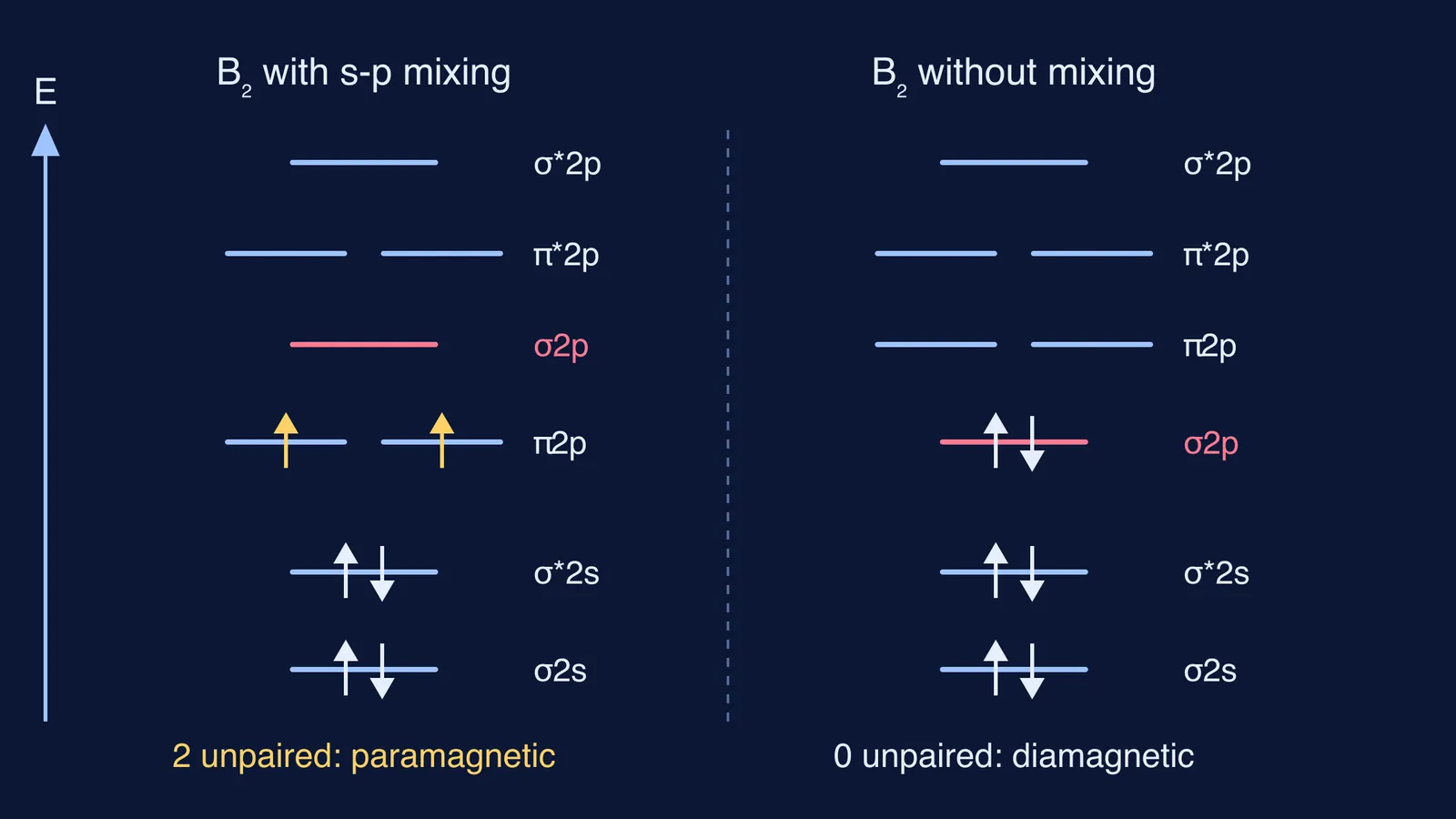
Fill B2's molecular orbitals in the order you use for O2 and you get zero unpaired electrons, so you would predict that B2 is diamagnetic. It is not. The fix is s-p mixing.
What is s-p mixing in molecular orbital theory?
In the simplest MO picture, 2s orbitals combine only with 2s, and 2p only with 2p. But the σ orbitals built from 2s and from 2p have the same symmetry along the bond axis, so they can interact. The OpenStax chemistry text on LibreTexts/08:_Advanced_Theories_of_Covalent_Bonding/8.05:_Molecular_Orbital_Theory) puts it plainly: "s-p mixing does not create new orbitals; it merely influences the energies of the existing molecular orbitals."
The important shift is that the σ2p orbital is pushed up in energy. In B2 it ends up above the two π2p orbitals, as a LibreTexts inorganic chemistry page explains.
How much mixing happens depends on the gap between the 2s and 2p energies. The OpenStax text notes that this gap is smaller for the lighter elements, lithium to nitrogen, than for oxygen to neon, so mixing matters for the first group and is negligible for the second. The Centre College page traces oxygen's large gap to its high effective nuclear charge and the penetration of the 2s orbital. If penetration is hazy, see our plots of the radial probability distribution of 1s, 2s and 2p.
Which MO order applies to B2, C2 and N2, and which to O2 and F2?
The two orderings of the valence orbitals, lowest energy first:
With s-p mixing (Li2 to N2, so B2, C2, N2): σ2s < σ*2s < π2p = π2p < σ2p < π*2p = π*2p < σ*2p
Without significant mixing (O2, F2, Ne2): σ2s < σ*2s < σ2p < π2p = π2p < π*2p = π*2p < σ*2p
The rule for homonuclear molecules and ions: those of Li to N use order 1; those of O, F or Ne use order 2.
Check it: after σ2s and σ*2s take 4 valence electrons, putting 1, 3 or 5 more into the σ2p and π2p set leaves one unpaired electron in either order, and 6 fills both. So a wrong order only gives a wrong magnetic answer for species with 10 or 12 electrons in total, such as B2, C2 and N2²⁺.
Why is B2 paramagnetic in molecular orbital theory?
B2 has 6 valence electrons. Using order 1:
σ2s² σ*2s² fills 4.
The next 2 go into the two π2p orbitals, which have equal energy. By Hund's rule, one goes into each with parallel spins.
Bond order = (bonding − antibonding) / 2 = (4 − 2) / 2 = 1.
Unpaired electrons: 2, so B2 is paramagnetic.
Use order 2 by mistake and those two electrons pair up in σ2p, giving 0 unpaired electrons and the wrong answer.
In 1976, Graham and Weltner trapped boron vapour in solid argon at 4–10 K. They saw no ESR signal from B2, which they interpreted as support for a 3Σg− ground state. In 1978, Dupuis and Liu's configuration interaction calculation established that the ground state of B2 is 3Σg−, with the lowest 5Σu− state about 1300 cm⁻¹ higher.
The superscript 3 marks a triplet: two unpaired electrons with parallel spins, exactly what order 1 predicts. For what paramagnetism means in bulk materials, see diamagnetic, paramagnetic and ferromagnetic materials with examples.
How do C2, N2 and O2 come out?
C2, 8 valence electrons, order 1: σ2s² σ*2s² π2p⁴. Bond order (6 − 2) / 2 = 2, no unpaired electrons, diamagnetic. Order 2 would wrongly give 2 unpaired.
N2, 10 valence electrons, order 1: σ2s² σ*2s² π2p⁴ σ2p². Bond order (8 − 2) / 2 = 3, diamagnetic.
O2, 12 valence electrons, order 2: σ2s² σ*2s² σ2p² π2p⁴ π*2p². Bond order (8 − 4) / 2 = 2, with 2 unpaired electrons in the π* pair, paramagnetic.
The OpenStax text gives the same π2p⁴ configuration for C2 and states that N2 has a bond order of 3 and is diamagnetic.
If the idea still feels shaky, the Fermi Concept Library gives every chemistry concept its own lesson and its place in the map, so you can rebuild MO theory from atomic orbitals up.
A five-step check for MO questions in the exam
Count the valence electrons, adjusting for charge.
Pick the order: Li to N means order 1; O, F or Ne means order 2.
Fill from the bottom. In each degenerate π pair, put one electron in each before pairing.
Bond order = (bonding − antibonding) / 2.
Any unpaired electron means paramagnetic. If the total is 10 or 12, recheck step 2, because that is where the order decides the answer.
The same counting of unpaired electrons explains why some iron complexes are only weakly paramagnetic. Try B2⁺, C2⁻ and N2⁺ yourself with the five steps. For more practice, the Fermi Problem Library has worked problems with a step-by-step solver that explains the reasoning rather than printing an answer.