On this page
Kinematics opens JEE Main mechanics, and later chapters reuse it. Learn to turn a word problem into a sketch, a sign convention and two or three equations here, and the rest gets easier. Here is the syllabus, worked problems and a two-week plan.
What does the JEE Main syllabus include in Kinematics?
In the official Syllabus for JEE (Main) - 2027 from NTA, Kinematics is Physics Unit 2, covering frame of reference, motion in a straight line, speed and velocity, uniform and non-uniform motion, average speed and instantaneous velocity, uniformly accelerated motion and its relations, position-time and velocity-time graphs, relative velocity, motion in a plane, projectile motion and uniform circular motion.
It maps to two chapters of the current NCERT Class 11 Physics Part I:
Chapter 2, Motion in a Straight Line: velocity, acceleration, the kinematic equations, relative velocity.
Chapter 3, Motion in a Plane: vectors, constant-acceleration motion, projectiles, uniform circular motion.
NCERT's relative velocity section (2.5) covers straight-line motion; Chapter 3 gives v₁₂ = v₁ − v₂ only as a point to ponder. Practise 2D cases (rain and a cyclist, a boat in a river) with Chapter 3's vector addition.
How do you solve 1D motion problems without sign errors?
Choose a positive direction and mark it on your sketch.
Example 1. A scooter moving at 4 m/s accelerates at 1.5 m/s² for 6 s. Final velocity: v = u + at = 4 + 1.5 × 6 = 13 m/s. Distance: s = ut + ½at² = 24 + 27 = 51 m. Check with v² = u² + 2as: 16 + 2 × 1.5 × 51 = 169, and √169 = 13 m/s.
Example 2, the classic trap. A ball is thrown straight up at 14.7 m/s (take g = 9.8 m/s², up as positive). After 2 s its displacement is 14.7 × 2 − 4.9 × 4 = 9.8 m. Distance is not 9.8 m: the ball stops at t = 14.7/9.8 = 1.5 s, at a height of 14.7²/19.6 = 11.025 m, then falls 11.025 − 9.8 = 1.225 m. Distance = 11.025 + 1.225 = 12.25 m. When velocity changes sign, split at the turning point.
For the basics, see our Class 9 guide to describing motion with graphs and equations.
How do you solve projectile problems for JEE Main?
Split the velocity into horizontal and vertical parts: two 1D problems sharing a time.
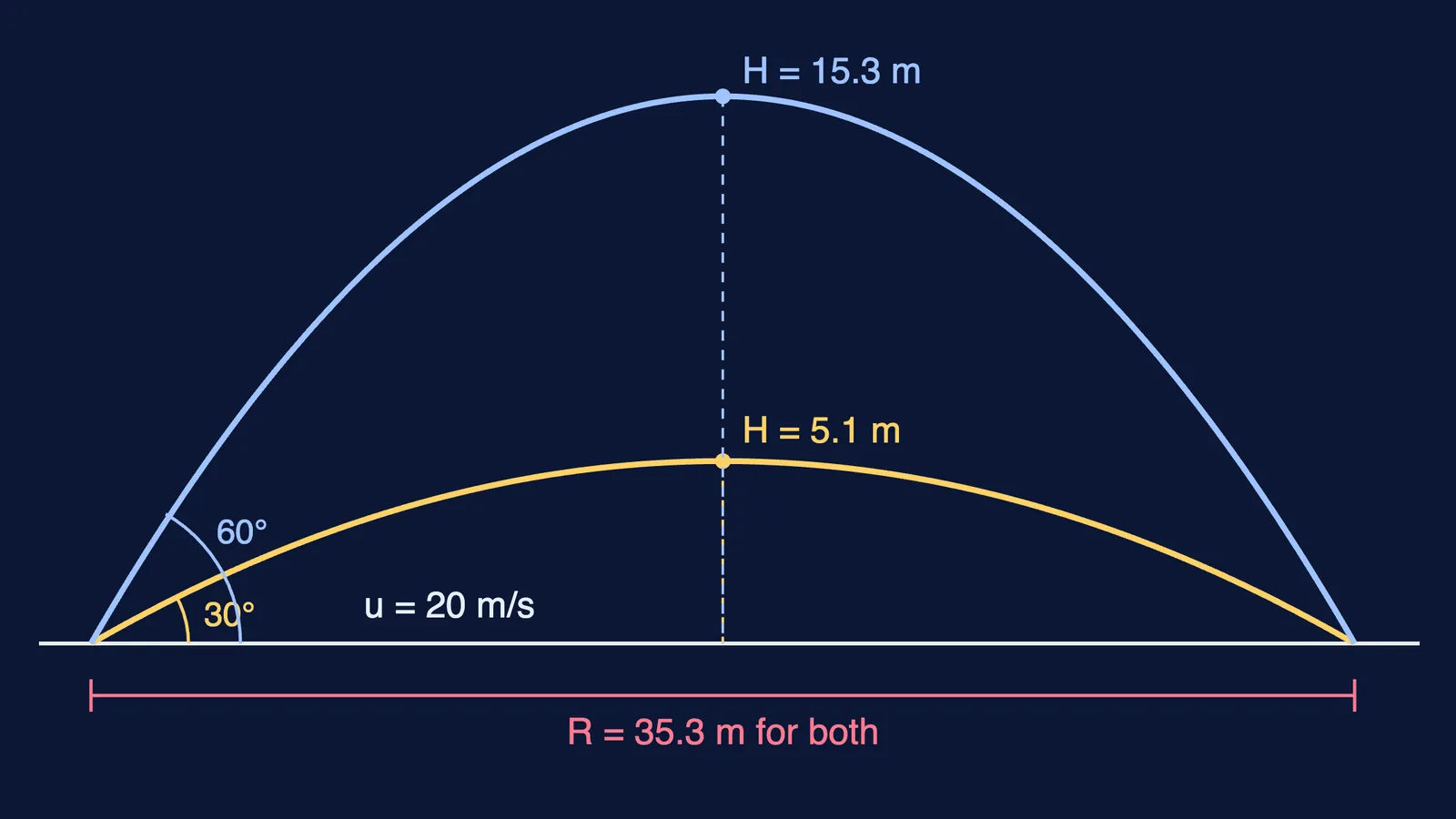
Example 3. A ball is launched at 20 m/s at 30° above level ground (g = 9.8 m/s²). uₓ = 20 cos 30° ≈ 17.32 m/s, uᵧ = 20 sin 30° = 10 m/s. Time of flight T = 2uᵧ/g = 20/9.8 ≈ 2.04 s. Maximum height H = uᵧ²/2g = 100/19.6 ≈ 5.10 m. Range R = uₓ × T ≈ 17.32 × 2.04 ≈ 35.3 m.
At 60° with the same speed, the range stays about 35.3 m (R = u² sin 2θ / g, and sin 120° = sin 60°), but the height triples to about 15.3 m and T rises to about 3.53 s. The diagram at the top shows both paths to scale.
If trajectories are hard to picture, the Fermi Simulation Lab has interactive simulations for ideas easier to see than to read.
How does relative velocity work?
To find A's velocity relative to B, subtract B's velocity from A's, as vectors.
Example 4 (1D). A car at 72 km/h (20 m/s) is 50 m behind a truck at 54 km/h (15 m/s), same direction. It closes at 5 m/s, so it draws level in 50/5 = 10 s.
Example 5 (2D). Rain falls vertically at 6 m/s; you cycle east at 8 m/s. Relative to you, rain moves at √(6² + 8²) = 10 m/s, at tan⁻¹(8/6) ≈ 53° from the vertical. Tilt the umbrella forward by that angle.
How do you read motion graphs quickly?
The slope of position-time is velocity, of velocity-time is acceleration, the area under velocity-time is displacement, and the area under acceleration-time is the change in velocity.
Example 6. A cyclist goes from 0 to 6 m/s in 4 s, holds 6 m/s for 6 s, then stops in 3 s. Accelerations: 1.5 m/s², 0, then −2 m/s². Displacement = 12 + 36 + 9 = 57 m, the sum of three areas.
What is a good 2-week practice plan for Kinematics?
Days 1-3: NCERT Chapter 2 and its exercises, sign convention on every sketch.
Days 4-5: graphs only; convert each graph into the other two types.
Days 6-8: Chapter 3 vectors and projectiles, including launches from a height.
Days 9-10: relative velocity in 1D and 2D, plus uniform circular motion (a = v²/r).
Days 11-12: timed mixed sets. Our guide to using previous year questions shows how to log mistakes.
Days 13-14: redo only the problems you got wrong, unaided.
When you cannot see where a solution went wrong, the Fermi Problem Library has worked problems with a step-by-step solver that explains the reasoning rather than printing an answer. Then fit Kinematics into a phase plan for your first JEE Main attempt.