On this page
Previous year questions (PYQs) are the closest thing you have to the real exam. But a pile of solved papers does not raise your score on its own. What helps is how you use them: when you start, whether you go chapter by chapter or paper by paper, and what you do with every question you get wrong.
When should you start previous year questions for JEE and NEET?
Start earlier than feels comfortable. Saving PYQs "for the end" gives up their main benefit.
In a classic study, Roediger and Karpicke found that students who took recall tests remembered more a week later than students who reread the same passages, even though rereading made students feel more confident. A large 2013 review of 10 study techniques rated practice testing and distributed practice as the only two of "high utility", and recommended practice testing in place of rereading.
So the rule is simple: as soon as you finish a chapter in class or in your own study, do that chapter's PYQs within the week. You will get many wrong. That is the point. If you want to see the effect for yourself, try our one-week rereading vs practice testing experiment.
Check the syllabus before you start. Syllabi change: the NMC issued an updated NEET-UG syllabus in October 2023, ahead of the 2024 exam, as Careers360 reported. Skip old questions on topics missing from the current syllabus on the official NTA exam website.
Chapter-wise or full papers: which should you do first?
Both, in that order, and then mixed.
Chapter-wise practice is blocked practice: you know the chapter, so you already know which idea each question needs. The exam never tells you that. Choosing the method is half the problem.
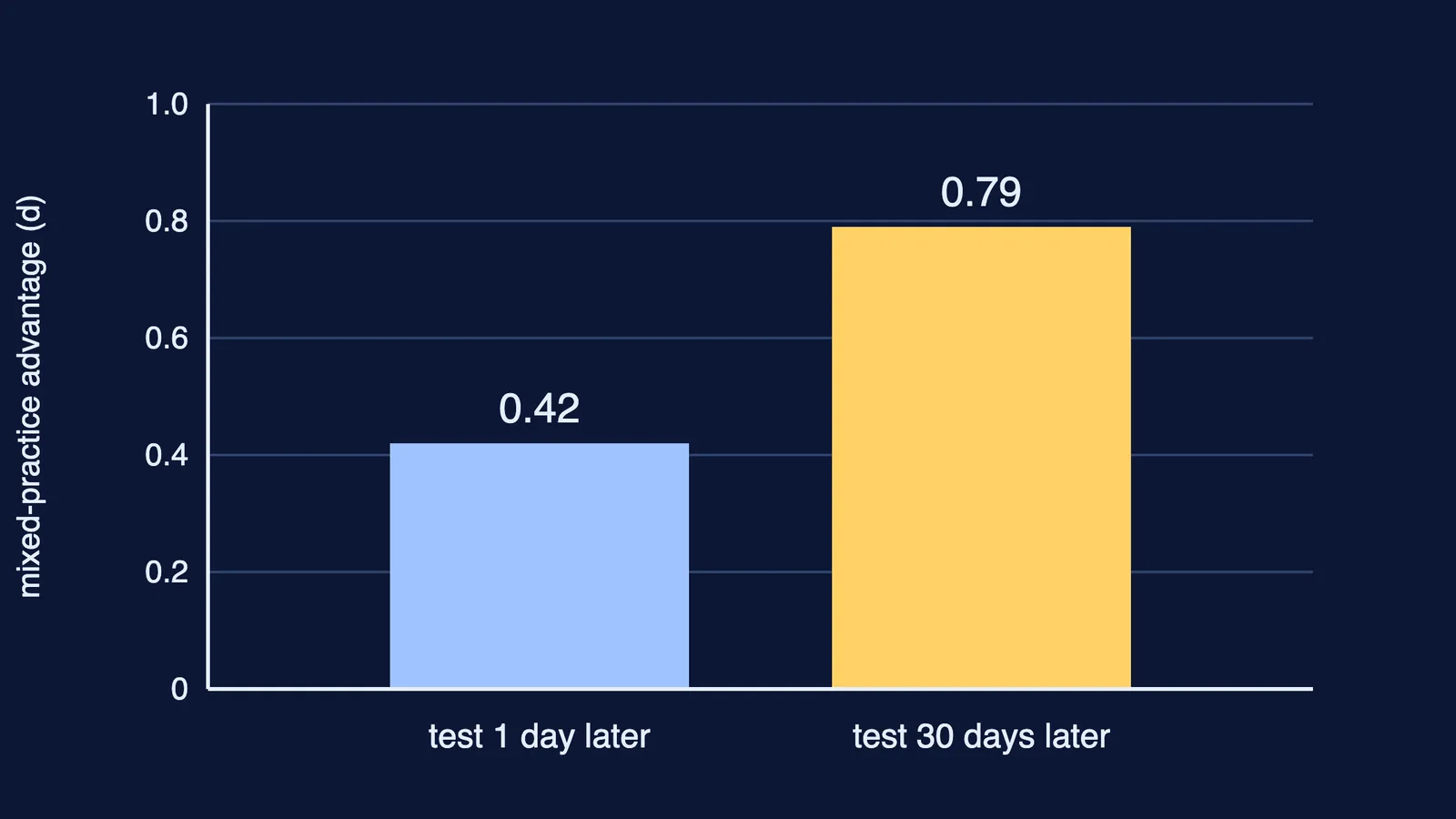
In one experiment, 126 seventh-grade students got the same maths practice over 3 months, either blocked by topic or interleaved (Rohrer, Dedrick and Stershic, Journal of Educational Psychology). Interleaved practice gave higher scores on a surprise test 1 day later (effect size d = 0.42) and a larger advantage 30 days later (d = 0.79).
A plan that uses both:
During the syllabus: chapter-wise PYQs within a week of finishing each chapter.
Once a few chapters are done: mixed sets of 15-20 PYQs drawn from all finished chapters, with no chapter labels.
Final months: full papers under exam timing, on a computer if your exam is computer-based.
How do you turn each wrong answer into a revision item?
A wrong answer is only useful if you know why it went wrong. A review of error research by Janet Metcalfe found that making errors and then getting corrective feedback helps learning, that feedback which analyses the reasoning behind the mistake is crucial, and that errors made with high confidence are corrected more readily.
For every wrong or guessed question, write one line in an error log with five parts:
Question: paper, year and question number.
Confidence: sure, unsure or guess.
Type: concept gap, wrong method, careless slip, or ran out of time.
Fix: the one sentence you will remember next time.
Re-attempt dates: 3 days and 2 weeks from now, without looking at the solution.
What does an error-log entry look like?
Suppose a JEE Main kinematics PYQ asks for the maximum height of a projectile and you marked an option four times too large. Your log line might read: "Was sure. Wrong method: put the total time of flight into h = ½gt² instead of the time to the top. Fix: at maximum height the vertical velocity is zero, so the time to the top is half the flight time. Re-attempt Thursday and the 28th."
Notice the type decides the next step. A careless slip needs a checking habit. A concept gap needs the idea relearned, for example from its lesson in the Fermi Concept Library. A wrong method needs you to see the full chain of reasoning: the Fermi Problem Library has worked problems with a step-by-step solver that explains the reasoning rather than printing an answer.
The re-attempt dates matter as much as the fix. Distributed practice was the other high-utility technique in the 2013 review above. If you get the question right on both re-attempts, strike it off. If not, it stays in the log.
What does a good PYQ week look like?
Two chapter-wise sessions on chapters you finished recently.
One mixed set of 15-20 PYQs from older chapters.
One error-log session: re-attempt every question due this week.
In the final months, one full paper under exam timing, followed by the same error-log review.
For how to reuse a mock you have already taken, see should you reattempt an old mock test. NEET students in the last stretch can fit this into a four-week NEET revision plan.
Start with one chapter this week: do its PYQs, log every miss, and set your first two re-attempt dates.