

On this page
In Class 11 you learn that 4s fills before 3d. Then, in the Class 12 d-block chapter, you are told that Fe²⁺ is [Ar] 3d⁶, not [Ar] 3d⁴ 4s². The filling order you memorised is a shortcut, and once you see what it leaves out, ion configurations become easy marks.
Why does 4s fill before 3d in the first place?
The familiar sequence 1s, 2s, 2p, 3s, 3p, 4s, 3d, 4p is a memory aid for building atoms element by element. In a 2013 article for the Royal Society of Chemistry, chemist Eric Scerri calls this the "sloppy version" of the aufbau principle and argues it gives false predictions about the order in which electrons fill orbitals (Education in Chemistry).
Scerri's point is that, in transition metal atoms, the 3d orbitals have a lower energy than 4s. So why does neutral iron still end up with two electrons in 4s instead of eight in 3d? In his words, "3d orbitals are more compact than 4s, and as a result any electrons entering 3d orbitals will experience greater mutual repulsion." Putting one or two electrons in the larger 4s orbital relieves that crowding, even though 4s is the higher level.
Our post on the Aufbau exceptions in chromium and copper shows two more places where the simple order breaks down.
Why are 4s electrons removed before 3d?
Ionisation removes the highest-energy, outermost electrons first. In a transition metal those are the 4s electrons, because 3d sits lower once it is occupied.
Scerri puts it plainly: "the 4s orbital actually fills last and consequently it is perfectly natural that it should be the first orbital to lose an electron on forming a positive ion" (Education in Chemistry). He uses spectral evidence from scandium ions: Sc⁺ is 3d¹ 4s¹ and Sc²⁺ is 3d¹ 4s⁰, so both electrons removed from the neutral atom come out of 4s.
In Table 4.2 of the NCERT Class 12 chapter on d- and f-block elements, Fe is 3d⁶ 4s², Fe⁺ is 3d⁶ 4s¹ and Fe²⁺ is 3d⁶: the 3d count does not change until the 4s electrons are gone.
How do you write the configurations of Fe2+, Fe3+, Cu+ and Mn2+?
Use three steps:
Write the neutral atom from the argon core, [Ar], which holds 18 electrons.
Remove electrons from 4s first, then from 3d.
Check: atomic number minus charge must equal 18 plus the electrons you wrote after [Ar].
All the configurations below match the M, M⁺, M²⁺ and M³⁺ rows of Table 4.2 in the NCERT d- and f-block chapter.
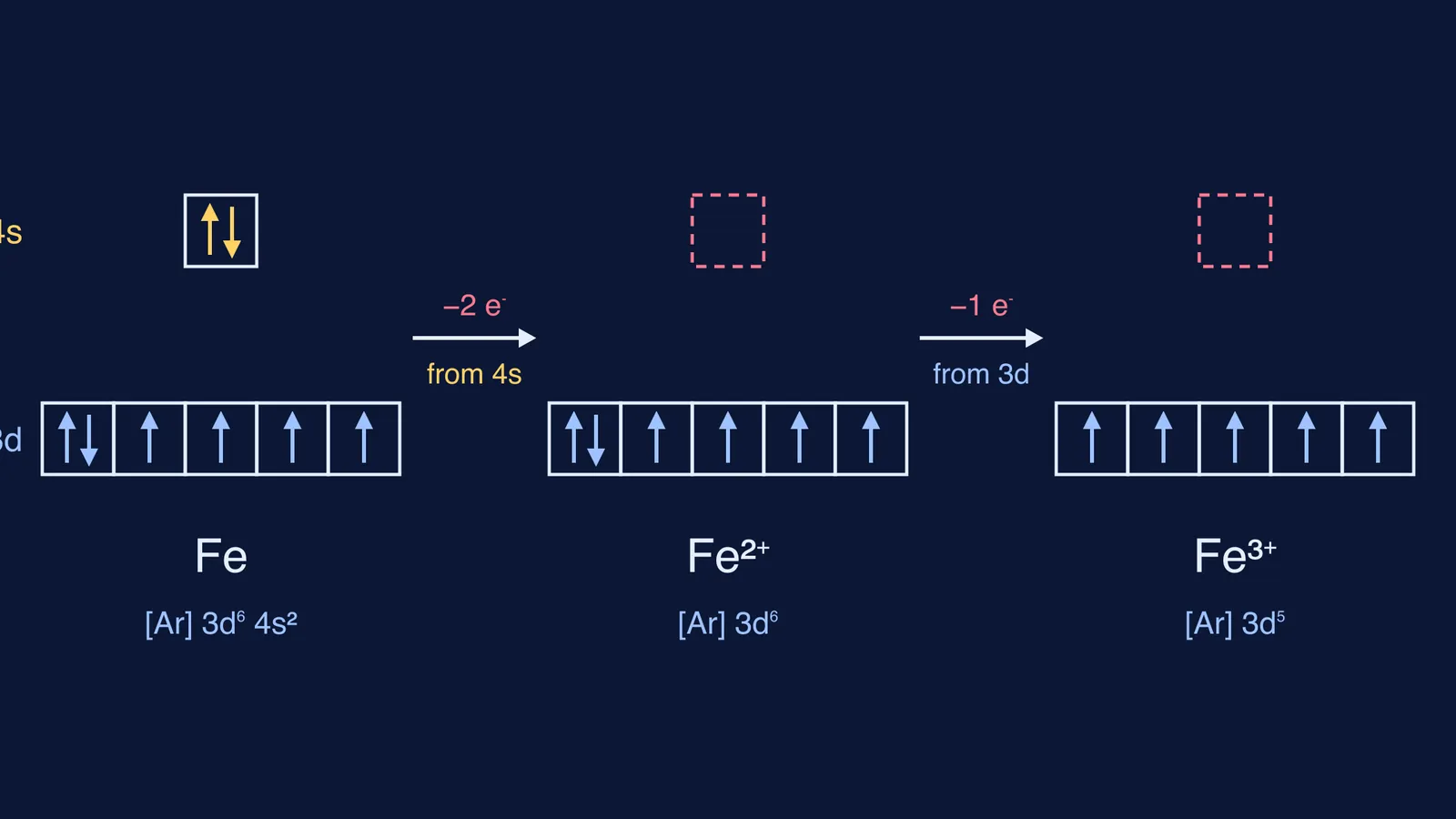
Fe²⁺ (iron, Z = 26). Neutral Fe is [Ar] 3d⁶ 4s². Take both 4s electrons: Fe²⁺ is [Ar] 3d⁶. Check: 26 − 2 = 24 = 18 + 6.
Fe³⁺. Start from Fe²⁺, [Ar] 3d⁶. The 4s is already empty, so the third electron comes from 3d: Fe³⁺ is [Ar] 3d⁵. Check: 26 − 3 = 23 = 18 + 5.
Cu⁺ (copper, Z = 29). Copper is an exception: neutral Cu is [Ar] 3d¹⁰ 4s¹, not 3d⁹ 4s². Remove the single 4s electron: Cu⁺ is [Ar] 3d¹⁰. Check: 29 − 1 = 28 = 18 + 10.
Mn²⁺ (manganese, Z = 25). Neutral Mn is [Ar] 3d⁵ 4s². Remove both 4s electrons: Mn²⁺ is [Ar] 3d⁵. Check: 25 − 2 = 23 = 18 + 5.
Fe³⁺ and Mn²⁺ end up with the same 23 electrons and the same half-filled 3d⁵ set, which is why the two are often compared; our explainer on why Fe³⁺ and Mn²⁺ are stable d⁵ ions picks up from here.
Once the configuration is right, count unpaired electrons with Hund's rule: Fe²⁺ has 4, Fe³⁺ and Mn²⁺ have 5, and Cu⁺ has none. Those counts feed straight into the spin-only magnetic moment calculation, so an error here costs you two answers.
What mistakes do students make with transition metal ion configurations?
Removing from 3d first. Writing Fe²⁺ as [Ar] 3d⁴ 4s² because 3d was "filled last". The 4s goes first.
Starting Cu from the wrong neutral atom. If you begin with 3d⁹ 4s², you get Cu⁺ as 3d⁹ 4s¹. Start from 3d¹⁰ 4s¹.
Stopping at 4s for a 3+ ion. Fe³⁺ needs three electrons out, and 4s only has two. The third must come from 3d.
Counting unpaired electrons from the neutral atom. Magnetic and colour questions are about the ion, so draw the ion's boxes.
Skipping the electron-count check. Atomic number minus charge is a quick check that catches counting slips.
If you keep tripping on the same step, the Fermi Problem Library has worked problems with a step-by-step solver that explains the reasoning rather than printing an answer. If the gap is the orbital energies themselves, the Fermi Concept Library gives each concept in chemistry its own lesson and shows where it sits in the map.
Practise the three steps on two ions a day this week, and the rule will stop feeling like a contradiction.


