

On this page
If you are studying the d-block for CBSE Class 12 or JEE Main, one idea answers a surprising number of questions: a half-filled 3d⁵ set is unusually stable. It explains why Fe³⁺ is more stable than Fe²⁺, why Mn²⁺ is hard to oxidise, and why Mn³⁺ is a strong oxidising agent.
What does a half-filled d5 set mean?
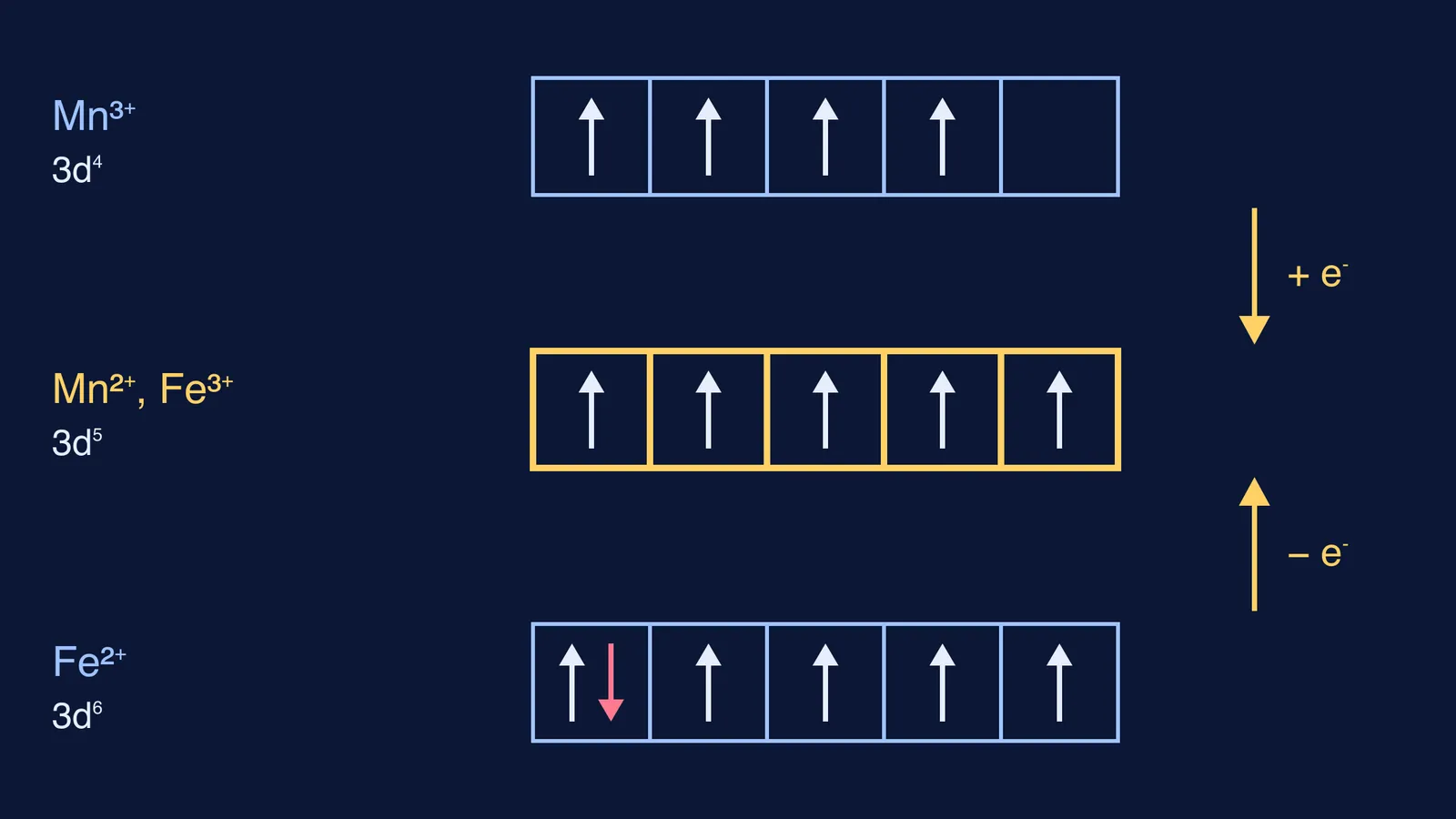
A d subshell has five orbitals. In a d⁵ ion each orbital holds exactly one electron, and all five spins point the same way. That follows from Hund's rule: the orbitals of a subshell are each occupied singly with electrons of parallel spin before double occupation occurs. If counting unpaired electrons still trips you up, our guide on how to count unpaired electrons using Hund's rule walks through it.
The Wikipedia article on Hund's rules also explains why this lowers energy: electrons in singly occupied orbitals are less shielded from the nucleus, so they are held more tightly. Many textbooks describe the payoff as exchange energy, which grows with the number of pairs of electrons with parallel spin. Five parallel electrons make 10 such pairs (5 × 4 ÷ 2), the most a d subshell can hold before any electron has to pair up. A sixth electron has to pair up with opposite spin, which adds repulsion and no new parallel pairs.
Why is Fe3+ more stable than Fe2+?
An iron atom is [Ar] 3d⁶ 4s². Fe²⁺ loses the two 4s electrons and is left with 3d⁶: four unpaired electrons plus one pair. Removing one electron of that pair gives Fe³⁺, which is 3d⁵. Iron loses the electron that was costing it repulsion, and the ion lands on the half-filled set.
The third ionisation energy, the energy to turn M²⁺ into M³⁺, shows the effect. According to Wikipedia's table of molar ionisation energies, the third ionisation energy is 2987 kJ/mol for chromium, 3248 kJ/mol for manganese, 2957 kJ/mol for iron and 3232 kJ/mol for cobalt.
Iron's value is the lowest of the four, even though nuclear charge rises across the row. Manganese's is 291 kJ/mol higher than iron's, largely because for manganese this step breaks a d⁵ set, while for iron it creates one. For the wider pattern, see why the ionisation enthalpy trend in the 3d series is irregular.
Why does Mn2+ resist oxidation while Mn3+ is a strong oxidant?
A manganese atom is [Ar] 3d⁵ 4s², so Mn²⁺ is already 3d⁵. Oxidising it to Mn³⁺ means breaking the half-filled set. A LibreTexts chapter on transition-metal trends puts it directly: "with a half-filled subshell, Mn2+ (3d5) is much more difficult to oxidize than Fe2+ (3d6)." The same chapter notes that the chemistry of manganese is primarily that of the Mn²⁺ ion.
Run the reaction backwards and you get the oxidant. Mn³⁺ is 3d⁴, one electron short of d⁵, so it pulls an electron in to get there. In the LibreTexts table of standard reduction potentials, E° for Mn³⁺/Mn²⁺ is +1.5 V. For Fe³⁺/Fe²⁺ it is +0.771 V. A more positive E° means a stronger oxidising agent, and manganese's value is about 0.73 V more positive than iron's.
Chromium goes the other way: the same table gives −0.424 V for Cr³⁺/Cr²⁺, so Cr²⁺ is a reducing agent. See why Cr2+ is reducing and Mn3+ is oxidising.
How do you write this in an exam answer?
Use the same four steps every time:
Write the configuration of both ions, removing 4s electrons before 3d.
Mark which ion is d⁵.
Say which change, losing or gaining an electron, moves the ion towards d⁵.
Back it up with one number: a third ionisation energy or an E° value.
Worked example. Question: "Mn³⁺ is a stronger oxidising agent than Fe³⁺. Explain."
Mn³⁺ is 3d⁴. When it is reduced it becomes Mn²⁺, 3d⁵, a half-filled and extra-stable set, so Mn³⁺ readily accepts an electron.
Fe³⁺ is already 3d⁵. Reducing it to Fe²⁺ (3d⁶) would break the half-filled set, so Fe³⁺ has much less drive to gain an electron.
So E°(Mn³⁺/Mn²⁺) is more positive than E°(Fe³⁺/Fe²⁺), and Mn³⁺ is the stronger oxidant.
Before you submit, check for these slips:
Taking electrons from 3d before 4s, which gives the wrong d count.
Saying Fe³⁺ is stable only because it has a higher charge. Charge alone does not explain why Fe³⁺ is favoured but Mn³⁺ is not.
If the configuration step is where you lose marks, the Fermi Problem Library has worked problems with a step-by-step solver that explains the reasoning rather than printing an answer. To revisit the idea itself, each concept in the Fermi Concept Library has its own lesson and its place in the map.
Next time a d-block question asks "which is more stable", write both configurations first and look for the d⁵.


