

On this page
Transition metals often throw up apparent paradoxes in chemistry. One of the most common exam questions asks why two ions with the exact same electronic configuration — chromium(II) and manganese(III) — behave in completely opposite ways when they undergo chemical reactions.
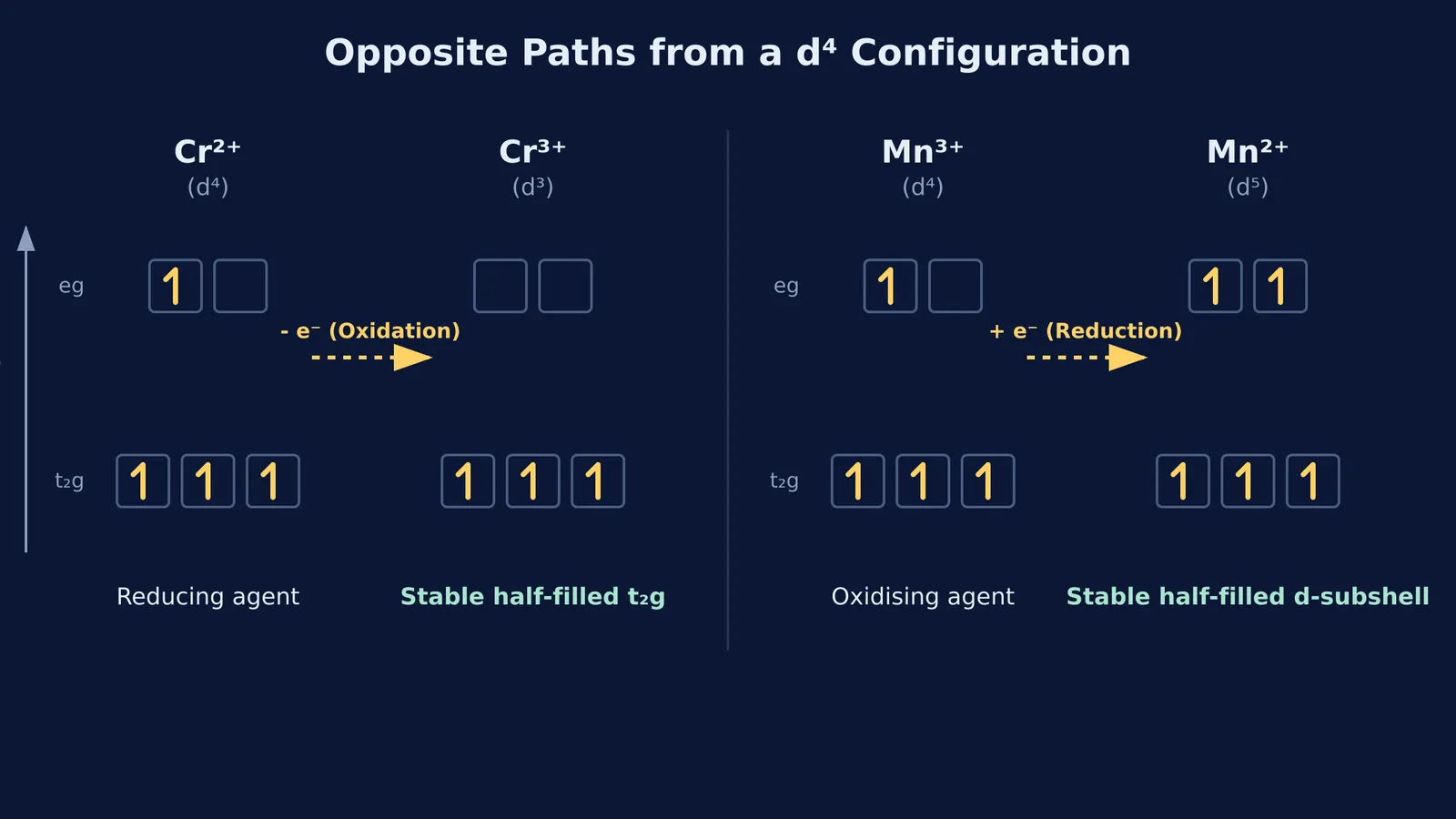
Both Cr²⁺ and Mn³⁺ have four electrons in their outermost d-subshell (a d⁴ configuration). Yet, if you put them in a reaction, Cr²⁺ will actively force electrons onto other substances (acting as a reducing agent), while Mn³⁺ will forcefully strip electrons away from them (acting as an oxidising agent).
The answer lies not in where the ions start, but in the highly stable configurations they are trying to reach.
Why is Cr2+ a reducing agent?
A reducing agent causes reduction in another substance by getting oxidised itself. To get oxidised, Cr²⁺ must lose one of its four d-electrons to become Cr³⁺.
In an aqueous solution, the five d-orbitals of a transition metal ion are surrounded by water molecules in an octahedral arrangement. This environment causes the orbitals to split into two energy levels: a lower t₂g level with three orbitals, and a higher eg level with two orbitals.
When Cr²⁺ (d⁴) loses an electron to become Cr³⁺ (d³), those three remaining electrons perfectly half-fill the lower t₂g level. This half-filled t₂g state provides significant extra stability known as crystal field stabilisation energy.
The standard reduction potential (E°) for the Cr³⁺/Cr²⁺ couple is −0.41 V (NCERT). This negative value confirms that Cr³⁺ is more stable than Cr²⁺ in aqueous solution, which is why Cr²⁺ readily gives up an electron.
Why is Mn3+ an oxidising agent?
An oxidising agent causes oxidation in another substance by getting reduced itself. To get reduced, Mn³⁺ must gain an electron to become Mn²⁺.
When Mn³⁺ (d⁴) gains one electron, it reaches a d⁵ configuration. A d⁵ state means the entire d-subshell is exactly half-filled, with one electron in each of the five orbitals. This perfectly symmetrical distribution of electrons creates maximum exchange energy, making the d⁵ configuration exceptionally stable.
According to the NCERT Class 12 chemistry textbook, the standard reduction potential for the Mn³⁺/Mn²⁺ couple is +1.57 V (NCERT). This large positive value shows a very strong drive for Mn³⁺ to accept an electron and achieve that stable d⁵ state.
How to predict oxidising and reducing behaviour?
When you encounter these exceptions in inorganic chemistry, rote memory often fails. If you map out the electronic configurations in the Fermi Concept Library, you can see exactly how the d-orbitals split and why the t₂g³ state is uniquely stable in an aqueous environment. Fermi's AI tutor can also help you practice predicting the oxidising or reducing nature of other transition metal ions by walking you through their standard electrode potentials step by step.
Instead of guessing, use this practical four-step checklist in your next chemistry exam:
Write the starting configuration: Find the atomic number, write the neutral atom's configuration (for example, neutral chromium is [Ar] 3d⁵ 4s¹ and neutral manganese is [Ar] 3d⁵ 4s²), and remove the outer s-electrons first, followed by the necessary d-electrons.
Test the oxidation path: Subtract one electron and check if the resulting configuration lands on a stable state (like d⁰, d³, d⁵ or d¹⁰). If it does, the starting ion is a reducing agent.
Test the reduction path: Add one electron and check if the resulting configuration lands on a stable state. If it does, the starting ion is an oxidising agent.
Compare with the environment: Remember that the d³ (t₂g³) stability specifically applies in aqueous (octahedral) fields, which is why standard reduction potentials are usually given for aqueous solutions.
By focusing on the stability of the final product, you can confidently explain the chemical behaviour of any transition metal ion without relying on memory alone.
Read more:


