

On this page
The elements from scandium to zinc make up the 3d transition series, and they exhibit properties that often puzzle students switching from the predictable s- and p-blocks. While main group elements show sharp, regular increases in ionisation energy across a period, the 3d transition metals behave differently.
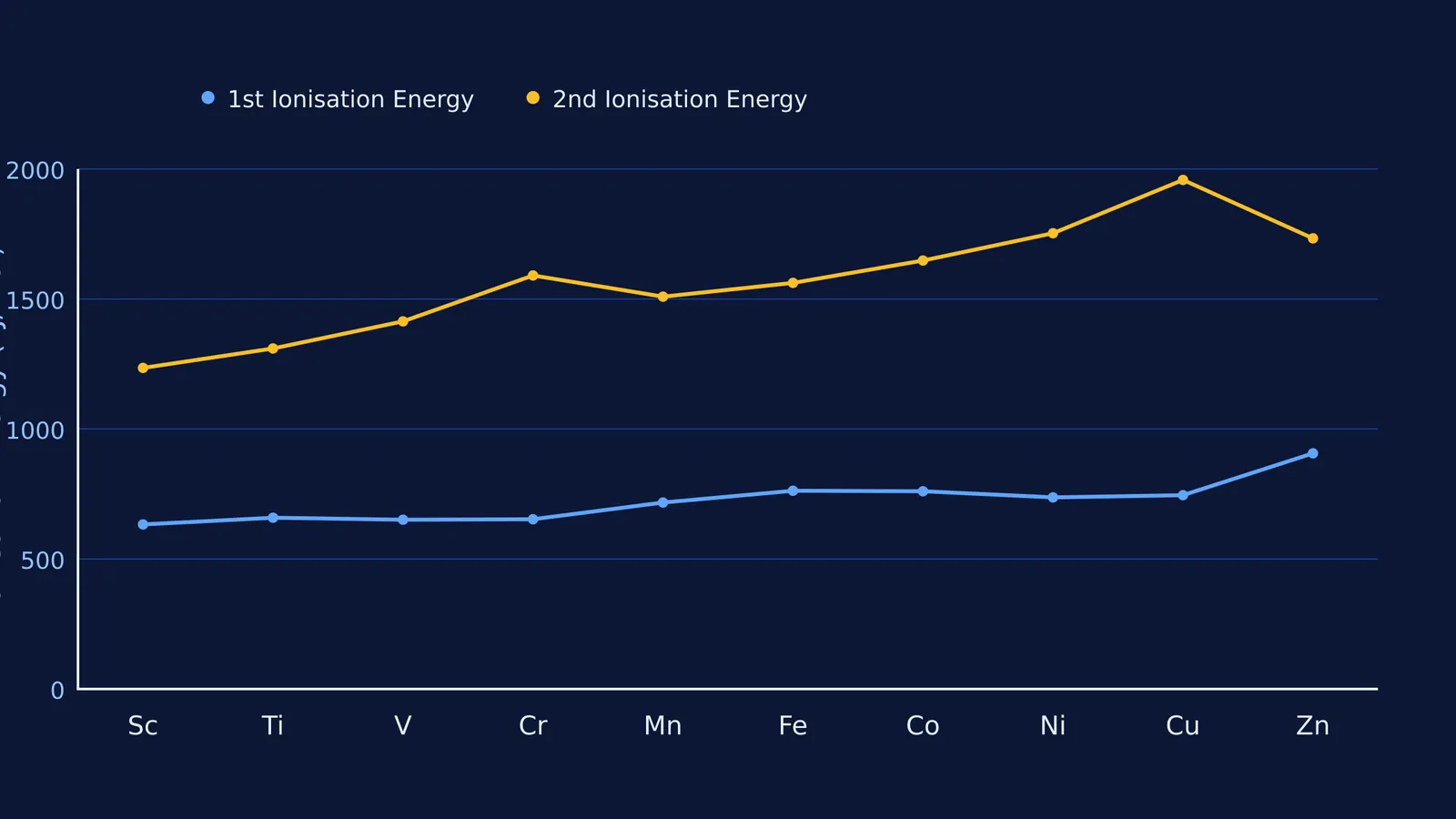
Their first ionisation enthalpies rise only gradually. Even more confusingly, their second ionisation enthalpies show sharp, irregular spikes, breaking the overall trend entirely. To understand this, we must look at how electrons fill the subshells and the stability they create.
Why does the first ionisation enthalpy rise so slowly?
When you move left to right across the 3d transition series, from scandium to zinc, each new element adds one proton to the nucleus and one electron to the atom. However, instead of adding this electron to the outermost 4s shell, it goes into the inner 3d subshell.
These inner 3d electrons act as a screen. They shield the outermost 4s electrons from the increasing positive pull of the nucleus. Because this shielding effect is significant, it largely cancels out the increased nuclear charge. The effective nuclear charge felt by the 4s electrons rises only slightly from one element to the next.
As a result, the first ionisation energy—the energy required to remove the first 4s electron—increases very slowly. It goes from 633.1 kJ/mol for scandium to 906.4 kJ/mol for zinc (Wikipedia). This is a much more gradual climb than the steep rise seen across a typical period in the main group elements.
Why are the second ionisation enthalpies of Cr and Cu unusually high?
The general trend for second ionisation enthalpies is also an upward slope, because removing a second electron from an already positive ion requires more energy. However, chromium (Cr) and copper (Cu) break the pattern with sharp spikes.
According to standard elemental data, the second ionisation energy of chromium is 1590.6 kJ/mol, which is significantly higher than manganese next to it at 1509.0 kJ/mol (Wikipedia). This happens because a neutral chromium atom has an anomalous electron configuration of [Ar] 3d⁵ 4s¹. The first ionisation removes the single 4s electron, leaving a highly stable, symmetrically half-filled 3d⁵ subshell. The second ionisation requires removing an electron from this stable arrangement, which demands a large input of energy.
Similarly, copper has a neutral configuration of [Ar] 3d¹⁰ 4s¹. Removing its first electron leaves a completely filled, highly stable 3d¹⁰ subshell. Taking away a second electron requires disrupting this full subshell. This drives copper's second ionisation energy to a high 1957.9 kJ/mol, standing far above zinc's 1733.3 kJ/mol (Wikipedia).
If you are struggling to predict the properties of an unfamiliar ion or keep track of these exceptions, the Fermi Concept Library explains every concept in physics, chemistry, biology, mathematics and computing, each with its own lesson and its place in the map.
How do other elements in the 3d series compare?
While chromium and copper show sharp spikes because of breaking stable subshells, you can see dips in the sequence when removing an electron creates a stable configuration.
For example, the second ionisation energy of manganese is relatively lower than expected. A neutral manganese atom has the configuration [Ar] 3d⁵ 4s². The first ionisation removes one 4s electron, and the second ionisation removes the remaining 4s electron. This leaves the Mn²⁺ ion with a highly stable 3d⁵ half-filled configuration. Because this final state is so stable, the atom gives up its second electron more readily than the overall upward trend would predict.
Understanding these configurations is the key to mastering transition metal chemistry. The Fermi Problem Library has worked problems with a step-by-step solver that explains the reasoning rather than printing an answer.
How to explain the irregularity in exams?
When an exam question asks "Why is the ionisation enthalpy trend in the 3d transition series irregular?", you should structure your answer to cover both the gradual rise and the sharp exceptions. Follow this script to secure full marks:
State that the first ionisation enthalpies increase slowly due to the shielding effect of the inner 3d electrons, which mostly cancels out the increasing nuclear charge.
Highlight chromium and copper as the key exceptions for the second ionisation enthalpy.
Explicitly write out their electron configurations ([Ar] 3d⁵ 4s¹ and [Ar] 3d¹⁰ 4s¹).
Conclude that removing a second electron requires breaking a highly stable half-filled (3d⁵) or fully filled (3d¹⁰) d-subshell, demanding unusually high energy.
Always rely on the underlying electron configuration rather than trying to memorise the ionisation energy numbers themselves. Once you know where the 3d subshell becomes half-full or completely full, the entire trend makes sense.
Read more:


