On this page
The last month before NEET-UG is for making what you already know fast and accurate under exam conditions, not for new chapters. This plan gives each subject a fixed daily slot and adds full mocks week by week.
How should you split the last 30 days before NEET?
Start from the marks. In NTA's NEET (UG) 2026 pattern, biology (botany and zoology) had 90 of the 180 questions and 360 of the 720 marks, while physics and chemistry had 45 questions and 180 marks each (NTA Information Bulletin NEET (UG) 2026). The same bulletin gives +4 for a correct answer, −1 for a wrong one and 0 for a question left blank, with 180 questions to attempt in 180 minutes. Patterns can change, so check the bulletin for your year on the official NEET-UG site.
On a normal study day of about nine hours, that suggests a simple split:
Biology, about 4 hours: an NCERT reread with recall.
Physics, about 2.5 hours: timed problem sets.
Chemistry, about 2.5 hours: NCERT-based revision and numericals.
Why recall instead of just rereading NCERT?
Rereading feels productive, but it is weak on its own. In a 2006 experiment, Henry Roediger and Jeffrey Karpicke found that students who took recall tests on a passage remembered substantially more a week later than students who restudied it, even though restudying made students more confident (Psychological Science). A 2013 review led by John Dunlosky rated practice testing and spaced (distributed) practice as high-utility techniques, and rereading and highlighting as low utility (Psychological Science in the Public Interest). The same review rated interleaved practice, which means mixing problem types, as moderate utility.
So each biology session goes: read one section, close the book, write the key points or redraw the diagram from memory, then mark what you missed. Next pass, read only your marks.
What does each week of the plan look like?
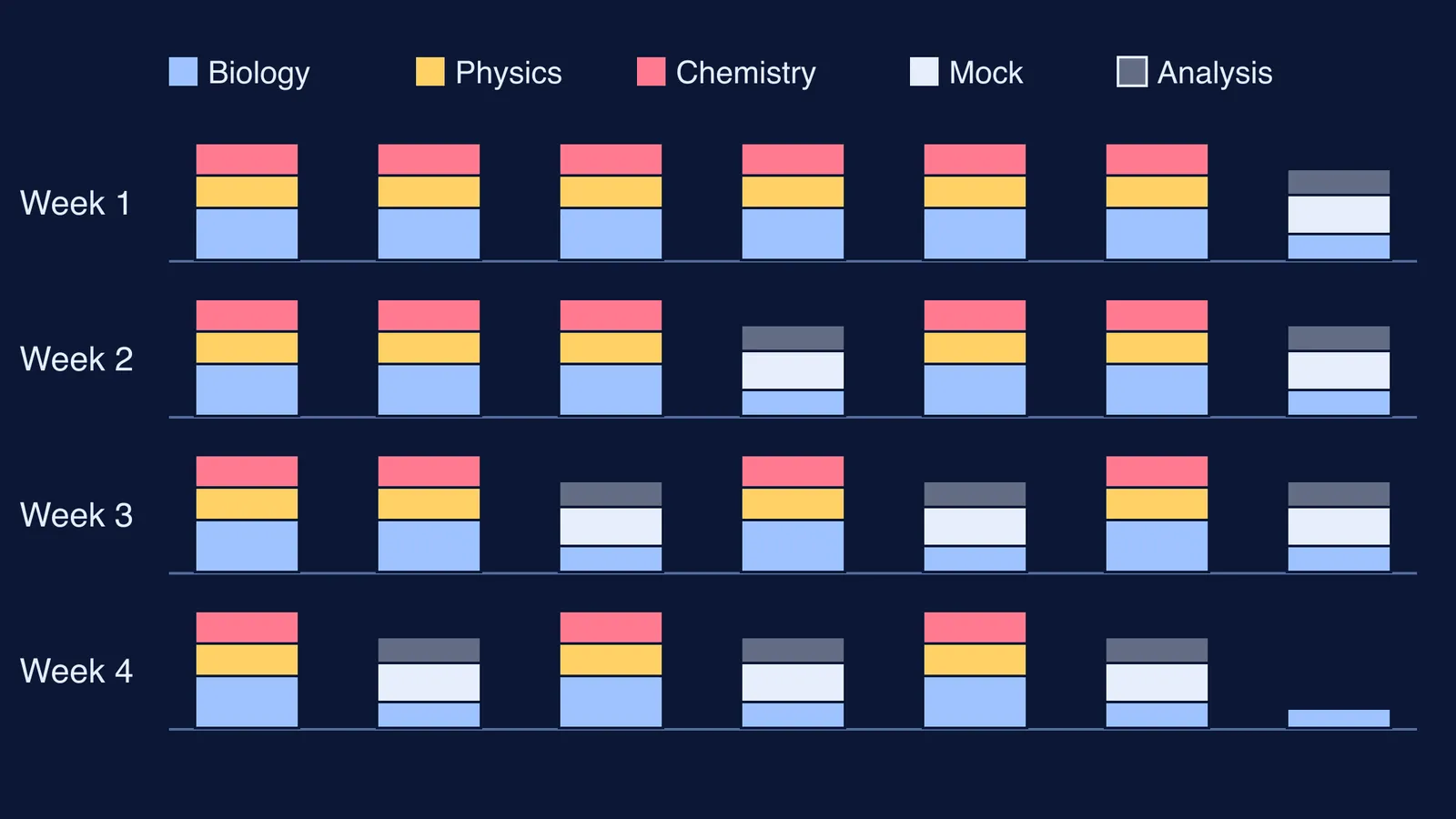
A full mock should match the real exam: 3 hours, and NTA's 2026 bulletin set the paper for 2:00 PM to 5:00 PM (NTA bulletin). On a mock day, do a short biology recall session in the morning, sit the mock in that afternoon window, then spend about 2 hours analysing it.
Week 1, days 1 to 7: first recall pass of Class 11 NCERT biology. Physics: mechanics sets. Chemistry: physical chemistry numericals. One full mock on day 7.
Week 2, days 8 to 14: first recall pass of Class 12 NCERT biology. Physics: electricity, magnetism and optics. Chemistry: inorganic chapters straight from NCERT, plus organic reaction maps. Mocks on days 11 and 14.
Week 3, days 15 to 21: second biology pass, only your marked lines, diagrams and tables. Physics: thermodynamics, waves, modern physics and mixed sets. Chemistry: mixed organic and physical sets. Mocks on days 17, 19 and 21.
Week 4, days 22 to 28: a third pass of your biology marks and your error log. Physics and chemistry: mixed sets from the topics your mocks exposed. Mocks on days 23, 25 and 27. Day 28 is light: a short skim, exam-day kit packed, an early night.
How do you analyse a NEET mock in the final month?
The marking scheme sets the stakes: a question you get wrong instead of right costs you 5 marks, the 4 you missed plus the 1 deducted (NTA bulletin). For example, you attempt 165 questions and get 132 right and 33 wrong, so you score 132 × 4 − 33 = 495. Turn 10 of those wrong answers into right ones and you gain 50 marks without attempting a single extra question.
Sort every wrong or guessed question into one of four bins:
I didn't know the fact or concept.
I knew it but used the wrong method.
Right method, but a slip in calculation or reading.
I ran out of time or rushed.
For the first bin, go back to the NCERT page the question came from. If one concept keeps landing there, the Fermi Concept Library covers every concept in physics, chemistry, biology, mathematics and computing, each with its own lesson. For the second bin, the Fermi Problem Library has worked problems with a step-by-step solver that explains the reasoning rather than printing an answer, so you can see where your method went wrong. Log every slip from the third bin and read the log before each mock. For the fourth, note where the minutes went and try a different section order next time.
What should you stop doing in the last month?
Starting new reference books.
Rereading with the book open the whole time.
Taking mocks without analysing them.
Cutting sleep to fit in more hours.
If stress starts to affect your sleep, appetite or mood for days at a time, talk to someone you trust and call Tele MANAS, the government's toll-free mental health helpline, on 14416 or 1-800-891-4416 (Press Information Bureau).
Pin the four weeks above your desk and start day 1 with a closed book.