

On this page
An old mock with red marks all over it is tempting to take again. The second score will probably be higher. Whether that means anything depends on how you re-attempt it.
Is it useful to reattempt the same mock test?
It can be, because answering a question from memory is itself a way of learning. In a 2006 study by Henry Roediger and Jeffrey Karpicke, students who took practice tests on a passage remembered more of it two days and one week later than students who restudied it the same number of times. Psychologists call this the testing effect.
The benefit is not limited to repeating the same answer. In Andrew Butler's 2010 experiments, repeated testing beat repeated studying a week later even when the final test asked new inferential questions, some from a different knowledge domain. That is what you want from a mock: a better grip on the idea, not on one paper.
So a re-attempt is a retrieval exercise. It is not a second mock score.
Why does a second attempt inflate your score?
Because you are partly remembering the paper. A meta-analysis by John Hausknecht and colleagues pooled 50 studies of people retaking ability tests, with 107 samples and 134,436 participants. Scores rose on retest, and the gains were larger when the identical test form was used again. Those were cognitive ability tests, not JEE Main or NEET-UG papers, but the pattern is familiar: you recognise the diagram, recall that the answer was (C), or remember the trick before you have rebuilt the reasoning.
The feeling misleads too. In the Roediger and Karpicke study above, repeated studying made students more confident even though they remembered less a week later. Recognising a solved question feels the same way; see why rereading feels like learning.
When does re-solving an old mock actually help?
It helps when three conditions hold together.
Spaced. Leave days between attempts so that recall takes effort. In a study of more than 1,350 people by Nicholas Cepeda and colleagues, the best gap between study sessions grew with how long the material had to be remembered: about 20 to 40% of the delay for a test one week away, and about 5 to 10% for a test a year away.
Timed. Give each question roughly the time it had in the real mock. Solving it in ten unhurried minutes tells you nothing about exam day.
Wrong questions only. Re-solve the questions you got wrong, guessed or left out. Questions you got right quickly mostly test your memory of the paper.
Do the first proper review before any re-attempt. Our 60-minute mock analysis routine shows how to tag each mistake as a concept, method, careless or time error.
A 21-day re-attempt schedule
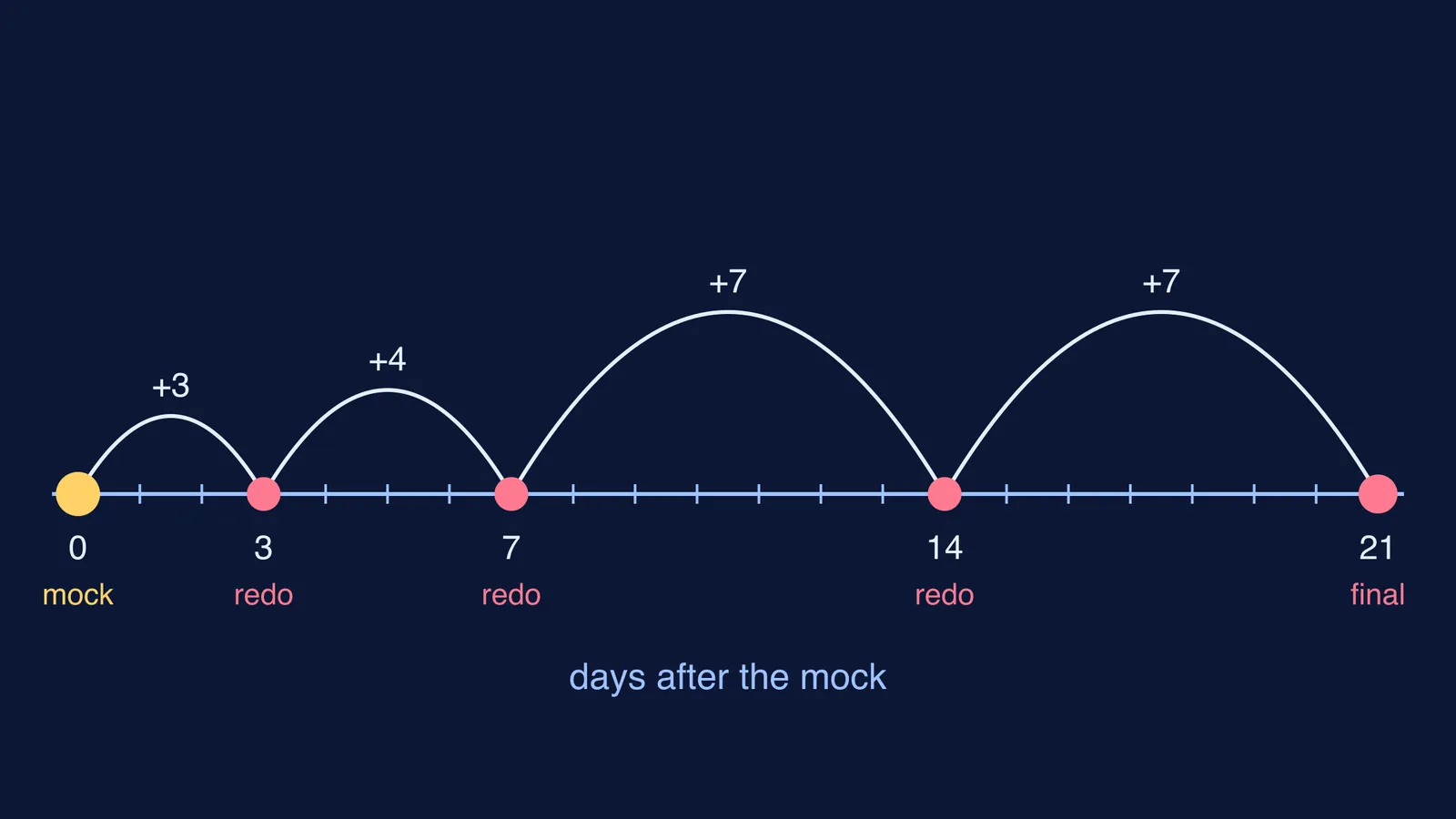
Day 0 is the day you take the mock. The gaps grow from three days to a week, so each attempt takes more effort to recall.
Day 0: Take the mock, analyse it, and list every wrong, guessed and skipped question. Read the solutions, but do not re-solve anything yet.
Days 1 and 2: Fix the causes. Relearn the concept behind each wrong question and solve two or three new questions of the same type from past papers.
Day 3: First re-attempt. Only the listed questions, cold, timed, solutions closed. Mark each one: right and in time, right but slow, or wrong.
Day 7: Second re-attempt. Only the slow and wrong ones from Day 3, shuffled, plus a few new questions on the same concepts.
Day 14: Third re-attempt. Everything still not clean, mixed into a set of new questions so you cannot tell which ones are old.
Day 21: Final check. All the original listed questions, shuffled and timed. Anything clean twice in a row is retired. Then file the paper away for good.
Here is how the list shrinks. Say your list from Day 0 has 18 questions. On Day 3 you get 11 right in time, 4 right but slow and 3 wrong, so Day 7 has 7 old questions plus new ones. If 5 of those come out clean, Day 14 carries only 2 old questions. A shrinking list is the real measure of progress.
For a wider revision rhythm beyond one paper, see our four-week spaced revision schedule.
What if the same question keeps going wrong?
If a question is still wrong on Day 14, memory is not the problem. Something underneath is missing: a concept, a step in the method, or a habit like checking units.
Go back to the idea itself. The Fermi Concept Library has every concept in physics, chemistry, biology, mathematics and computing, each with its own lesson, so you can fill the gap before your next attempt. If you understand the idea but keep choosing the wrong method, the Fermi Problem Library has worked problems with a step-by-step solver that explains the reasoning rather than printing an answer.
Pick one old mock this week, list its wrong questions, and put Day 3 on your calendar.


