On this page
Mole concept sits in the first chapter of Class 11 chemistry and the arithmetic behind most of physical chemistry. Get fluent with grams, moles, particles and gas volume here, and solutions, equilibrium and electrochemistry get lighter.
What does the JEE Main syllabus include for mole concept?
The official Syllabus for JEE (Main) - 2027, linked from the NTA JEE Main website, lists Unit 1, Some Basic Concepts in Chemistry, under physical chemistry. Its list includes Dalton's atomic theory, laws of chemical combination, atomic and molecular masses, mole concept, molar mass, percentage composition, empirical and molecular formulae, and chemical equations and stoichiometry. The same document lists molality, molarity, mole fraction and percentage concentration under Unit 5, Solutions, so you will meet those terms twice.
The matching textbook chapter is Unit 1, Some Basic Concepts of Chemistry in NCERT Class 11 Chemistry Part I. It defines one mole as exactly 6.02214076 × 10²³ elementary entities, and it covers limiting reagent, mass per cent, mole fraction, molarity and molality in the same chapter. Read it in full once before any other book.
How do you convert between mass, moles, particles and volume?
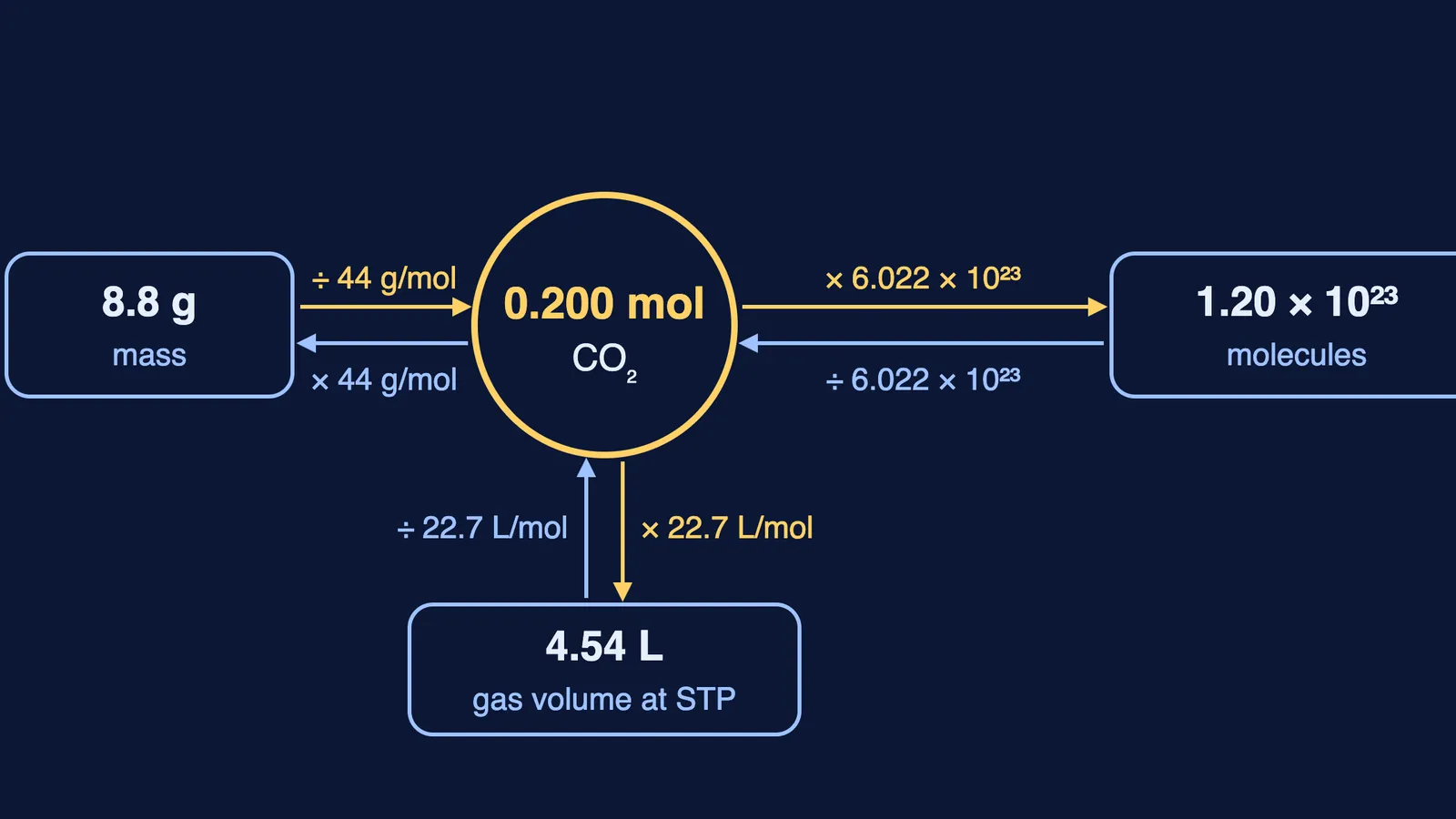
Everything runs through moles. Use n = mass ÷ molar mass, particles = n × 6.022 × 10²³, and, for a gas at STP, volume = n × 22.7 L, the molar volume NCERT's chapter uses (0 °C, 1 bar). Older books use 22.4 L (0 °C, 1 atm), so use whichever the question gives.
Worked example 1. Take 8.8 g of CO₂ (C = 12, O = 16, so M = 44 g/mol).
Moles: 8.8 ÷ 44 = 0.200 mol.
Molecules: 0.200 × 6.022 × 10²³ = 1.20 × 10²³.
Atoms: each molecule has 3 atoms, so 3.61 × 10²³ atoms.
Volume at STP: 0.200 × 22.7 = 4.54 L.
Step 3 is the classic trap when a question asks for atoms.
How do you find the limiting reagent?
Convert each reactant to moles and divide by its coefficient in the balanced equation. The smallest result is limiting.
Worked example 2. 5.4 g of aluminium reacts with 14.2 g of chlorine: 2Al + 3Cl₂ → 2AlCl₃ (Al = 27, Cl = 35.5).
Moles: Al = 5.4 ÷ 27 = 0.200 mol; Cl₂ = 14.2 ÷ 71 = 0.200 mol.
Divide by coefficients: Al 0.200 ÷ 2 = 0.100; Cl₂ 0.200 ÷ 3 = 0.0667. Chlorine is limiting, even though the mole counts are equal.
Product: 0.200 × 2/3 = 0.133 mol AlCl₃ = 0.133 × 133.5 = 17.8 g.
Leftover Al: 0.200 − 0.133 = 0.0667 mol = 1.8 g.
Check: 5.4 + 14.2 = 19.6 g, and 17.8 + 1.8 = 19.6 g.
If the experiment gives only 16.0 g of AlCl₃, the percentage yield is 16.0 ÷ 17.8 × 100 = 90 per cent.
How are molarity, molality and mole fraction different?
Worked example 3. 18 g of glucose (C₆H₁₂O₆, M = 180 g/mol) is dissolved in 182 g of water. The solution's density is 1.03 g/mL.
Moles of glucose: 18 ÷ 180 = 0.100 mol.
Molality (moles per kg of solvent): 0.100 ÷ 0.182 = 0.549 mol/kg.
Molarity (moles per litre of solution): solution mass is 200 g, so volume = 200 ÷ 1.03 = 194 mL, and M = 0.100 ÷ 0.194 = 0.515 mol/L.
Mole fraction of glucose: water is 182 ÷ 18 = 10.1 mol, so x = 0.100 ÷ 10.2 = 0.0098.
Mass per cent: 18 ÷ 200 × 100 = 9 per cent.
Molality uses the solvent's mass; molarity uses the solution's volume, hence the density. For the reverse, see our guide to converting mole fraction to molality and molarity.
If you keep landing on the right method but the wrong number, the Fermi Problem Library has worked problems with a step-by-step solver that explains the reasoning rather than printing an answer, so you can see where your setup drifted.
Which mistakes cost the most marks?
Using the molar mass of an atom for a diatomic gas (16 instead of 32 for O₂).
Comparing reactants without dividing by coefficients.
Mixing grams of solution with kilograms of solvent in molality.
Forgetting to convert mL to L in molarity.
Rounding too early. Carry one extra digit and round at the end, using the rules for significant figures.
What is a good seven-day practice plan?
Day 1: Read NCERT Unit 1 and redo its solved problems unaided.
Day 2: Twenty mass-mole-particle-volume conversions, timed.
Day 3: Empirical and molecular formulae from percentage composition.
Day 4: Limiting reagent and percentage yield, with a mass check on every answer.
Day 5: Molarity, molality, mole fraction and the conversions between them.
Day 6: Mixed previous-year questions, logged the way our guide on how to use previous year questions suggests.
Day 7: Redo only the problems you got wrong, noting each trap.
Pick one worked example above, cover the solution and do it again tonight.