

On this page
An answer can be right to the last decimal and still be wrong, because it claims more precision than the data had. Significant figures are the rule that stops that. This guide puts NCERT's Class 11 rules in one place, with an example of every operation and the rounding traps that catch students in physics and chemistry numericals.
How do you count significant figures?
Significant figures are the digits known with certainty plus the last, uncertain one, as NCERT Class 11 Chemistry, Chapter 1 defines them. That chapter and NCERT Class 11 Physics, Chapter 1 give the counting rules:
Every non-zero digit is significant: 285 has three.
Zeros between non-zero digits are significant: 2.005 has four.
Zeros before the first non-zero digit are not significant: 0.0052 has two.
Trailing zeros count only when there is a decimal point: 3.500 and 0.06900 have four each, but 12300 with no decimal point has three.
Scientific notation removes the doubt about trailing zeros. In the chemistry chapter, 100 written as 1×10^2 has one significant figure, 1.0×10^2 has two and 1.00×10^2 has three. The power of 10 never counts; every digit before it does.
What are the rules for significant figures in each operation?
The two rules below come from section 1.3.1 of NCERT Class 11 Physics, Chapter 1.
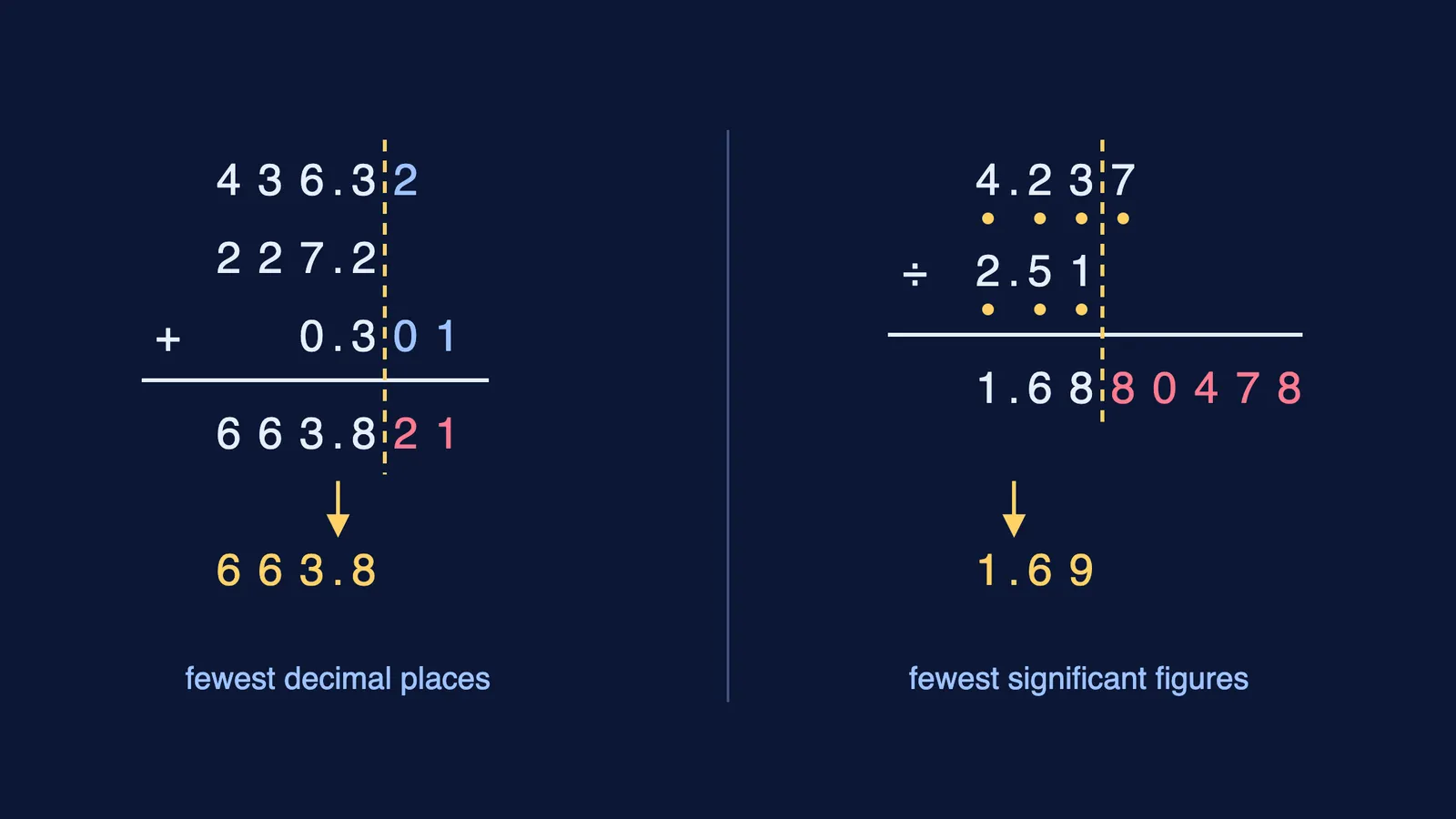
Multiplying or dividing: keep as many significant figures as the number with the fewest. A mass of 4.237 g in a volume of 2.51 cm³ gives a density of 1.69 g cm⁻³, three figures, not 1.68804780876.
Adding or subtracting: keep as many decimal places as the number with the fewest. 436.32 g + 227.2 g + 0.301 g is 663.821 g by arithmetic, but it is reported as 663.8 g.
For scientific notation, NCERT Chemistry adds the mechanics. To multiply, multiply the coefficients and add the exponents: (5.6×10^5) × (6.9×10^8) = 38.64×10^13 = 3.864×10^14. Both inputs have two significant figures, so you report 3.9×10^14. To add, first give both numbers the same exponent: 6.65×10^4 + 8.95×10^3 becomes (6.65 + 0.895)×10^4 = 7.545×10^4.
How do you round off when the dropped digit is 5?
NCERT's rounding rule, in section 1.3.2 of the Physics chapter, has three cases. If the digit you drop is more than 5, raise the one before it: 2.746 becomes 2.75. If it is less than 5, leave it: 1.743 becomes 1.74. If it is exactly 5, keep the preceding digit when it is even and raise it when it is odd, so 2.745 becomes 2.74 and 2.735 also becomes 2.74.
That last case changes the addition above. 6.65×10^4 is known only to the second decimal of its coefficient, so 7.545×10^4 must be cut to two decimals. The digit before the 5 is 4, which is even, so the answer is 7.54×10^4, not 7.55×10^4.
The same chapter adds a rule for long calculations: keep one extra digit in every intermediate step and round only at the end, or rounding errors build up.
JEE-style worked examples
Each example applies the rules from NCERT Class 11 Physics, Chapter 1.
1. A sphere. The radius is 2.50 cm. Volume = (4/3)π(2.50)³ = 65.4498... cm³. The 4/3 is exact and π can be carried to as many digits as you like, so the radius alone decides: three figures, 65.4 cm³.
2. A subtraction that loses figures. 12.9 g − 7.06 g = 5.84 g by arithmetic. Both have three significant figures, but 12.9 has one decimal place, so the answer is 5.8 g. NCERT Physics uses this case to show that subtraction can reduce the significant figures.
3. A mixed calculation. Find (12.11 + 18.0 + 1.013) ÷ 2.5. The sum is 31.123, good to one decimal place, so carry 31.12 (one extra digit). Then 31.12 ÷ 2.5 = 12.448, and 2.5 has two significant figures, so the answer is 12.
If a step like the third trips you, the Fermi Problem Library has worked problems with a step-by-step solver that explains the reasoning rather than printing an answer, so you can see where the rounding happens.
A 30-second check before you write the final answer
Mark which numbers were measured and which are exact.
Count the significant figures, or decimal places, of each measured value.
Use the right rule: figures for × and ÷, decimal places for + and −.
Carry one extra digit until the last step.
Round once, using the even-odd rule for a dropped 5, and use scientific notation if trailing zeros are ambiguous.
For more practice, read our guides to scientific notation in chemistry calculations, rounding to significant figures in maths and how errors combine when you add or subtract.


