On this page
Chemistry numericals swing between huge and tiny numbers. The Avogadro constant is exactly 6.022 140 76 × 10²³ per mole, a value fixed by definition (NIST CODATA value). The solubility product of silver chloride at 25 °C is 1.8 × 10⁻¹⁰ (University of Wisconsin–Madison Ksp table). You can get the chemistry right and still lose the mark on the power of ten.
How do you multiply and divide numbers in scientific notation?
A number in scientific notation has two parts: a coefficient (the digit term) and a power of ten. In the OpenStax Chemistry 2e maths appendix, the digit term is a number not less than 1 and less than 10.
The same appendix gives the rules:
Multiply: multiply the coefficients and add the exponents.
Divide: divide the coefficients and subtract the exponents.
Add or subtract: first rewrite both numbers with the same power of ten.
Square root: if needed, adjust the number so the exponent divides by 2, then take the root of the coefficient and halve the exponent.
For where these come from, see why same-base powers add, subtract or multiply and how to write large and small numbers in standard form.
How do you fix the coefficient after multiplying?
After you multiply or divide, the coefficient often lands outside 1 to 10. Move the decimal point and change the exponent so the value stays the same, as the OpenStax appendix does in its worked examples.
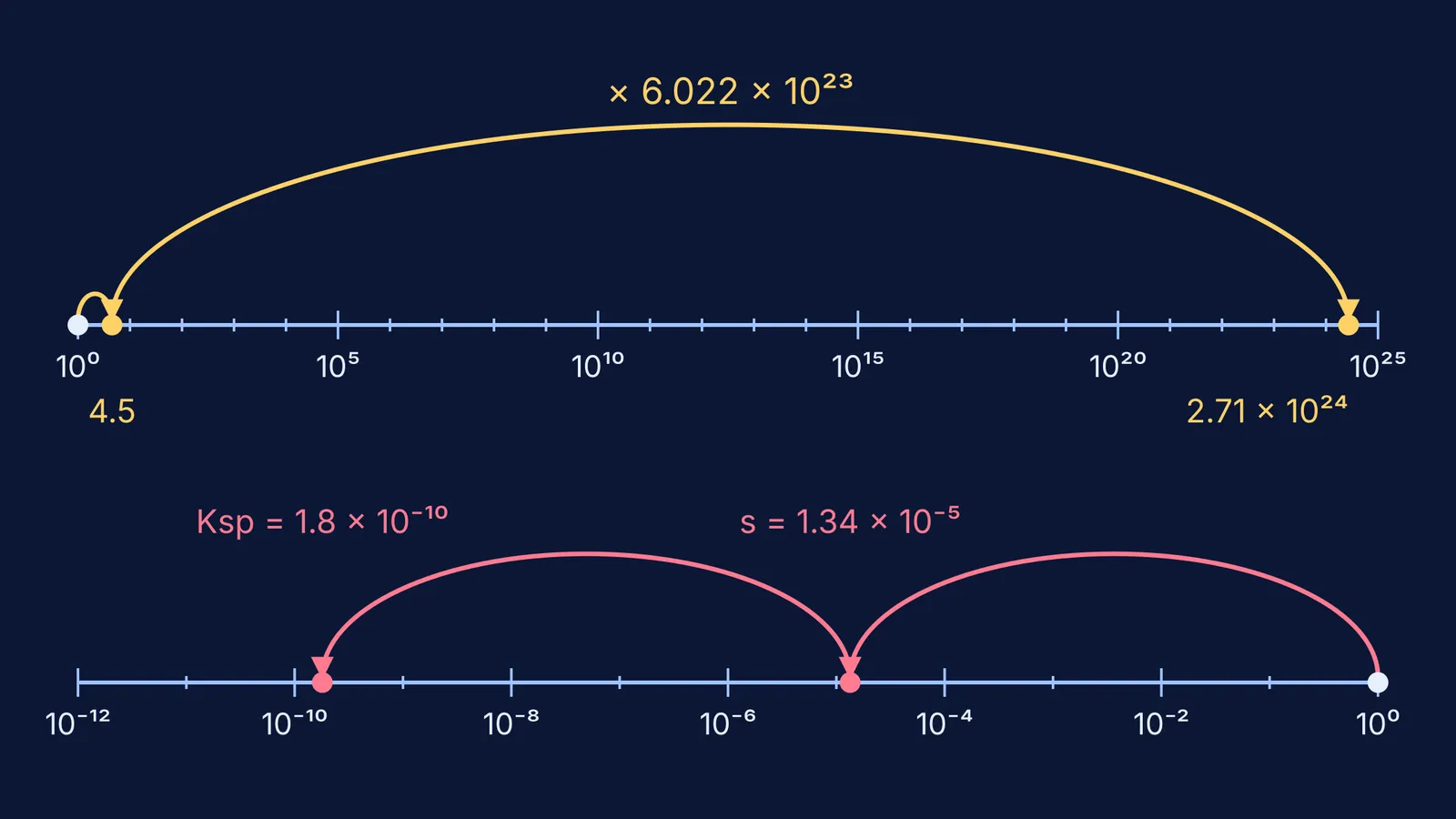
27.1 × 10²³ becomes 2.71 × 10²⁴: the coefficient got 10 times smaller, so the exponent goes up by 1.
0.60 × 10⁻¹ becomes 6.0 × 10⁻²: the coefficient got 10 times bigger, so the exponent goes down by 1.
The second line comes from the OpenStax division example: 3.6 × 10⁻⁵ divided by 6.0 × 10⁻⁴ gives 0.60 × 10⁻¹, which is then written as 6.0 × 10⁻². Look at the exponent step: −5 − (−4) = −1.
Worked example: how many molecules are in 81 g of water?
Use 18 g/mol for water and 6.022 × 10²³ per mole (NIST).
Moles: 81 ÷ 18 = 4.5 mol.
Multiply: 4.5 × 6.022 × 10²³ = 27.099 × 10²³ (4.5 is 4.5 × 10⁰, so the exponent stays 23).
Fix the coefficient: 27.099 × 10²³ = 2.7099 × 10²⁴.
Round to two significant figures to match 81 g: 2.7 × 10²⁴ molecules.
Division runs in reverse: one carbon-12 atom is 12 g ÷ 6.022 × 10²³ = 1.99 × 10⁻²³ g, because 12 is 12 × 10⁰ and 0 − 23 = −23.
How do you take square and cube roots in Ksp problems?
Going from Ksp to solubility (s, in mol/L) means taking a root, which is easy only when the exponent divides cleanly. The Ksp values below are from the UW–Madison table.
AgCl, Ksp = 1.8 × 10⁻¹⁰. Here Ksp = s², and −10 halves cleanly, so s = √1.8 × 10⁻⁵ = 1.3 × 10⁻⁵ mol/L.
AgBr, Ksp = 3.3 × 10⁻¹³. The exponent −13 is odd, so rewrite first: 33 × 10⁻¹⁴. Then s = √33 × 10⁻⁷ = 5.7 × 10⁻⁷ mol/L.
CaF₂, Ksp = 3.9 × 10⁻¹¹. One CaF₂ gives one Ca²⁺ and two F⁻, so Ksp = s(2s)² = 4s³. Then s³ = 3.9 × 10⁻¹¹ ÷ 4 = 0.975 × 10⁻¹¹ = 9.75 × 10⁻¹². The exponent −12 divides by 3, so s = ∛9.75 × 10⁻⁴ = 2.1 × 10⁻⁴ mol/L.
Skip the AgBr rewrite, take √3.3 = 1.8 and round the half-exponent −6.5 to −7, and you get 1.8 × 10⁻⁷, about three times too small. For a Ksp question that starts from a conductivity reading, see solubility and Ksp of AgCl from conductivity, step by step.
What are the most common exponent mistakes?
Each breaks an OpenStax rule.
Multiplying exponents instead of adding them: 10³ × 10⁴ = 10⁷, not 10¹².
Dropping a minus sign when you divide: 10⁻⁵ ÷ 10⁻⁴ = 10⁻¹, not 10⁻⁹.
Moving the decimal the wrong way: 27.1 × 10²³ is 2.71 × 10²⁴, not 2.71 × 10²².
Rooting an odd exponent without rewriting it, as with AgBr.
Forgetting to square the stoichiometric number: (2s)² is 4s², not 2s².
Typing ten twice: the EXP or ×10ˣ key already means "times ten to the", so 6.022 × 10 EXP 23 is ten times too big.
If a slip keeps coming back, the Fermi Problem Library has worked problems with a step-by-step solver that explains the reasoning rather than printing an answer, so you can find where your exponent went wrong.
A three-step routine for any powers-of-ten numerical
Work out the coefficients and the powers of ten on separate lines.
Move the decimal so the coefficient sits between 1 and 10, then round.
Check against your estimate; if the exponent is off, redo step 1.
If the gap is the idea itself, such as what a solubility product means, the Fermi Concept Library has a lesson for every concept in chemistry, each with its place in the map.