

On this page
Silver chloride barely dissolves, so you can't weigh how much went into the water. You can measure how well the saturated solution conducts electricity, though. Every Ag⁺ and Cl⁻ ion that dissolves carries a little current, so the conductivity tells you how many ions are there. This question comes up in Class 12 electrochemistry and in JEE practice papers, and it has the same three steps every time: subtract, divide, square.
How do you find the solubility of AgCl from conductivity?
The method rests on two facts. First, molar conductivity is conductivity divided by molar concentration, Λm = κ/c (Wikipedia, Molar conductivity). Second, Kohlrausch's law says that in very dilute solutions the limiting molar conductivity of a salt is the sum of the limiting values for its ions. The same page lists λ°(Ag⁺) = 61.9 and λ°(Cl⁻) = 76.4 S cm² mol⁻¹, so Λ°m(AgCl) = 138.3 S cm² mol⁻¹.
A saturated AgCl solution is so dilute that you can use Λ°m in place of Λm. The LibreTexts chapter on applications of electrolytic conduction explains why: at such low concentrations the limiting conductivities can be used directly. The recipe:
Subtract: κ(AgCl) = κ(saturated solution) − κ(water).
Add the ions: Λ°m(AgCl) = λ°(Ag⁺) + λ°(Cl⁻).
Divide: s = 1000 × κ(AgCl) / Λ°m, with κ in S cm⁻¹ and Λ°m in S cm² mol⁻¹, which gives s in mol L⁻¹.
Square: Ksp = [Ag⁺][Cl⁻] = s × s = s².
If Kohlrausch's law feels shaky, go back to our explainer on conductance and Kohlrausch's law before you do the numbers.
Worked example: what is the Ksp of AgCl from its conductivity?
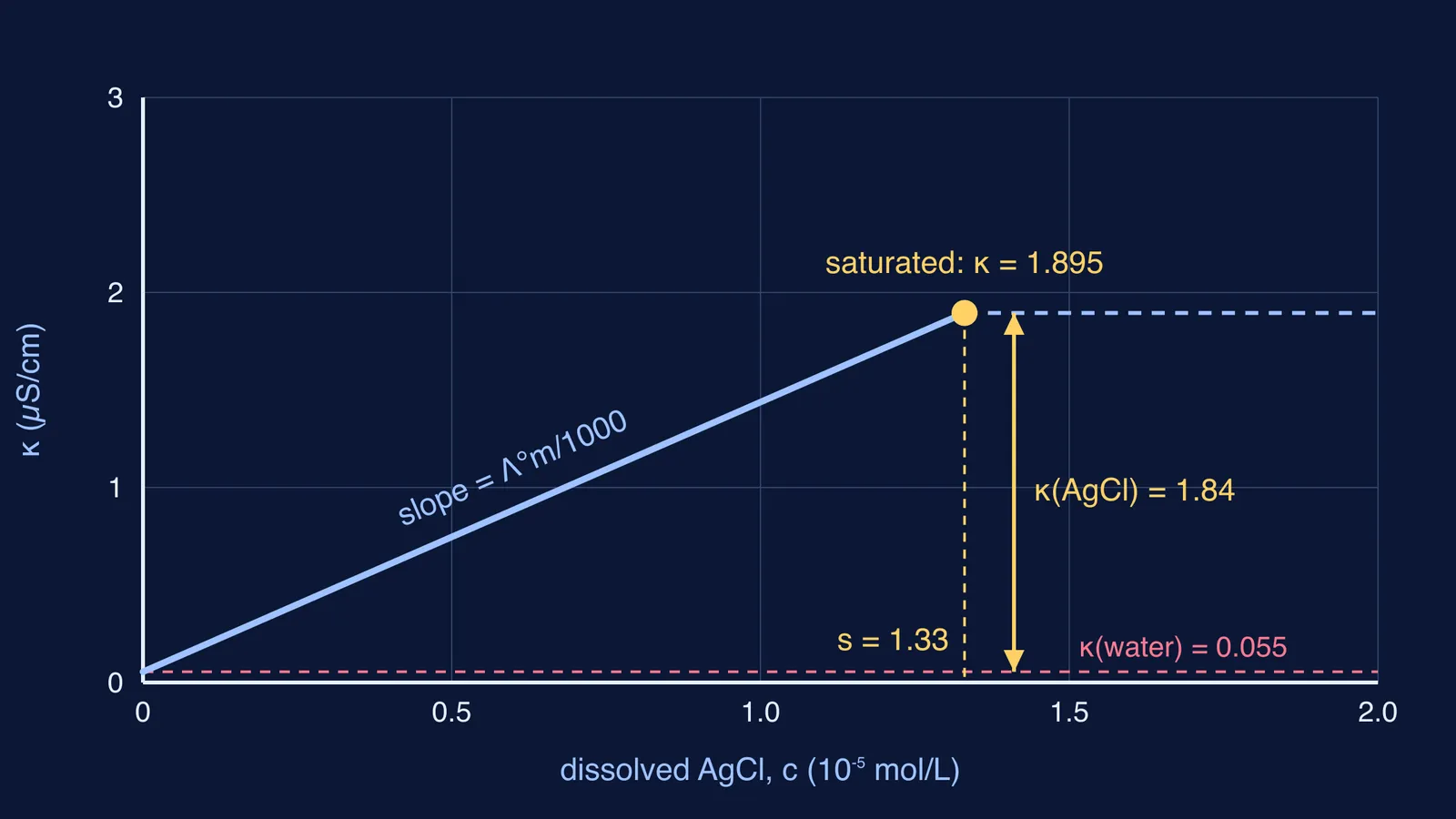
Say you measure a saturated AgCl solution at 25 °C and get κ = 1.895 × 10⁻⁶ S cm⁻¹. You made it with high-quality deionised water, which conducts 0.05501 µS/cm at 25 °C (Wikipedia, Conductivity (electrolytic))). Call that 0.055 × 10⁻⁶ S cm⁻¹. The solution reading is made up, chosen so you can check the answer against a published value.
κ(AgCl) = 1.895 × 10⁻⁶ − 0.055 × 10⁻⁶ = 1.840 × 10⁻⁶ S cm⁻¹.
Λ°m(AgCl) = 61.9 + 76.4 = 138.3 S cm² mol⁻¹.
s = 1000 × 1.840 × 10⁻⁶ / 138.3 = 1.330 × 10⁻⁵ mol L⁻¹.
Ksp = (1.330 × 10⁻⁵)² = 1.77 × 10⁻¹⁰.
That matches the Ksp of 1.77 × 10⁻¹⁰ listed for silver chloride, and the molar mass of 143.32 g/mol on the same page turns s into about 1.9 mg per litre (Wikipedia, Silver chloride). If you're asked for solubility in g/L rather than mol/L, our guide to converting solubility in grams to Ksp covers that step.
Why do you subtract the conductivity of water?
Water is never a perfect insulator. Even high-quality deionised water conducts 0.05501 µS/cm at 25 °C, and typical drinking water conducts 200 to 800 µS/cm, according to Wikipedia's conductivity article). The dissolved AgCl in our example adds only 1.84 µS/cm. So the water's share has to come off before you divide. If you made the solution with tap water, the impurities would swamp the silver chloride signal completely.
The same article notes that meters usually correct for temperature by assuming conductivity rises about 2% per kelvin. That's why both readings should be taken at the same temperature, usually 25 °C.
What mistakes cost marks in this problem?
Forgetting the subtraction and dividing the solution's total conductivity.
Dropping the 1000, or mixing S m⁻¹ with S cm⁻¹. Our note on conductivity units in S/cm shows the conversions.
Using a measured Λm when the question gives ionic λ° values to add.
Squaring out of habit. Ksp = s² only works for 1:1 salts like AgCl. For a salt like CaF₂, Λ°m = λ°(Ca²⁺) + 2λ°(F⁻) and Ksp = 4s³.
For a second practice problem, try the LibreTexts solubility-product example: κ(solution) = 2.28 × 10⁻⁶ S cm⁻¹, κ(water) = 0.116 × 10⁻⁶ S cm⁻¹, Λ°m = 138.2. Do the subtraction yourself, because the page's own subtraction line contains a typo. You should get s ≈ 1.57 × 10⁻⁵ mol L⁻¹ and Ksp ≈ 2.45 × 10⁻¹⁰.
If you keep losing marks on the units rather than the chemistry, work a few of these in the Fermi Problem Library. Its step-by-step solver explains the reasoning rather than printing an answer. If the idea of limiting molar conductivity itself is the gap, the Fermi Concept Library has a lesson for each concept and shows its place in the map.
Next time you see this question, write the four lines (subtract, add, divide, square) before you touch the numbers.


