

On this page
When you first learn about molar conductivity in Class 12 electrochemistry, the definition is straightforward: it is the conducting power of all the ions produced by dissolving exactly one mole of an electrolyte in a solution Unacademy. It represents the efficiency of an electrolyte in conducting electricity.
The base mathematical formula is simply Λm = κ / c, where κ is the specific conductivity and c is the molar concentration.
But when you turn to your textbook's numerical problems, a wild 1000 suddenly appears in the numerator: Λm = (κ × 1000) / c. Where does it come from, and why do some problems divide by 1000 instead?
The confusion comes down to matching units in chemistry. Here is how to convert the units and never guess where the 1000 goes again.
What are the units of conductivity and molar conductivity?
To see the mismatch, look at the units of the two variables in the base formula:
Specific conductivity (κ): This is usually measured in S cm⁻¹ (siemens per centimetre) in the laboratory because conductivity cells have electrodes separated by a few centimetres. It can also be measured in S m⁻¹ in standard SI units.
Concentration (c): This is usually measured in molarity (M), which is defined as moles of solute per litre of solution (mol L⁻¹).
If you just divide S cm⁻¹ by mol L⁻¹, your final unit would be S cm⁻¹ L mol⁻¹, which is physically meaningless. To get a standard unit of area (like cm²), we need the volume part of the concentration to perfectly match the length part of the conductivity. Molar conductivity needs to express conductivity over a given area, so the units must align.
Why is there a factor of 1000 in the formula?
The factor of 1000 is a unit conversion specifically for the concentration term. It changes litres into cubic centimetres so that they can cleanly cancel out with the cm⁻¹ in the specific conductivity.
We know that 1 litre is exactly equal to 1000 cubic centimetres (1 L = 1000 cm³). For more on this geometric relationship, you can read our guide to converting cubic centimetres to litres.
When your concentration c is given in mol L⁻¹, it means you have c moles dissolved in 1000 cm³ of solution. So, to find the concentration in moles per single cm³, you must divide the molarity by 1000. The concentration in moles per cm³ is therefore c / 1000.
Now plug this corrected concentration back into the base formula: Λm = κ / (c / 1000)
When you simplify this fraction, the 1000 flips to the numerator: Λm = (κ × 1000) / c
This formula gives you the molar conductivity in S cm² mol⁻¹, which is by far the most common unit requested in chemistry board exams and competitive entrance tests.
How do you convert molar conductivity from S m² mol⁻¹ to S cm² mol⁻¹?
Sometimes, an exam question will give you the final answer or intermediate values in S m² mol⁻¹, but the multiple-choice options are all written in S cm² mol⁻¹.
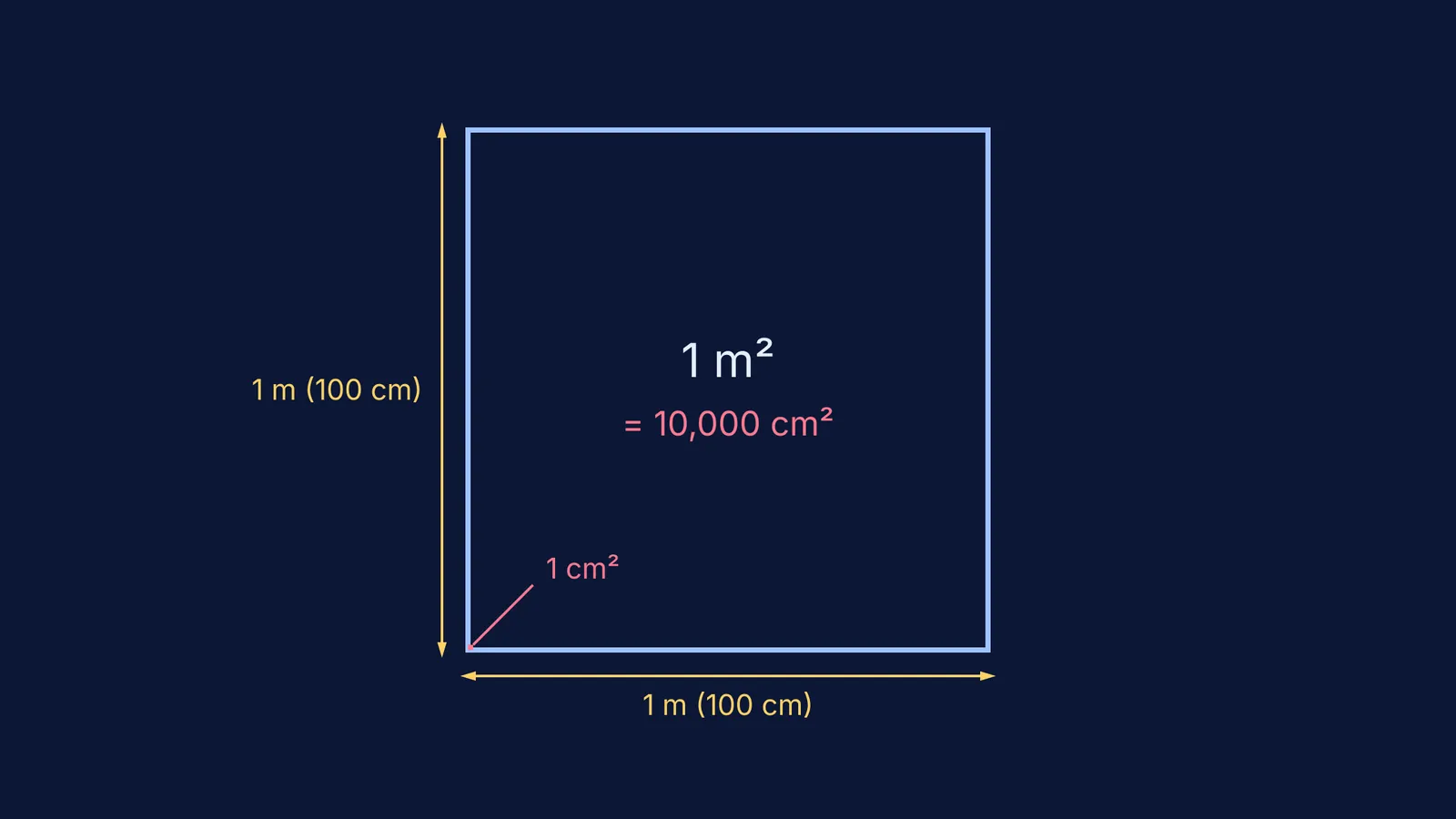
You might instinctively think that because 1 metre is 100 centimetres, you should just multiply your result by 100. However, molar conductivity deals with an area measurement (m² or cm²), not a simple linear length.
As shown in our guide on why 1 square metre is 10,000 cm², an area of 1 m² is a square measuring 100 cm by 100 cm. When you multiply 100 cm × 100 cm, you get exactly 10,000 cm².
To convert your final molar conductivity result between these two systems:
From S m² mol⁻¹ to S cm² mol⁻¹: Multiply by 10,000 (10⁴). For example, if your value is 0.0124 S m² mol⁻¹, multiplying by 10,000 gives you 124 S cm² mol⁻¹.
From S cm² mol⁻¹ to S m² mol⁻¹: Divide by 10,000 (10⁻⁴). For example, 150 S cm² mol⁻¹ becomes 0.0150 S m² mol⁻¹.
If you get stuck on complex unit conversions during your electrochemistry revision, the Fermi Concept Library can help you trace the derivation step by step. Rather than simply memorising disconnected formulas, you can ask the AI tutor to show you exactly how the unit dimensions cancel out, building a deep understanding that prevents silly mistakes in the exam hall.


