

On this page
Many students breeze through the geometry of Surface area and volume in Class 9 formulas, only to lose points at the very end because they couldn't convert the final volume into litres. A water tank problem usually gives dimensions in metres or centimetres, but asks for the final capacity in litres.
What is the relationship between a litre and a cubic centimetre?
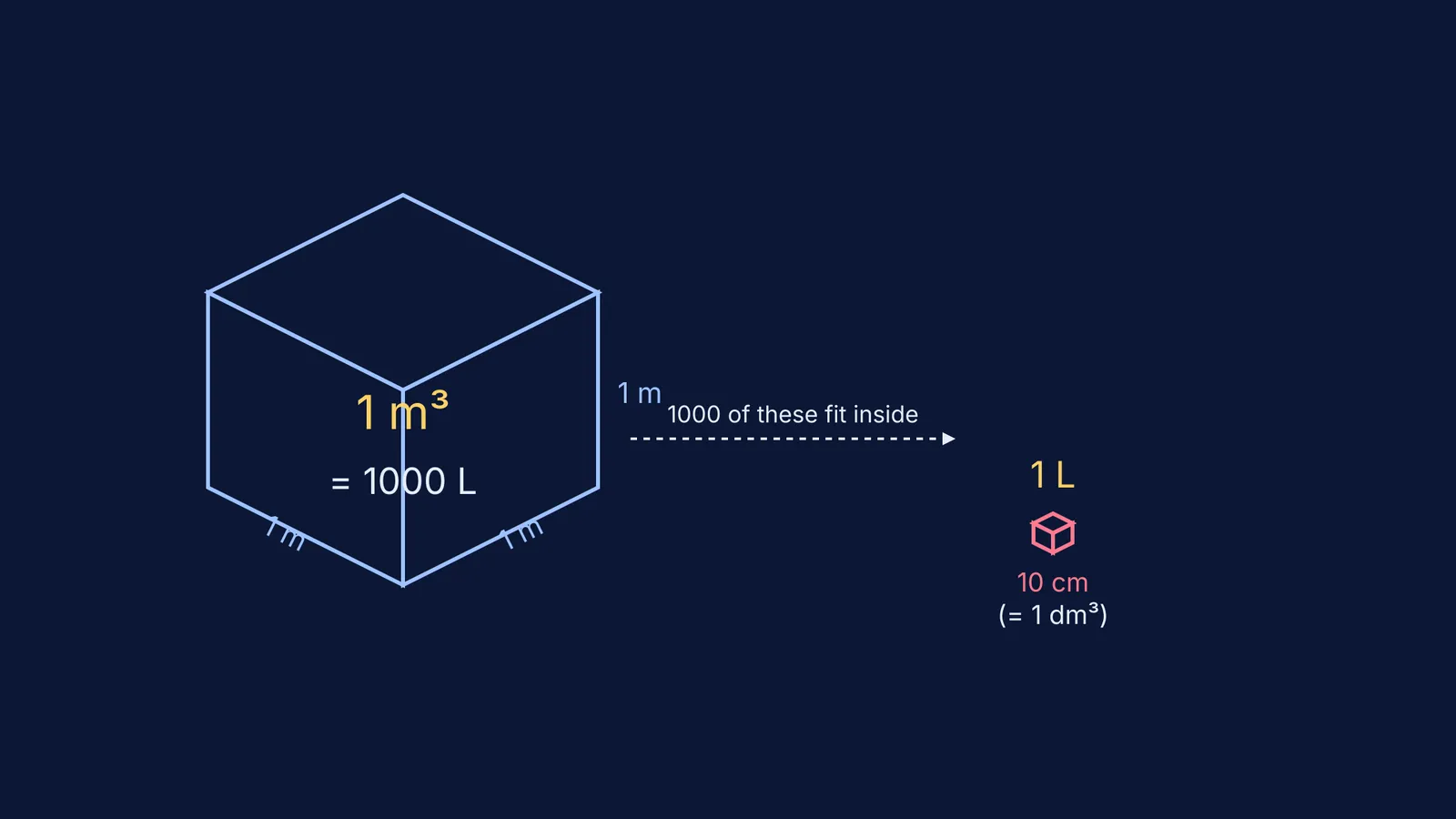
According to the definition of the litre, the litre is defined exactly as a cubic decimetre (1 L = 1 dm³).
Because one decimetre equals 10 centimetres, a cubic decimetre is 10 cm × 10 cm × 10 cm. This means 1 litre is exactly 1000 cubic centimetres (cm³).
In chemistry and medicine, one cubic centimetre is also commonly referred to as one millilitre (mL). Therefore, 1000 cm³ = 1000 mL = 1 L.
How many litres are in a cubic metre?
A cubic metre (m³) is the standard SI unit of volume.
Since 1 metre = 100 centimetres, a cubic metre expands cubically: 100 cm × 100 cm × 100 cm = 1,000,000 cm³.
Because 1000 cm³ make a single litre, dividing 1,000,000 by 1000 gives us exactly 1000. Therefore, 1 cubic metre equals 1000 litres. This is the single most important conversion factor for large tank-capacity questions in physics and maths.
Why volume conversions often cause errors
The most common mistake students make is applying linear conversions to volume. A student knows that 1 metre is 100 centimetres. When asked to convert cubic metres to cubic centimetres, their brain instinctively uses the familiar factor of 100, instead of 1,000,000 (100³).
This cognitive slip happens because our intuition is built for one-dimensional lengths, not three-dimensional spaces. A box that is 1 metre wide might not look like it can hold a million tiny 1 cm³ blocks, but mathematically, it does. To prevent this, you should always explicitly write out the cubes during an exam: (100 cm)³ = 100³ cm³ = 1,000,000 cm³.
How to convert cubic centimetres to litres in word problems
If you are solving Ideal gas problems: gas laws, Dalton's law and the units trap or calculating tank volumes, you need a reliable method that prevents calculation errors. If you struggle to switch between measurement systems, converting a quantity between unit systems using dimensions provides a foolproof algebraic check.
Here is a simple, mechanical framework for calculating tank capacity:
Unify the given units: Never mix metres and centimetres. Convert all side lengths to a single unit (either all metres or all centimetres) before multiplying.
Calculate the volume: Multiply the unified lengths to find the volume in your chosen starting unit.
Apply the final conversion factor: To convert cubic centimetres (cm³) to litres, divide the volume by 1000. To convert cubic metres (m³) to litres, multiply the volume by 1000.
Worked Example:
A rectangular water tank measures 2 m long, 50 cm wide, and 40 cm deep. What is its capacity in litres?
Step 1: Unify the units. Convert the 2 m length into centimetres: 2 m = 200 cm.
Step 2: Find the volume in cm³. 200 cm × 50 cm × 40 cm = 400,000 cm³.
Step 3: Convert cubic centimetres to litres. 400,000 / 1000 = 400 Litres.
If you are unsure where you went wrong in a calculation, the Fermi Problem Library features a step-by-step solver that explains the reasoning rather than just printing an answer. The AI tutor notices where you are stuck—often at the unit conversion stage—and checks your understanding as it goes, ensuring you grasp the scaling factor before moving on.
Common applications: From water tanks to medical doses
The need to convert cubic centimetres to litres appears across several scientific disciplines, each using slightly different terminology for the exact same physical volume.
Mathematics and Physics: You will frequently encounter rectangular prisms, cylinders, and spheres where dimensions are given in metres or centimetres. Here, remembering that 1 m³ = 1000 L and 1000 cm³ = 1 L is essential for correct final answers.
Chemistry and Medicine: In a laboratory or clinical setting, a cubic centimetre is almost universally referred to as a millilitre (mL) or "cc". An IV bag containing 1 litre of saline is exactly equivalent to 1000 mL or 1000 cc. When reading a graduated cylinder, the markings are usually in mL, which maps directly to cm³.


