

On this page
Exponent questions look easy, and then marks slip away on a line like 2³ × 3² = 6⁵. The laws are short; they work when you know why they hold and when they stop.
Why does a^m × a^n add the exponents?
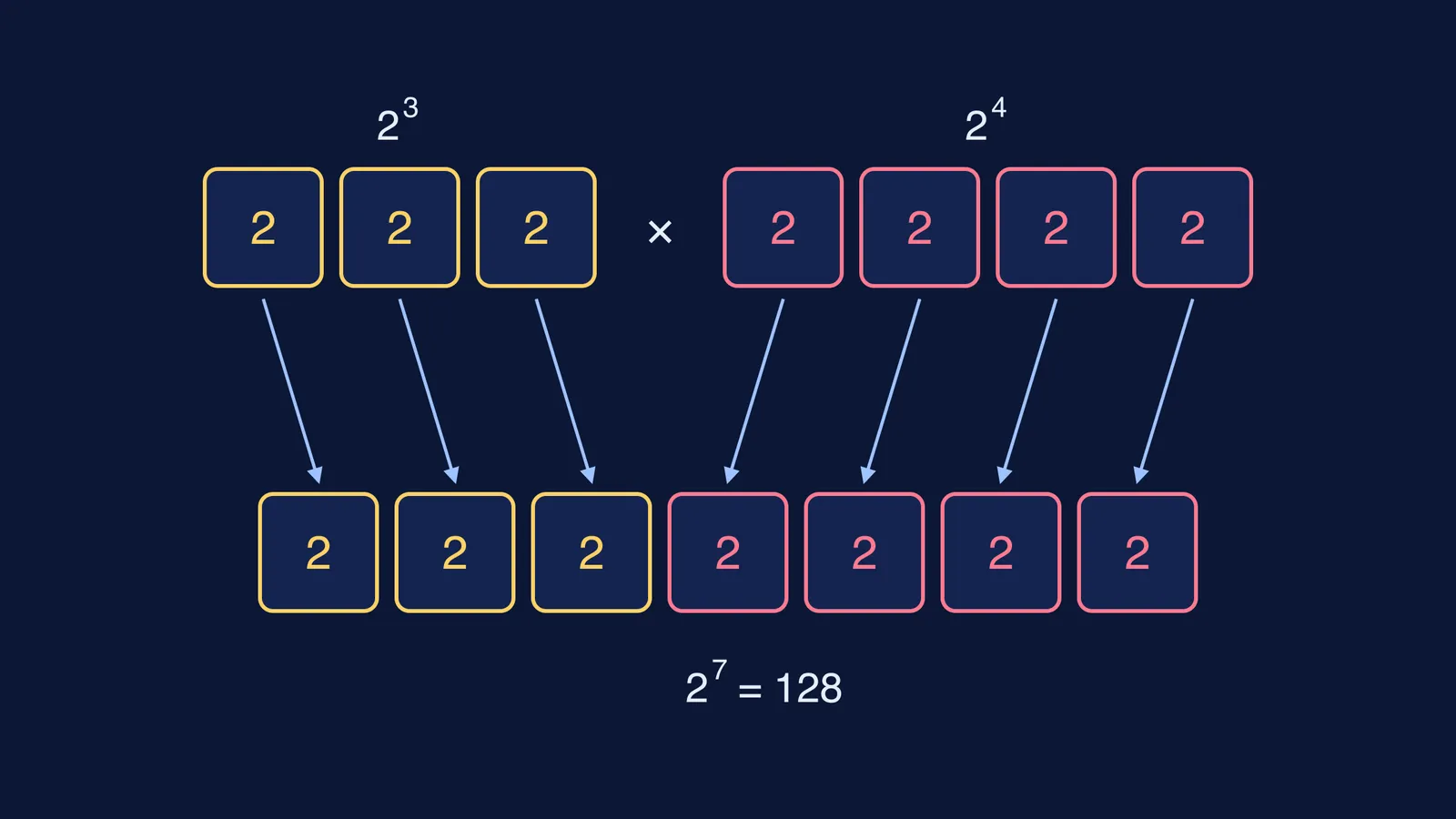
An exponent counts how many times the base is multiplied by itself. 2³ means 2 × 2 × 2, three factors of 2. 2⁴ means four factors of 2.
Now multiply them: (2 × 2 × 2) × (2 × 2 × 2 × 2). Remove the brackets and you have one long row of 2s. Count them: 3 + 4 = 7. So 2³ × 2⁴ = 2⁷, and 8 × 16 = 128 = 2⁷ confirms it.
You are not adding the 2s. You are adding the counts of 2s. That is why the law needs the same base: the factors can only join one row if they are all the same number.
What are the laws of exponents for the same base?
OpenStax's College Algebra 2e states them for a real number a and natural-number exponents m and n:
Product rule: a^m × a^n = a^(m+n). Multiplying joins two rows of factors, so the counts add.
Quotient rule: a^m ÷ a^n = a^(m−n), with a not zero (OpenStax states it for m > n). Each factor on the bottom cancels one on the top, so the counts subtract. Example: 5⁶ ÷ 5² = 5⁴.
Power of a power: (a^m)^n = a^(m×n). You write n copies of a row that is m long, so the counts multiply. Example: (3²)³ = 3² × 3² × 3² = 3⁶.
Zero exponent: a^0 = 1 for any non-zero a. It comes from extending the quotient rule to equal exponents: a³ ÷ a³ is 1, and it is also a^(3−3).
The same reasoning extends to negative and fractional exponents. Our guides to simplifying fractions with negative exponents and fractional exponents, root first then power take it from there.
Why can't you add exponents when the bases are different?
Because there is no single row to count. 2³ × 3² is 8 × 9 = 72. It is not 5⁵, 6⁵ or 6⁶.
Researcher Fadime Ulusoy gave a paper-and-pencil task to 165 eighth-grade students and interviewed 12 of them, as reported in the International Journal of Research in Education and Science (2019). The study found that errors generally came from defining an exponent as repeated multiplication with natural numbers and from under-developed ideas of when to add and when to multiply. Students stretched rules that hold for positive exponents to cases where they do not, and most did not know what a zero exponent means.
Four common slips to watch for:
Adding unlike bases: 2³ × 3² written as 5⁵. No law adds bases.
Adding when you should not: 2³ + 2⁴ written as 2⁷. The product rule is for multiplication only. 8 + 16 = 24, while 2⁷ = 128.
Adding instead of multiplying: (2³)² written as 2⁵. It is 2⁶ = 64. Watch the brackets, too: 2^(3²) is 2⁹ = 512, a different number.
Thinking a^0 = 0: any non-zero base to the power 0 is 1.
How do you check an exponent step in one minute?
Ask three questions before you write the next line:
Same base? If not, can you rewrite one? 4 = 2² and 8 = 2³, so both can become base 2. If you cannot, no law applies.
Which operation? Multiply means add the exponents, divide means subtract, a power of a power means multiply. Addition and subtraction of powers have no shortcut.
Does it pass the small-number test? Try a = 2 on the step you are unsure of.
Worked example 1: simplify (3⁵ × 3²) ÷ (3³)².
Top: 3⁵ × 3² = 3⁷ (product rule).
Bottom: (3³)² = 3⁶ (power of a power).
Divide: 3⁷ ÷ 3⁶ = 3¹ = 3 (quotient rule).
Check: 3⁷ = 2187 and 3⁶ = 729, and 2187 ÷ 729 = 3.
Worked example 2: simplify 4³ × 8².
The bases differ, so rewrite them: 4³ = (2²)³ = 2⁶ and 8² = (2³)² = 2⁶.
Now the bases match: 2⁶ × 2⁶ = 2¹².
Check: 64 × 64 = 4096 = 2¹².
This check-before-you-write habit is the same one that stops BODMAS mistakes like 8 ÷ 2 × 4.
What should you practise next?
Take ten mixed questions and, before solving each one, write the base and the operation in the margin. Many exponent slips are wrong-method errors, not arithmetic ones. The Fermi Problem Library has worked problems with a step-by-step solver that explains the reasoning rather than printing an answer, so you can see which law each line uses. If a law itself still feels shaky, the Fermi Concept Library gives each mathematics concept its own lesson.
Once you have the counting picture, you can rebuild every law in seconds, even if you forget the formula in the exam.


