

On this page
If you have ever felt stuck when an exam question mixes fractions and negative exponents, you are not alone. It looks complicated, but there is a straightforward mathematical property that makes solving these easy.
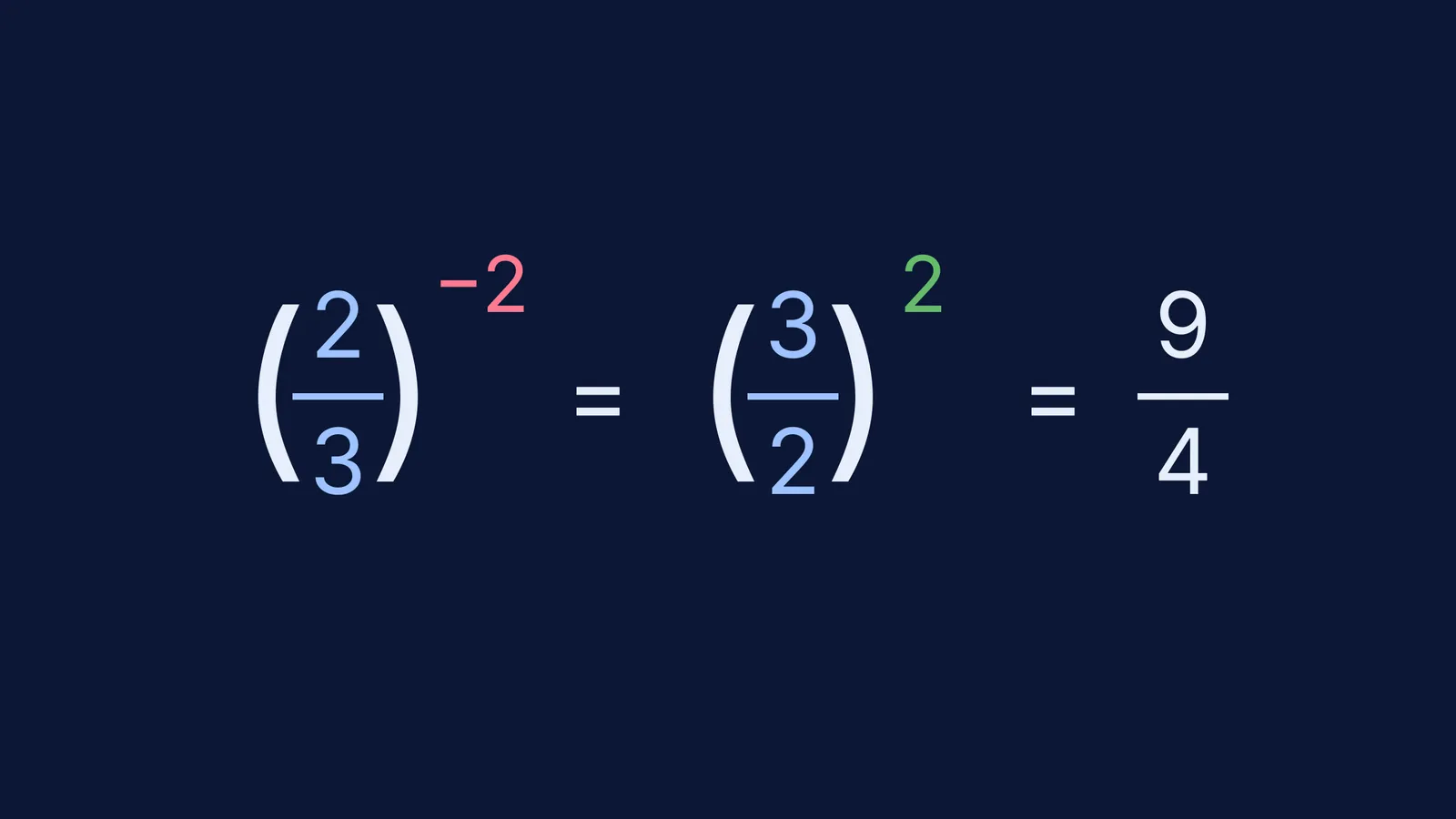
The rule states that when a fraction is raised to a negative power, it is equal to its reciprocal raised to the same positive power.
What is the reciprocal in the flip rule?
To use the flip rule effectively, you must understand what a reciprocal is. The reciprocal of any number or fraction is what you multiply it by to get 1. For a fraction like *a*/*b*, the reciprocal is simply *b*/*a*, because multiplying them together (*a*/*b* × *b*/*a*) gives 1. When the negative exponent property tells you to flip the fraction, you are mathematically multiplying by its reciprocal. This is why a negative exponent indicates the multiplicative inverse. Understanding this foundation helps you avoid memorising the rule without knowing why it works, and gives you a built-in way to check your logic during an exam.
What is the negative exponent of a fraction flip rule?
A negative exponent means you are finding the multiplicative inverse of the base. For example, the NCERT Class 8 Mathematics textbook defines a negative power such that any non-zero integer *a* raised to −*m* is 1/*a*ᵐ.
When your base is a fraction, dividing 1 by that fraction requires you to multiply by its reciprocal. Educational resources like OpenStax formalise this as the Quotient to a Negative Exponent Property: for any non-zero numbers *a* and *b*, (*a*/*b*)⁻ⁿ = (*b*/*a*)ⁿ.
Why does (2/3)⁻² equal (3/2)²?
Let us walk through exactly why the flip rule works using the example (2/3)⁻².
Apply the definition of a negative exponent:
By definition, *x*⁻² is equal to 1/*x*². Therefore, (2/3)⁻² becomes 1 / (2/3)².
Apply the exponent to the fraction:
(2/3)² is just 2²/3², which equals 4/9. So, your expression is now 1 / (4/9).
Divide by the fraction:
To divide 1 by a fraction, you multiply 1 by its reciprocal. 1 × (9/4) gives you 9/4.
Notice that you arrive at exactly the same answer if you just use the flip rule from the start: (2/3)⁻² becomes (3/2)², which is 3²/2² or 9/4. The rule saves you from having to write out complex double fractions.
If you are preparing for algebra exams, reviewing the binomial theorem for negative and fractional index is a smart next step.
Worked Example: Mixing fractional bases and negative exponents
Exam questions often combine negative exponents with variables across the numerator and denominator. According to Cuemath, you solve expressions with negative exponents by first converting them into positive exponents using exponent rules.
Here is how you handle a combined problem:
Problem: Simplify the expression (4*x*² / 5*y*⁻³)⁻²
Step 1: Flip the outer fraction and make the outside power positive. Using the flip rule, swap the entire top and bottom, and change the outer −2 to 2: (5*y*⁻³ / 4*x*²)²
Step 2: Apply the positive power to everything inside. Square the coefficients and multiply the exponents on the variables: (5² × *y*⁻⁶) / (4² × *x*⁴) 25*y*⁻⁶ / 16*x*⁴
Step 3: Move any remaining negative powers across the fraction bar. The variable *y* still has a negative exponent. To make it positive, move it from the numerator down to the denominator: 25 / (16*x*⁴*y*⁶)
If you need a space to practice algebra, the Fermi Problem Library has worked problems with a step-by-step solver that explains the reasoning rather than printing an answer.
A checklist for exam questions
When you encounter negative powers in a test, follow this order of operations:
Check for an outer negative power: If the entire bracket has a negative exponent, flip the fraction inside immediately and make the outer power positive.
Distribute powers: If you have an exponent outside a bracket, multiply it by the exponents of every term inside.
Move individual negative terms: If an individual term inside a fraction has a negative power, move just that term to the opposite side of the fraction bar (numerator to denominator, or vice versa) to make its power positive.
Combine like terms: Use the product and quotient rules (adding exponents when multiplying, subtracting when dividing) to combine remaining variables.
For a deeper dive into checking your algebraic working, read our guide on using dimensions to check your physics answers.


