

On this page
You learnt the binomial theorem as a finite formula: (1 + x)⁵ has six terms and you are done. Then a problem asks for the coefficient of x³ in √(1 + x), and nCr with factorials stops working. Here is what changes, why |x| < 1 matters, and how to solve the coefficient questions in JEE practice.
What changes when the index is negative or a fraction?
The binomial series extends the binomial formula to exponents that are not positive integers (Wikipedia). Three things change:
The series never ends. It stops only when the index is a positive integer (Wolfram MathWorld). For n = −2 or n = 1/2 it goes on forever.
The coefficients are not nCr. You cannot write n! when n = 1/2. Instead you use the generalised coefficient n(n − 1)…(n − r + 1)/r!, which has r factors on top.
The expansion holds only for some x. That is the |x| < 1 condition.
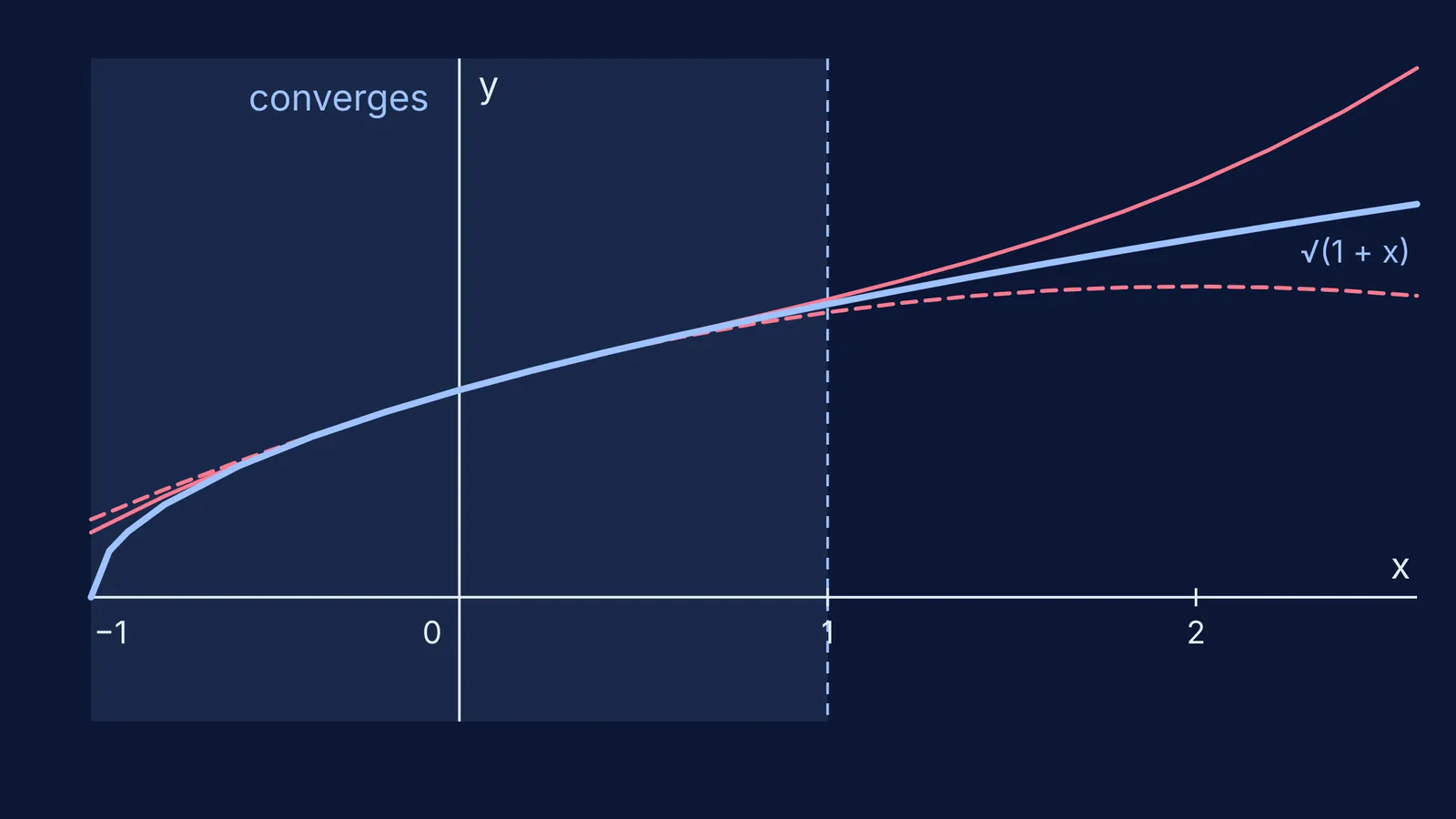
The expansion is (1 + x)ⁿ = 1 + nx + n(n − 1)x²/2! + n(n − 1)(n − 2)x³/3! + …, valid for |x| < 1 (Wolfram MathWorld).
Why must |x| be less than 1?
Take n = −1 and replace x with −x. The series becomes 1 + x + x² + x³ + …, which is just the geometric series for 1/(1 − x). Put x = 1/2 and both sides equal 2. Put x = 2 and the left side is −1, while the right side, 1 + 2 + 4 + 8 + …, grows without limit. You have used the formula outside the range where it holds.
The binomial series converges when |x| < 1, and at x = ±1, whether it converges depends on n (Wikipedia). For JEE, state the open interval and move on.
How do you write the general term?
The (r + 1)th term of (1 + x)ⁿ is T(r+1) = n(n − 1)(n − 2)…(n − r + 1)xʳ/r!, using the generalised coefficient defined on Wikipedia. Count r factors in the numerator, then count the negative ones to get the sign.
Negative integer indices come up so often that four results are worth memorising. All of them follow from the negative binomial series on Wolfram MathWorld:
(1 − x)⁻¹ = 1 + x + x² + x³ + …
(1 + x)⁻¹ = 1 − x + x² − x³ + …
(1 − x)⁻² = 1 + 2x + 3x² + 4x³ + …, so the coefficient of xʳ is r + 1.
In (1 − x)⁻ⁿ for a positive integer n, the coefficient of xʳ is (n + r − 1)Cr, and every term is positive.
Worked JEE-style coefficient problems
1. Coefficient of x³ in √(1 + x). Here n = 1/2. The coefficient is (1/2)(−1/2)(−3/2)/3! = (3/8)/6 = 1/16. So √(1 + x) = 1 + x/2 − x²/8 + x³/16 − …, for |x| < 1.
2. Coefficient of x⁴ in (1 − 2x)⁻³. Use result 4 with y = 2x. The coefficient of y⁴ is 6C4 = 15, and y⁴ = 16x⁴, so the answer is 240. The expansion holds for |x| < 1/2, not |x| < 1.
3. Coefficient of x⁵ in (1 + 2x)/(1 − x)². Write the expression as (1 + 2x)(1 + 2x + 3x² + …). x⁵ comes from 1 × 6x⁵ and 2x × 5x⁴, so the answer is 6 + 10 = 16.
4. Expand (8 + x)^(1/3) up to x². Factor out the 8: 2(1 + x/8)^(1/3). The x² coefficient inside the bracket is (1/3)(−2/3)/2 = −1/9. That gives 2 + x/12 − x²/288, valid for |x| < 8. Check with x = 1: you get about 2.0799, and the cube root of 9 is about 2.0801.
Keeping just the first two terms is the trick physics uses all the time; see our post on the binomial approximation in physics.
Is the binomial theorem for any index in the JEE syllabus?
The Mathematics syllabus in the official JEE (Advanced) 2026 Information Brochure lists "binomial theorem for a positive integral index, properties of binomial coefficients" and does not name other indices. So treat the general form as a tool for approximations, limits and series questions.
A checklist for every problem:
Rewrite the expression as a constant times (1 ± y)ⁿ.
Write the range |y| < 1 before you expand.
Write the general term with r factors, then fix the sign.
For negative integers, use the (n + r − 1)Cr shortcut.
Check the answer with a small number, as in problem 4.
If the positive-integer version still feels shaky, start with our guide to the binomial theorem for JEE, then try binomial coefficient sums. If you keep getting the sign or the range wrong, the Fermi Problem Library has worked problems with a step-by-step solver that explains the reasoning rather than printing an answer. If the gap is the idea of a series itself, look it up in the Fermi Concept Library.


