

On this page
Stuck on 8^(2/3), unsure whether to divide or multiply? The fix is a fixed order of moves. A fractional exponent is two instructions packed into one number. Read them in the right order and most of these questions take three lines.
What does a fractional exponent like 8^(2/3) mean?
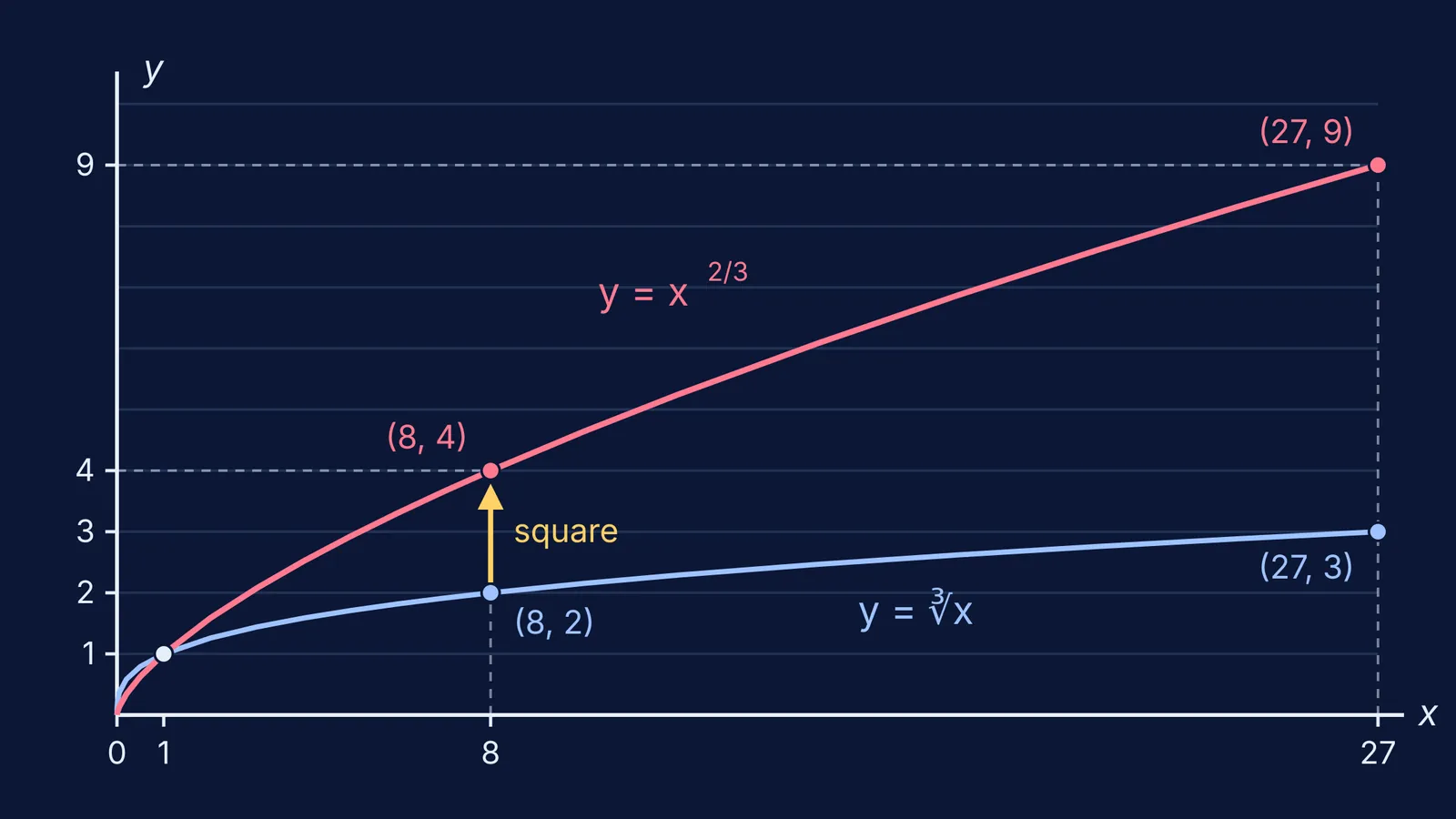
The denominator of the exponent tells you which root to take, and the numerator tells you which power to raise it to. OpenStax's College Algebra 2e defines a^(m/n) as the nth root of a raised to the power m, which also equals the nth root of a^m. The same section states that "all of the properties of exponents that we learned for integer exponents also hold for rational exponents".
The denominator (bottom) is the root: 3 means cube root.
The numerator (top) is the power: 2 means square.
That gives 8^(2/3) = (∛8)² = 2² = 4. Check it the other way: ∛(8²) = ∛64 = 4. Same answer.
Why should you take the root first?
For a positive base both orders give the same answer, but one is easier. The OpenStax section puts it plainly: "In general, it is easier to find the root first and then raise it to a power."
See it with 81^(3/4):
Root first: the fourth root of 81 is 3, and 3³ = 27.
Power first: 81³ = 531441, and now you need its fourth root. It is 27, but that is hard to see without a calculator.
Root first keeps the numbers small.
How do you simplify a negative fractional exponent?
A negative exponent never makes the answer negative. It means reciprocal: a^(−p) = 1/a^p. Deal with the sign first, then go root, then power.
Example 1: 32^(−3/5)
Flip: 32^(−3/5) = 1/32^(3/5).
Root: the fifth root of 32 is 2, because 2 × 2 × 2 × 2 × 2 = 32.
Power: 2³ = 8.
Answer: 1/8.
Example 2: (16/81)^(−3/4)
Flip the fraction: (81/16)^(3/4).
Root: the fourth root of 81 is 3 and of 16 is 2, giving 3/2.
Power: (3/2)³ = 27/8.
Example 3: 125^(−1/3) = 1/∛125 = 1/5. Not −5.
How do the Class 9 laws of exponents work with surds?
Rewrite every root as a fractional power, use the laws you already know for whole-number exponents, then convert back. CBSE's Class 9 and 10 maths curriculum for 2025-26 listed "rational exponents with positive real bases" in the Class 9 Number Systems unit. The 2026-27 Class IX curriculum does not list rational exponents in its Number System unit, so check with your teacher which version applies to you. Our guide to the new NCERT Class 9 books explains what changed.
The four laws, for positive bases a and b and rational exponents p and q:
a^p × a^q = a^(p+q)
a^p ÷ a^q = a^(p−q)
(a^p)^q = a^(pq)
a^p × b^p = (ab)^p
Applied to surds:
√2 × ∛2 = 2^(1/2) × 2^(1/3) = 2^(5/6), the sixth root of 32. Law 1: add 1/2 and 1/3.
∛(√64) = (64^(1/2))^(1/3) = 64^(1/6) = 2. Law 3: multiply the exponents.
√12 × √3 = (12 × 3)^(1/2) = √36 = 6. Law 4: same exponent, so multiply the bases.
When the bases differ, break each into primes. Simplify 27^(−1/3) × 9^(3/2):
27 = 3³, so 27^(−1/3) = 3^(−1).
9 = 3², so 9^(3/2) = 3³.
Multiply: 3^(−1) × 3³ = 3² = 9.
If roots and powers feel shaky, recap exponents and standard form from Class 8 and cubes and cube roots first. The Fermi Concept Library has a lesson for every concept in mathematics, so you can go back to the exact idea you are missing.
Why must the base be positive?
The cube root of −8 is −2, so (−8)^(1/3) = −2. But 1/3 = 2/6, and if you treat (−8)^(2/6) as square first, then sixth root, you get the sixth root of 64, which is 2. Same exponent, two answers. Keeping the laws to positive bases removes the contradiction, so with a negative base, work with the root directly instead of reshuffling exponents.
What should you check before writing the answer?
Did I treat the minus sign as a reciprocal, not a negative answer?
Did I take the root (denominator) before the power (numerator)?
Did I add exponents only for matching bases, and multiply bases only for matching exponents?
Did I use prime powers when the bases differed?
Does the answer reverse? For 8^(2/3) = 4, check that 4³ = 64 = 8².
Practice set, answers in brackets: 27^(2/3) [9]; 16^(−3/4) [1/8]; 32^(2/5) [4]; (1/64)^(−1/3) [4]; 9^(1/2) × 9^(1/4) [3√3]; (125/8)^(−2/3) [4/25].
If your answer keeps differing from the book's, the Fermi Problem Library has worked problems with a step-by-step solver that explains the reasoning rather than printing an answer, so you can find the line where your method went off.


