On this page
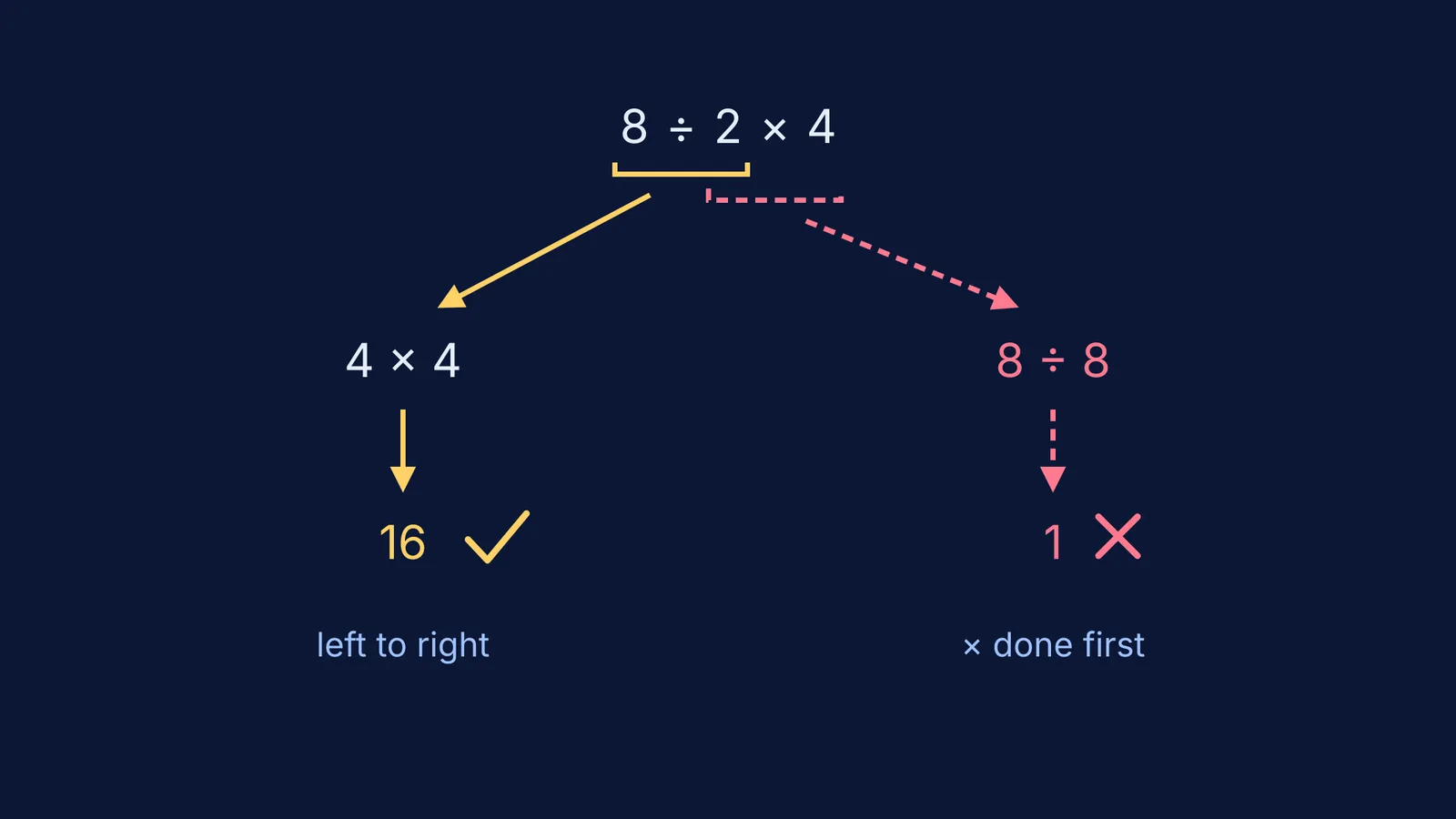
Ask a class to work out 8 ÷ 2 × 4 and some will say 16 and some will say 1. The answer is 16. The wrong answer comes from reading BODMAS as a ranking of six letters, where D beats M. It is really four levels, and two of them hold a pair of operations that tie.
What does the BODMAS rule actually say?
BODMAS stands for Brackets, Orders (powers and roots), Division and Multiplication, Addition and Subtraction. Read it as four ranks:
Brackets first.
Orders: powers and roots.
Division and multiplication, as equals, worked left to right.
Addition and subtraction, as equals, worked left to right.
NCERT's Grade 7 textbook, Ganita Prakash, covers brackets and terms in its chapter Arithmetic Expressions. It says that with brackets, "we need to first find the values of the expressions inside the brackets before performing other operations." In its example 30 + 5 × 4, Purna adds first and gets 140, while Mallesh multiplies first and correctly gets 50. It also splits expressions into terms, the parts separated by a plus sign.
Why is 8 ÷ 2 × 4 equal to 16 and not 1?
Go left to right through the tied pair: 8 ÷ 2 = 4, then 4 × 4 = 16. Getting 1 means doing 2 × 4 first, which answers a different expression: 8 ÷ (2 × 4).
A check that needs no rule: dividing by 2 is multiplying by one half, so 8 ÷ 2 × 4 is 8 × ½ × 4, and a string of multiplications gives 16 in any order.
Adults make this slip too. Peter Glidden tested 381 prospective teachers on four order-of-operations problems. Of those who multiplied before adding, 38.0% did multiplication before division and 30.9% did addition before subtraction, "rather than from left to right". The paper suggests they were following the PEMDAS mnemonic literally.
The viral puzzle 8 ÷ 2(2+2) is a separate argument. Evelyn Lamb wrote in Scientific American that one method gives 1 and the other 16. Her advice: write (8÷2)(2+2) if you mean 16, and 8÷(2(2+2)) if you mean 1.
Where do sign slips in order of operations come from?
A minus sign in front of a bracket. The NCERT chapter shows that removing brackets with a minus sign in front changes the sign of every term inside: 500 − (250 − 100) = 500 − 250 + 100 = 350. Our guide to subtracting algebraic expressions uses the same rule with letters.
A minus sign in front of a power. −3² means −(3²) = −9, because powers come before the minus. (−3)² = 9. In Glidden's study, 78.5% of the 381 trainee teachers worked out −3² in the wrong order. If negative numbers still feel shaky, start with natural numbers, whole numbers and integers.
How do you avoid BODMAS mistakes? A bracket-first checklist
Extra brackets printed in a question don't teach the rule on their own. In a study of 169 Swedish students in years 6 and 7, Robert Gunnarsson and colleagues found their data did not support adding brackets, as in a + (b × c), during brief teaching. The habit belongs in your own working: mark the structure first.
Circle the terms. Split at every + and −, and keep each sign with the number after it.
Work out each bracket. If a minus sign comes just before the bracket, flip every sign inside when you remove it.
Inside a term, go left to right through × and ÷.
Before you square anything, check whether the minus sign is inside the bracket.
Add the terms, then do a rough estimate to check the answer.
Try it on 20 − 12 ÷ 4 × 2 + (−3)² − (6 − 8).
The terms are 20, −(12 ÷ 4 × 2), (−3)² and −(6 − 8).
Left to right: 12 ÷ 4 = 3, then 3 × 2 = 6, so this term is −6.
(−3)² = 9, because the minus sign is inside the bracket.
−(6 − 8) = −(−2) = +2.
Add them: 20 − 6 + 9 + 2 = 25.
Doing 4 × 2 first gives 12 ÷ 8 = 1.5, a surprise decimal that should make you recheck.
How can parents help with BODMAS homework?
When an answer is wrong, first ask "Which part did you do first, and why?" If your child says "D comes before M", you have found a misunderstanding, not carelessness. Our piece on how parents can respond to silly mistakes in maths covers staying calm while you look for the pattern.
If the same slip keeps returning, compare working line by line. The Fermi Problem Library has worked problems with a step-by-step solver that explains the reasoning rather than printing an answer, so you can find the step where the order went wrong.
Tonight, write five expressions mixing ÷ and ×, solve each left to right, and check by rewriting ÷ 2 as × ½, ÷ 4 as × ¼ and so on.