On this page
Adding algebraic expressions is mostly bookkeeping: put like terms together and add their numbers. Subtracting is where marks go missing, because one minus sign in front of a bracket has to reach every term inside it.
How do you subtract one algebraic expression from another?
Subtracting an expression is the same as adding the opposite of each of its terms. NCERT's new Class 7 textbook, Ganita Prakash, Chapter 4 "Expressions Using Letter-Numbers", shows it first with plain numbers: 68 − (18 + 13) is rewritten as 68 + (−18) + (−13), which gives 37, the same as working out the bracket first.
The same chapter then does it with letters. A shop charges 40x + 75y to rent x chairs and y tables and pays back 6x + 10y on return, so the amount paid is (40x + 75y) − (6x + 10y) = 40x + 75y − 6x − 10y = 34x + 65y, as worked in the NCERT chapter.
So the rule has three steps:
Write the expression being subtracted in a bracket.
Remove the bracket and the minus in front of it, changing the sign of every term inside: + becomes −, − becomes +.
Group like terms and add their coefficients.
Like terms are terms with the same letter-numbers, such as 5c and 10c; 18c and 11d are unlike terms and cannot be combined into one term, as the NCERT chapter explains. If that feels shaky, read our post on like and unlike terms in Class 7 algebra, or refresh negative numbers with natural numbers, whole numbers and integers.
What does the column method look like?
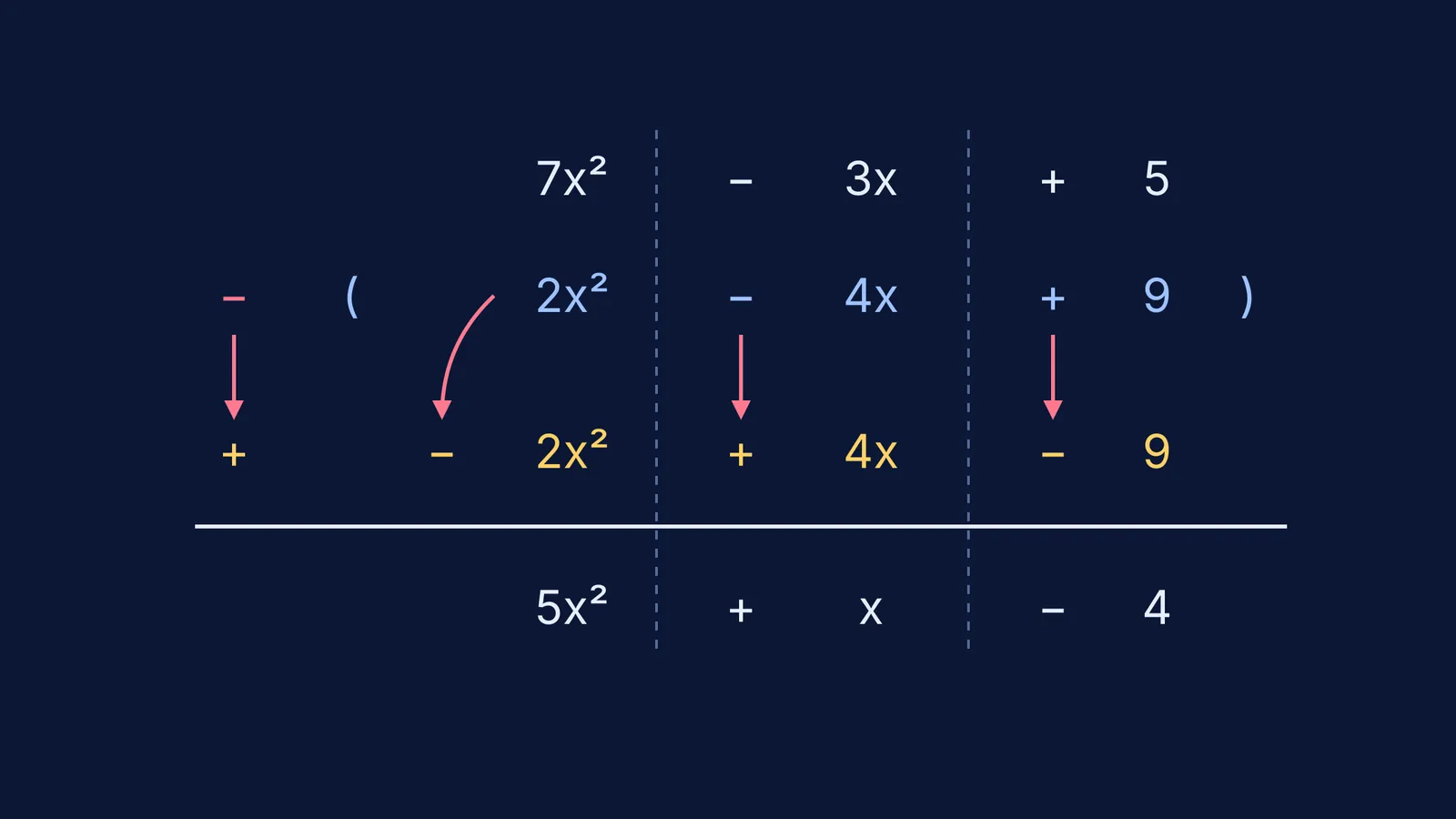
The column method lines up like terms one under another, the way you subtract big numbers. Take this question: subtract 2x² − 4x + 9 from 7x² − 3x + 5.
First, read the order carefully. "Subtract A from B" means B − A, so the expression after "from" goes on top.
Top row: 7x² − 3x + 5
Second row, in a bracket with a minus in front: −(2x² − 4x + 9)
Change every sign in the second row: −2x² + 4x − 9
Add down each column: 7x² − 2x² = 5x², then −3x + 4x = x, then 5 − 9 = −4
Answer: 5x² + x − 4
If a term is missing from one row, leave a gap in that column so the columns stay lined up. Adding works the same way, minus step 3.
The NCERT chapter uses the same check: two forms of an expression must give the same value when the letters are replaced by numbers (Ganita Prakash, Class 7).
Why do students get the signs wrong?
Older students make this slip too. In a 2024 study in the journal Pythagoras, Theba, Pournara and Takker analysed the errors of a random sample of 58 Grade 10 learners in South Africa who had scored above 40% on a test.
The item 3a − (b + a) drew 22 incorrect answers of the kind the authors call surface structure errors, the highest of the five items they discuss, according to the published paper. Answers such as 3ab − 3a² show learners multiplying 3a with both terms in the bracket instead of subtracting them. The correct answer is 3a − b − a = 2a − b.
The authors recommend teaching what the arrangement of an expression means before how to operate on it. In practice: before you touch a bracket, say whether the thing in front of it multiplies or subtracts.
A common mistake checklist
Run this list on every subtraction question before you move on:
Did I put the right expression first? "Subtract A from B" is B − A.
Did I change the sign of every term in the bracket, including the last one?
Did a first term with no sign count as positive, so it became negative?
Is the thing before the bracket a minus or a multiplier? 3a − (b + a) is not 3a(b + a).
Did I combine only like terms? x² and x stay separate.
Does a check with x = 1 give the same number both ways?
If the same error keeps coming back, see each step written out. The Fermi Problem Library has worked problems with a step-by-step solver that explains the reasoning rather than printing an answer, so you can see exactly where a sign changes. For the ideas underneath, such as like terms and integers, the Fermi Concept Library gives each concept its own lesson.
Next step: pick three subtraction sums from your textbook, do them in columns, and check each with x = 1. When that feels easy, try telling which expressions are polynomials with our quick polynomial test.