On this page
When students first meet algebra in Class 7, the letters feel like a foreign language. In arithmetic, every problem finishes with a single number as the answer. In algebra, an expression like 3x + 2 is often the final answer itself.
Because this feels unfinished, many students try to combine everything they see. A large analysis of middle school assessments found that students who fail these early algebra items frequently make mistakes rooted in a misunderstanding of variables and like terms. They might write 3x + 2y = 5xy, treating the variables like physical objects where 3 apples and 2 bananas make 5 apple-bananas.
If you are stuck on this, an AI tutor can guide you through a method that builds real understanding: simplifying the expression and then testing it with a real number.
Why do like and unlike terms confuse students in Class 7?
The biggest trap is the fruit salad analogy. Many of us are taught that x stands for apples and y stands for oranges. This is a classic teaching shortcut that often causes more harm than good as the maths gets harder.
This shortcut works perfectly for simple addition like 2x + 3x = 5x (2 apples plus 3 apples is 5 apples). But it breaks down completely when you see x² (is it a square apple?) or when you have to add a constant, like 3x + 4. A student who thinks of apples will often write 7x, because they simply add the numbers 3 and 4 together. They assume the 'apples' label just tags along at the end of the sum.
Variables are not objects; they are placeholders for numbers. A term is just a chunk of maths separated by a plus or minus sign. Like terms are terms that have the exact same variable raised to the exact same power. You can add 4x and 3x because they represent the same unknown quantity, but you cannot add 4x and 3y because they represent different quantities.
How can an AI tutor help with like and unlike terms?
If you ask an ordinary chatbot to simplify an expression, it will just print the final answer. This does not help you spot why you added two unlike terms together in the first place, and it leaves you helpless in an exam hall.
Instead, a good AI tutor teaches you how to check your own work and think critically about what the letters mean. Fermi's AI tutor works out what you already know and builds a plan for the session, walking you through the reasoning step by step. Rather than saying your answer is wrong, the tutor might ask you to prove it. When you use AI to understand mistakes, not get answers, it will often suggest a reliable checking strategy called substitution.
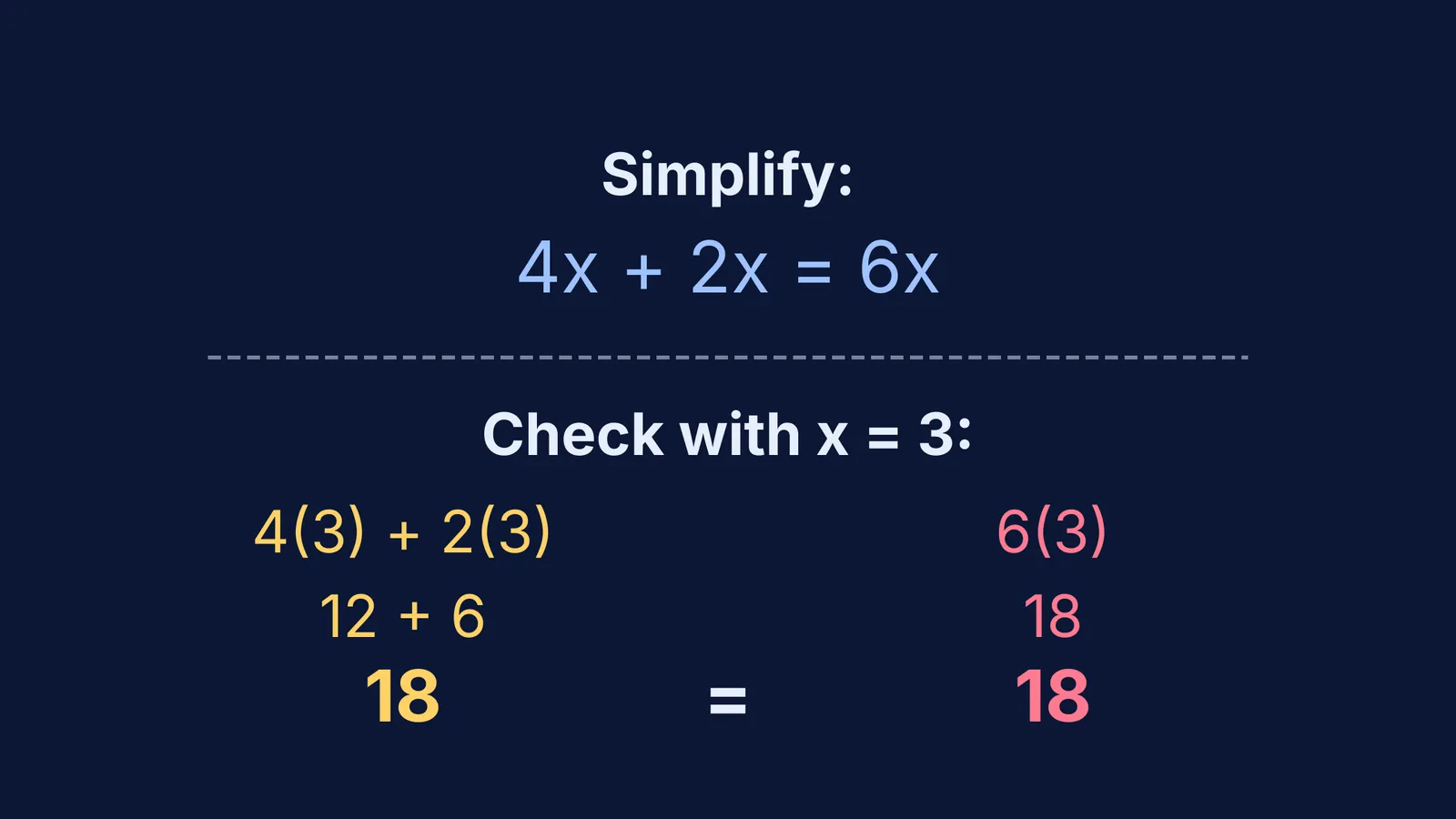
Why does substitution work? Algebra is just a generalized form of arithmetic. The substitution method means replacing the letter with a random number to see if your simplified answer gives the same result as the original question. Because variables represent numbers, the rules of arithmetic still apply. Substitution takes the abstract letters and turns them back into familiar numbers, making it instantly clear if you have broken an arithmetic rule. If the two numbers match, your algebra is correct. If they do not, you combined something you should not have.
How do you check your algebra with substitution?
Let us say your textbook asks you to simplify the expression 5x + 3y + 2x - y.
Step 1: Group the like terms Ask the AI to help you sort the terms into groups. Keep the plus or minus sign attached to the term that comes immediately after it. Group 1 (the x terms): 5x + 2x Group 2 (the y terms): 3y - y
Step 2: Simplify each group 5x + 2x = 7x 3y - y = 2y Your final simplified expression is 7x + 2y.
Step 3: Test both expressions with a number This is where the learning happens. Pick simple numbers, such as x = 2 and y = 3.
Substitute them into the original expression: 5(2) + 3(3) + 2(2) - 3 10 + 9 + 4 - 3 19 + 4 - 3 = 20
Now, substitute them into your simplified answer (7x + 2y): 7(2) + 2(3) 14 + 6 = 20
Both expressions equal 20. This proves that 7x + 2y is the correct simplification.
If you had accidentally combined everything into 9xy, substituting the numbers would give 9 × 2 × 3 = 54, which is not 20. The mismatch instantly tells you that a mistake was made. It is a reliable way to check your NCERT exercise answers with AI while building confidence that your algebra is actually right.