

On this page
The moment numbers go beyond counting physical objects, definitions can get tricky. Ask a student if zero is a natural number, and you will get different answers depending on whether they are reading a school algebra textbook or a university set theory paper.
This confusion comes from a long history of mathematical conventions. Here is a clear breakdown of the difference between natural numbers, whole numbers, and integers, where their standard symbols come from, and why mathematicians still disagree on where zero belongs.
What is the difference between natural numbers, whole numbers and integers?
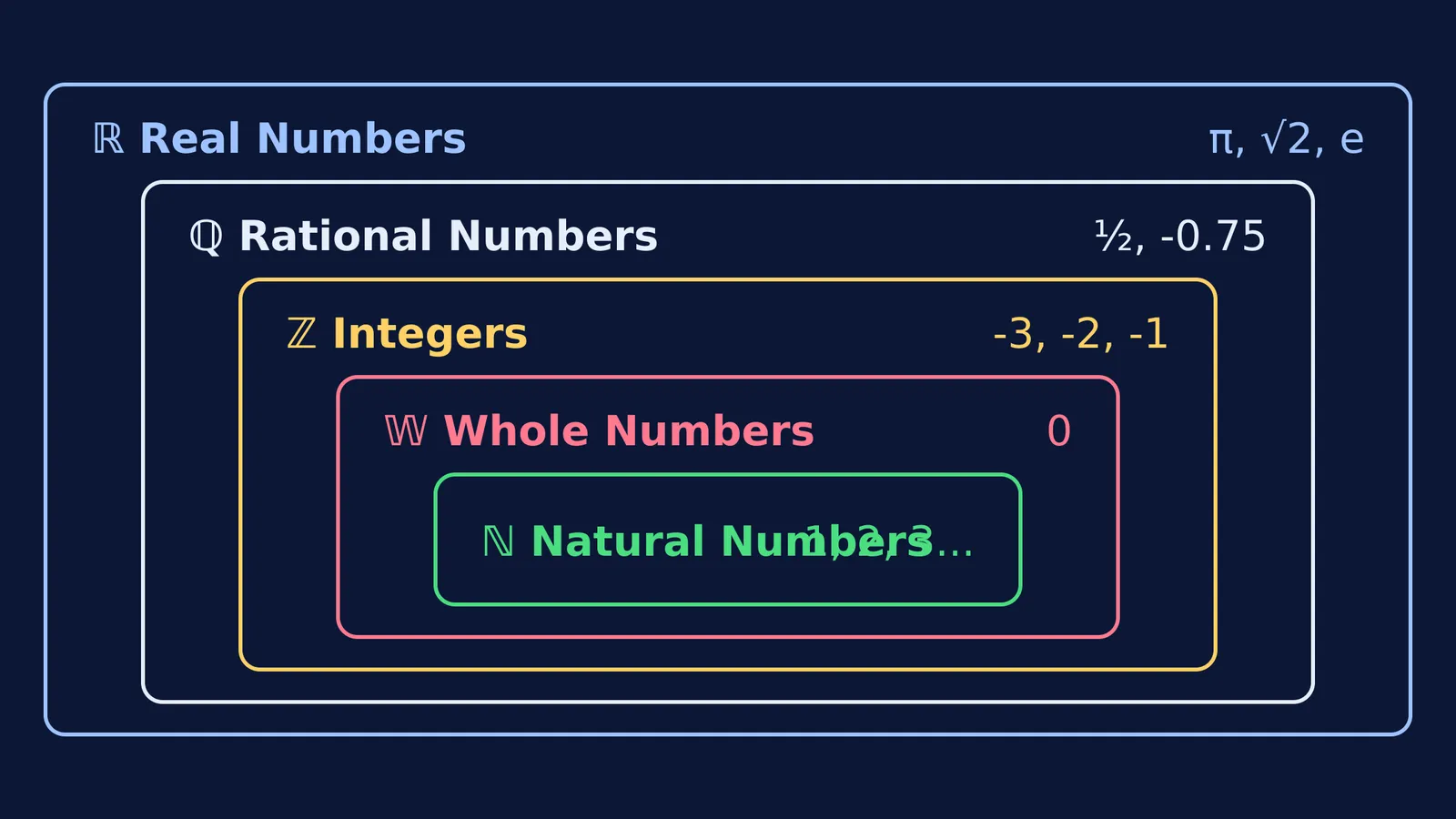
The number sets build on each other like nesting boxes. Every time you move to a larger set, you add a new type of number to the collection, expanding what you can calculate.
Natural numbers (N): These are the counting numbers. When you count physical objects like apples or chairs, you naturally start at one. The set is {1, 2, 3, 4, ...}.
Whole numbers (W): This set simply adds zero to the natural numbers. It represents counts of whole things, including the complete absence of things. The set is {0, 1, 2, 3, ...}.
Integers (Z): This set expands the whole numbers by including negative numbers. It allows us to represent concepts like debt or temperatures below freezing. The set is {..., -3, -2, -1, 0, 1, 2, 3, ...}.
To complete the picture, rational numbers (Q) include any number that can be written as a fraction of two integers (where the denominator is not zero), such as ½ or -0.75. Real numbers (R) include all of these plus irrational numbers like π and √2, filling in the gaps to create a continuous number line.
Where do the symbols N, W, Z, Q and R come from?
The letters come from the European languages of the mathematicians who formalised these sets in the 19th and 20th centuries:
N (Natural): From the Latin *naturalis*.
W (Whole): The English word "whole". It is mostly used in early school textbooks and is rarely seen in advanced international mathematics.
Z (Integers): From the German word *Zahlen*, meaning "numbers" or "to count".
Q (Rational): From the Italian word *quoziente*, meaning "quotient" (a fraction).
R (Real): For real numbers, distinguishing them from imaginary numbers.
Why do some textbooks say zero is a natural number?
If you check the International Organization for Standardization's rules for mathematics (ISO 80000-2), you will find that it officially defines natural numbers as starting from zero: {0, 1, 2, 3, ...}. So why do school textbooks start at 1?
The split happened as mathematicians tried to write down the fundamental rules of numbers.
The Peano axioms: In 1889, the Italian mathematician Giuseppe Peano published a set of rules for natural numbers starting at 1. However, he later realised that starting at zero made the logical rules for addition and multiplication cleaner, and he changed his definition to include 0.
The Bourbaki group: In the 1930s, a highly influential group of French mathematicians writing under the name Nicolas Bourbaki built mathematics from set theory. In set theory, numbers represent the sizes of sets. Because the simplest set is the empty set (which has exactly 0 elements), Bourbaki defined zero as the first natural number.
Today, fields like computer science, logic and set theory start natural numbers at 0, while school algebra and number theory usually start at 1. In India, most school boards use "natural numbers" for counting starting at 1, and introduce "whole numbers" to explicitly include zero.
If you are unsure which convention your textbook uses or have other concept gaps, the Fermi Concept Library has a lesson on every concept in mathematics and its place in the map.
How can you remember which set to use?
When reading a math problem, look for context clues to understand which numbers are allowed:
"Positive integers": Means strictly greater than zero (1, 2, 3...). This is the clearest way to describe counting numbers without any ambiguity.
"Non-negative integers": Means zero and positive integers (0, 1, 2...). This is the safest way to describe whole numbers in advanced maths.
Counting objects: If a problem asks for the "number of coins" or "number of people", it strongly implies natural numbers starting from 1.
Measuring changes: If a temperature drops below zero, or a bank account is overdrawn, you need to use integers to represent the negative values.
If you are helping a young learner grasp these ideas visually, see our guide on subtracting negative integers for practical examples. For older students, the next step is understanding how these sets sit densely together on the number line, such as how to find rational numbers between two rational numbers.


