

On this page
When you first learn subtraction, you naturally picture it as taking away physical objects or stepping backwards. If you have 5 apples and take away 3, you have 2 apples left. This physical model works cleanly for tangible items. But what does it mean to take away a negative quantity? You cannot hold negative three apples in your hand. This is where arithmetic ceases to be about counting physical items and becomes an abstract system of directions, signs, and balanced quantities.
Research published in *Mathematics Teaching in the Middle School* shows that transitioning from whole numbers to integer addition and subtraction is one of the first major roadblocks students encounter when learning algebra (Ponce, 2007). Without an intuitive grasp of integers on the number line, higher-level topics like equations and inequalities with modulus or quadratic word problems turn into a maze of sign errors. When you lose track of a single minus sign, an entire algebraic derivation collapses.
Why is subtracting a negative number the same as adding?
The most direct mathematical rule to remember is that subtracting any number is identical to adding its additive inverse.
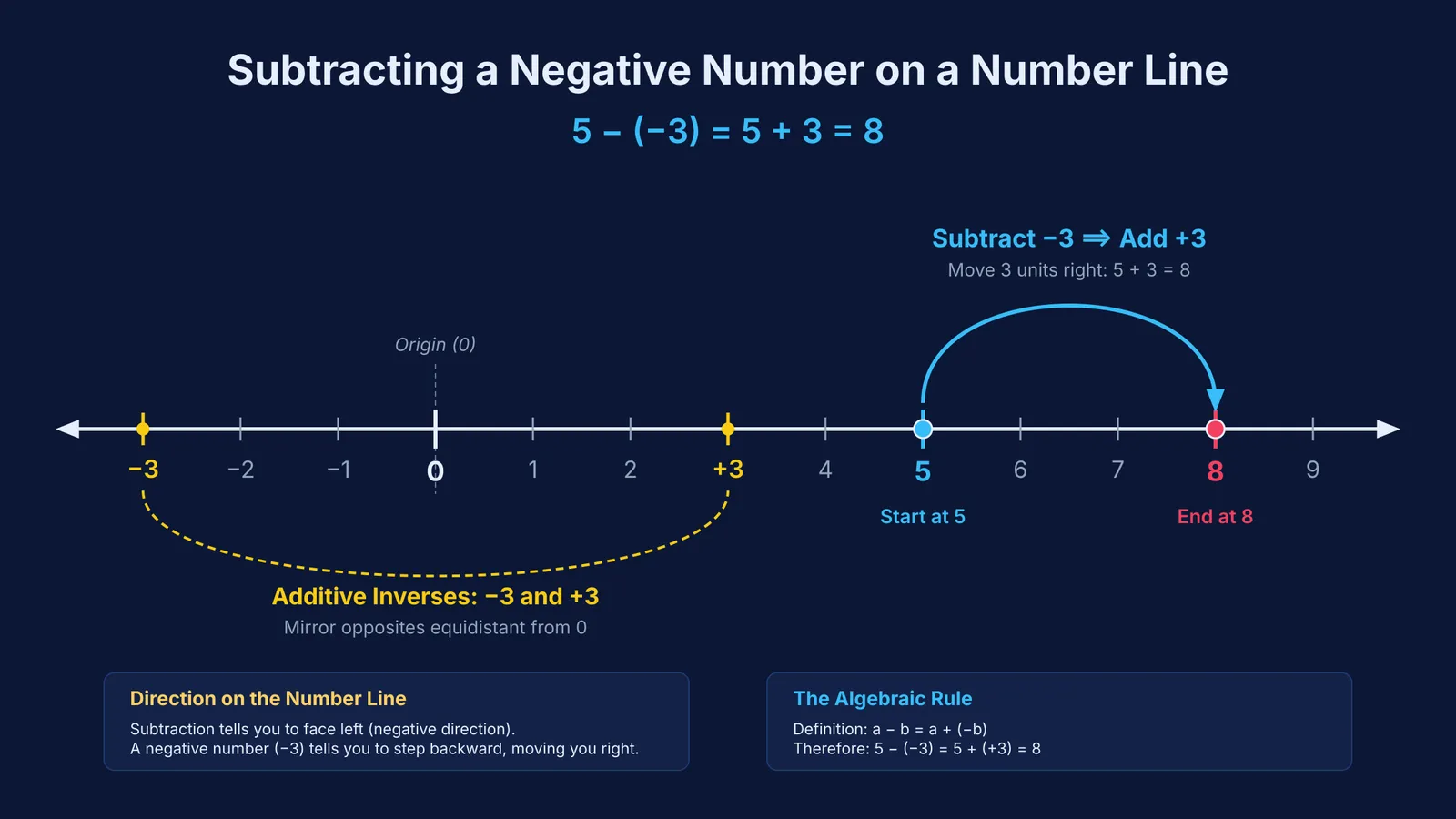
The additive inverse of a number is what you must add to it to get zero. Geometrically, it is that number's mirror image across zero on the number line. The additive inverse of 3 is −3, because 3 + (−3) = 0. Likewise, the additive inverse of −3 is +3, because −3 + 3 = 0.
In algebra, subtraction `a − b` is formally defined as adding the additive inverse of `b`: `a + (−b)`. Therefore, subtracting −3 means adding its additive inverse, +3. This turns the expression `5 − (−3)` directly into `5 + 3 = 8`. The two minus signs do not disappear arbitrarily; taking the negative of a negative value yields a positive quantity.
How does subtracting a negative look on a number line?
If the additive inverse feels abstract, a number line provides clear physical intuition. Picture a line where positive numbers lie to the right and negative numbers lie to the left.
Locate your start: For `5 − (−3)`, place your marker at 5.
Read the operator: The middle minus sign denotes subtraction. Subtraction tells you to turn and face left, towards negative numbers.
Read the number's sign: The value being subtracted is −3. A negative sign tells you to walk backwards rather than forward.
Think about your resulting motion: if you face left and walk backwards 3 steps, you actually travel to the right! Stepping backwards while facing left carries you from 5 past 6 and 7, landing directly on 8. This spatial intuition matches the arithmetic rule exactly.
How to avoid sign errors in longer expressions?
In competitive exams like JEE, long calculations in physics and chemistry are filled with negative values. For example, finding changes in potential energy or enthalpy (ΔH) relies on the formula 'final minus initial.' If your initial state is already negative, you must calculate expressions like `−50 − (−120)`.
Here is a reliable three-step checklist to keep your signs straight under exam conditions:
Enclose negative values in brackets: When substituting negative numbers into a formula, place brackets around them immediately. Writing `ΔU = U_final − (U_initial)` prevents adjacent minus signs from blurring together.
Resolve double negatives into addition immediately: Before doing mental arithmetic, scan your written line. Whenever you spot a subtraction next to a negative, `− (−x)`, rewrite it at once as `+ x`.
Combine terms from left to right: In an expression like `−6 − (−4) + 7 − 9`, rewrite it first as `−6 + 4 + 7 − 9`. Then evaluate step by step: `−6 + 4 = −2`, then `−2 + 7 = 5`, and finally `5 − 9 = −4`.
If you need to strengthen your foundation, the Fermi Concept Library covers every concept in mathematics with its own lesson and its place in the map, from integer arithmetic to algebra. For guided practice, the Fermi Problem Library has worked problems with a step-by-step solver that explains the reasoning rather than printing an answer, helping you spot exactly where a sign error occurred in a longer derivation.
Once the additive inverse becomes an automatic habit, negative numbers stop being a source of careless mistakes and become an intuitive tool you can trust.


