

On this page
When you are asked to identify whether an expression is a polynomial, you do not need to memorise long lists of complex algebraic forms. Instead, you only need to look at what happens to the variable.
The test for a polynomial comes down to checking the powers (exponents) of the variable. By looking for three specific red flags—negative powers, fractional powers, and variables in the denominator—you can quickly rule out expressions that fail the test and identify the ones that pass.
What makes an expression a polynomial?
A polynomial is defined by strict rules about what operations are allowed. "In mathematics, a polynomial is a mathematical expression consisting of indeterminates (also called variables) and coefficients, that involves only the operations of addition, subtraction, multiplication and exponentiation to nonnegative integer powers, and has a finite number of terms" (Wikipedia).
The key phrase is "nonnegative integer powers". This means the exponents of your variable (like x or y) must be whole numbers: 0, 1, 2, 3, and so on.
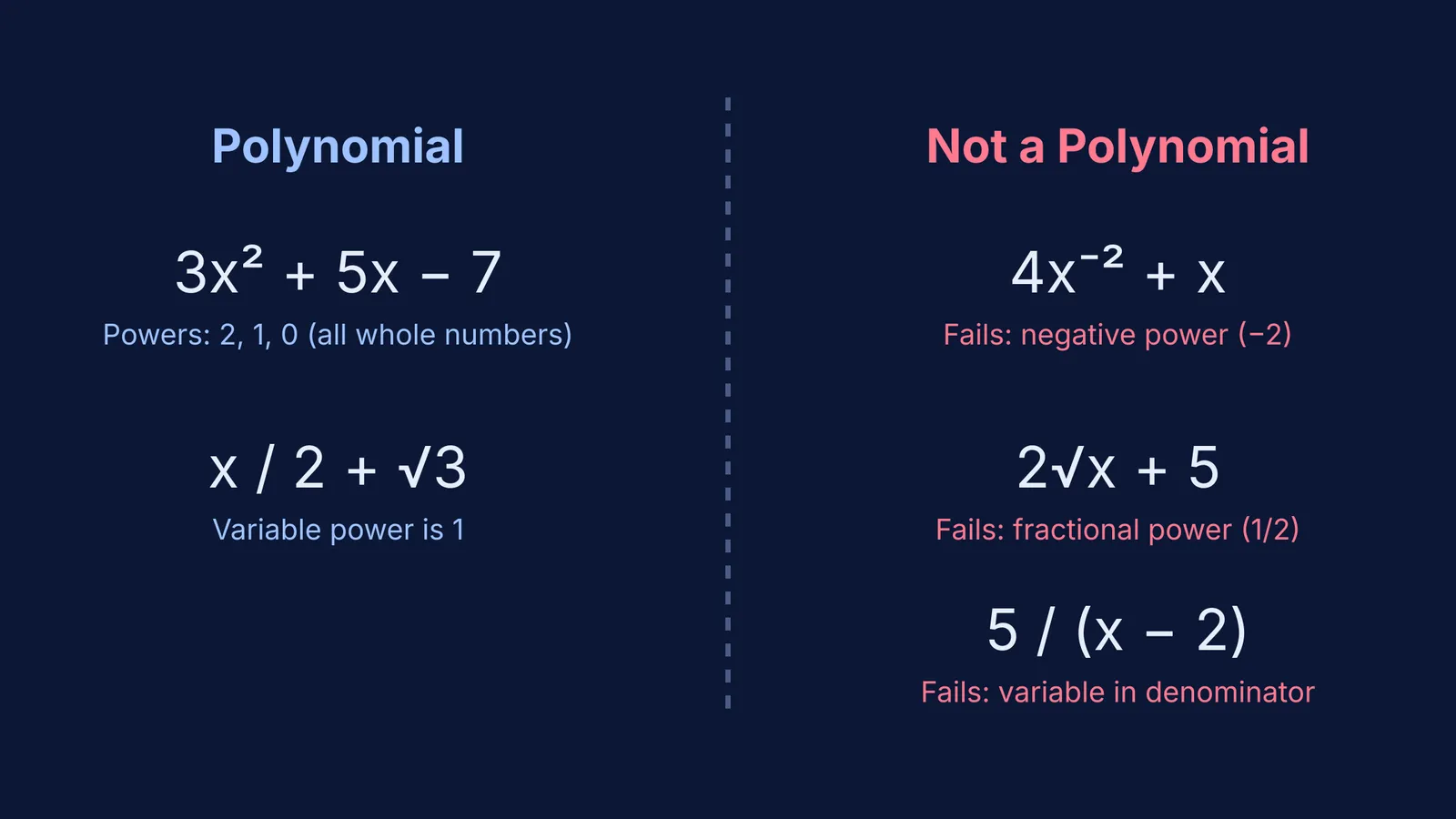
For example, 3x² + 5x − 7 is a polynomial. The powers of x are 2, 1, and 0. Even an expression like x/2 + √3 is a polynomial, because the strict rules apply only to the variable, while the coefficients can be fractions or irrational numbers.
This definition exists so that polynomials remain mathematically predictable. Because they only involve addition, subtraction, multiplication, and positive whole-number powers, you can substitute any real number for x and always get a real number back. You never have to worry about dividing by zero or taking the square root of a negative number, which can cause equations to break down.
Which expressions are not polynomials?
To fail the polynomial test, an expression must break the rule about whole-number powers. Here are the three main types of expressions that are not polynomials:
Variables in the denominator. An expression like 1/x or 5/(x − 2) is not a polynomial. A variable in the denominator is mathematically equivalent to a negative power (since 1/x equals x⁻¹). This creates a discontinuity where x equals zero, breaking the predictable nature of a polynomial.
Negative powers. Expressions written explicitly with negative exponents, such as x⁻² + 3x, fail the test immediately because the powers must be zero or positive.
Fractional powers. Any expression where the variable is trapped inside a root, such as √x or x^(1/2), is not a polynomial because the power is a fraction, not an integer.
How to check if an expression is a polynomial?
When facing a tricky expression in an exam, use this practical three-step checklist to ensure you do not get caught out by hidden terms:
Simplify the expression first. Sometimes an expression hides its true form. For example, (x² − x) / x might look like it has a variable in the denominator, but it simplifies to x − 1 (for x ≠ 0), which is a valid polynomial. Always expand brackets and cancel common terms before making a decision.
Check the variable's location. Look for the variable inside square roots, cube roots, or in the denominator of a fraction. If it is in any of these places after simplification, it fails the test.
Check the exponents. Ensure every power attached to the variable is a positive whole number or zero.
What are common exam traps with polynomials?
Examiners often try to trick students by mixing up the rules for coefficients with the rules for variables. Here are two common traps that appear in tests:
Irrational constants: An expression like √2 x² + 5 is a perfect polynomial. The square root is on the number 2, not on the variable x.
Pi and other constants: Expressions like πx² or x / π are polynomials. Pi is just a constant number, so dividing x by it does not violate the rule against variables in the denominator.
If you are practising algebra and keep getting stuck on why certain expressions fail these tests, the step-by-step solver in the Fermi Problem Library explains the reasoning behind each algebraic rule rather than just printing an answer.


