

On this page
In Class 9 Mathematics, the rules for polynomials are usually straightforward: look for the highest power of the variable, and that is your degree. But when you are asked about the constant 0, the standard rules break down.
If you are facing a multiple-choice question in an exam, the short answer is that the degree of the zero polynomial is undefined. Here is why this specific number gets its own rule, and how it differs from other constants.
What is the degree of a constant polynomial?
To understand the zero polynomial, we first need to look at normal numbers. A polynomial consisting of only a non-zero constant (such as 5, −2, or π) is called a constant polynomial.
The degree of a non-zero constant polynomial is 0 (NCERT).
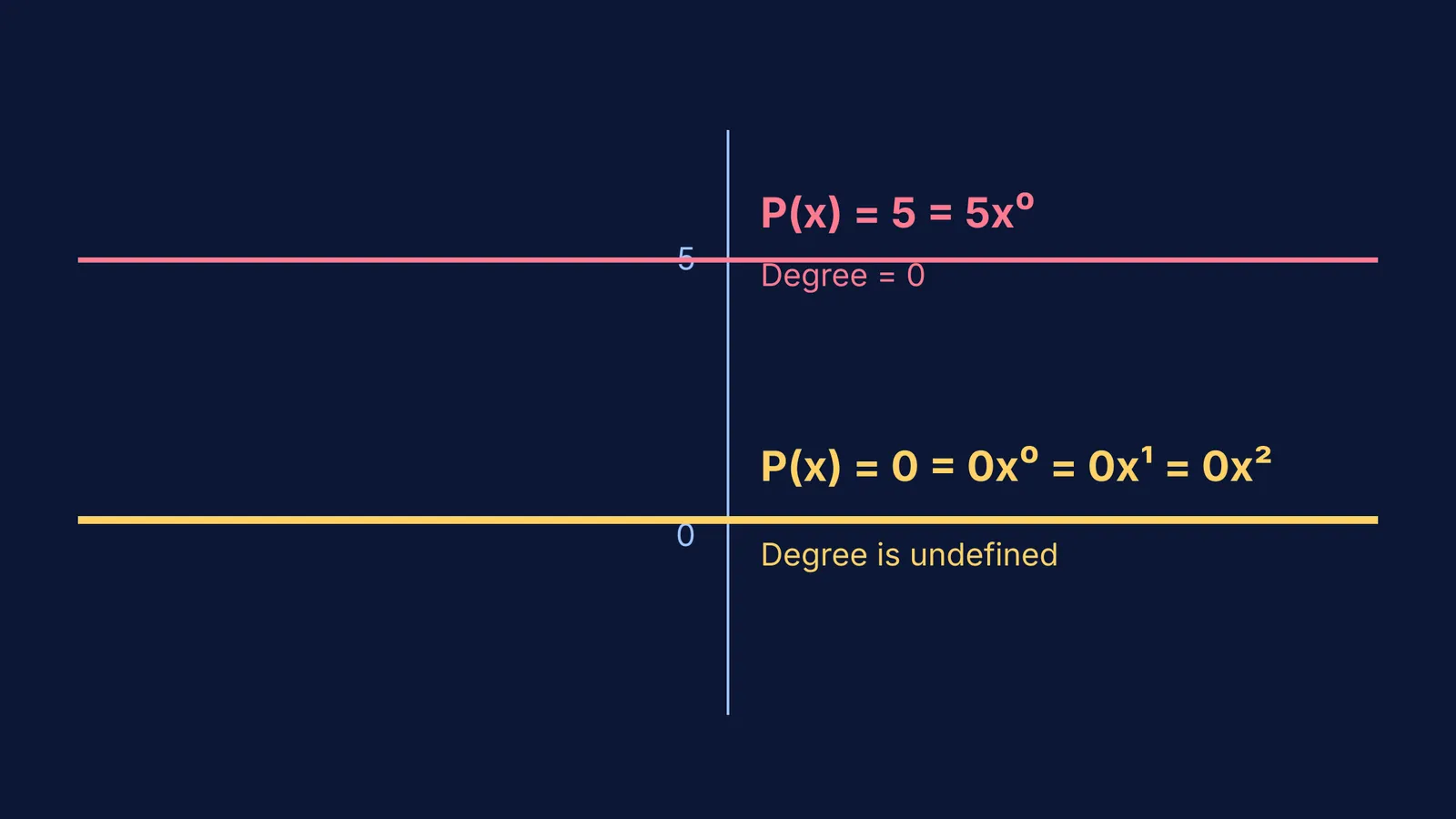
This works because you can write any non-zero number alongside the variable x raised to the power of 0. Since x⁰ = 1 for any non-zero x, multiplying by it changes nothing. For example, the number 8 can be written as 8x⁰. The highest power of the variable is 0, making its degree exactly 0.
What is the degree of zero polynomial?
The constant polynomial 0 is given a special name: the zero polynomial (Cuemath). Unlike the others, its degree is not 0.
The degree of the zero polynomial is undefined (Cuemath).
This trips up many students who assume that because 0 is a constant, it must follow the same rule as 8 or 5. But mathematics treats 0 differently because it absorbs any power of x you attach to it.
If you are confused by definitions like this, the Fermi Concept Library covers every concept in physics, chemistry, biology, mathematics and computing, each with its own lesson and its place in the map.
Why is the degree of zero polynomial not defined?
The degree of a polynomial is the highest power of the variable with a non-zero coefficient. For the zero polynomial, every coefficient is zero, which breaks the standard definition.
Because 0 multiplied by anything remains 0, you can rewrite the zero polynomial in an infinite number of ways (Cuemath):
P(x) = 0x⁰ (which looks like degree 0)
P(x) = 0x¹ (which looks like degree 1)
P(x) = 0x² (which looks like degree 2)
Since the power of the variable can be any whole number without changing the value of the polynomial, there is no unique highest power. Therefore, mathematicians and curriculum boards agree that the degree cannot be defined.
Assigning it a degree would also conflict with how a polynomial's degree determines the maximum number of solutions it can have (Cuemath). The polynomial P(x) = 0 is zero for every possible value of x, meaning it has an infinite number of solutions.
When working through Class 9 MCQs, if you get stuck on a tricky expression or exception like this, the Fermi Problem Library has worked problems with a step-by-step solver that explains the reasoning rather than printing an answer.
How to find the degree of any polynomial
You can avoid careless mistakes by following a simple mental checklist when you see a polynomial question. Just ask yourself what type of expression you are looking at:
Is it exactly 0? It is the zero polynomial. The degree is undefined.
Is it a number other than 0? It is a non-zero constant polynomial (like 12 or −7). The degree is 0.
Does it have a variable? Look at all the terms and find the highest exponent on the variable. For example, in 4x³ − 2x + 1, the highest power is 3, so the degree is 3.
Understanding how the highest power behaves is critical for later topics, such as evaluating limits at infinity of rational functions or determining the range of a rational function. By pinning down the definitions in Class 9, you build a solid foundation for the algebra ahead.


