

On this page
How do you find the number of zeros of a polynomial from its graph?
When you look at the graph of a polynomial, the horizontal x-axis acts as your counting line. To find the number of real zeros, you simply count the number of x-intercepts. As defined by the OpenStax Precalculus textbook, "if f is a polynomial function, the values of x for which f(x) = 0 are called zeros of f."
Because the y-value is strictly zero along the x-axis, every intersection is a real solution to the polynomial equation. For example, imagine a standard Cartesian coordinate system. If you graph a linear equation like y = 2x - 4, you will see it crosses the x-axis exactly once at x = 2. Therefore, it has exactly one real zero. A quadratic equation, which draws a U-shaped parabola, might cross the axis twice, meaning it has two real zeros. These simple visual checks are the first step in understanding the underlying algebra of any function.
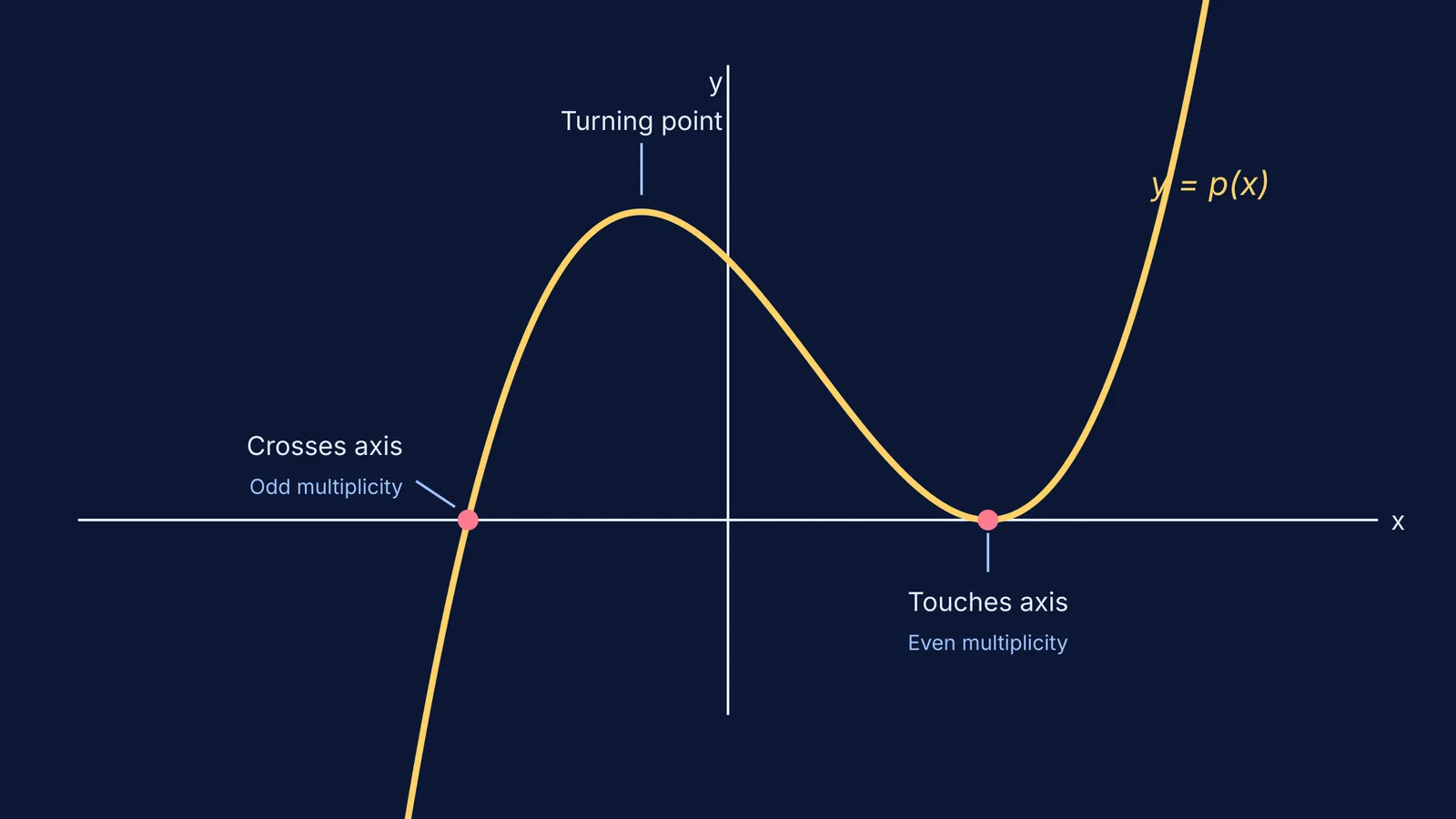
This counting method holds true whether you are counting intersections of two sketched curves or analysing a single polynomial. You can also cross-check your count by looking at the "humps" or turning points in the curve. A turning point is where the graph changes from rising to falling, or vice versa. The mathematical rule here is that "a polynomial of degree n will have at most n - 1 turning points" OpenStax. If you see three turning points, you know the polynomial must have a degree of at least four, which means it can have up to four zeros.
However, just counting the physical contact points does not always give you the full mathematical picture. You also have to pay attention to *how* the graph touches the axis.
Why does touching the x-axis still count as a zero?
Sometimes, a graph does not slice cleanly through the x-axis. Instead, it reaches down, touches the axis at a single point, and turns back around. This still counts as a zero, but it behaves differently due to a property called multiplicity.
Multiplicity is defined as "the number of times a given factor appears in the factored form of the equation of a polynomial" OpenStax. The way the graph meets the axis tells you about this underlying algebra:
Crossing the axis: "The graph will cross the x-axis at zeros with odd multiplicities," such as 1, 3, or 5. A straight crossing usually indicates a multiplicity of 1.
Touching the axis: "The graph of a polynomial function will touch the x-axis at zeros with even multiplicities," such as 2, 4, or 6.
This means that a point where the graph bounces off the axis is counted as a "double root" (or multiplicity of 2) rather than just one independent zero. As the textbook notes, "the sum of the multiplicities is the degree of the polynomial function."
To picture this, think of the function y = (x - 3)². If you set the y-value to zero, the only solution is x = 3. However, because the factor (x - 3) is squared, this single location represents a double root. On the graph, the parabola descends, its vertex perfectly grazes the x-axis at the point where x = 3, and then it curves back upward. Because the vertex sits exactly on the axis, we count it as a zero with an even multiplicity. If the power were three, like y = (x - 3)³, the graph would cross the line but flatten out significantly as it passes through, indicating an odd multiplicity of 3.
What if the graph never meets the x-axis?
Not all polynomials have real zeros. A classic example is the quadratic function y = x² + 1. Because any real number squared is positive or zero, adding 1 ensures the y-value is always at least 1. If you draw it, the entire parabola floats above the x-axis, meaning it never intersects the zero line. This is a standard test for when a quadratic is positive for all x.
So, how many zeros does it have? According to the Fundamental Theorem of Algebra, a polynomial always has a total number of zeros equal to its highest power (its degree). However, if the graph does not meet the x-axis, those zeros are not real numbers. They are complex zeros involving imaginary numbers, which do not show up as x-intercepts on a standard Cartesian graph. When you encounter a graph floating above or completely submerged below the horizontal axis, it is visually telling you that no real number will solve the equation f(x) = 0. The roots still exist mathematically, but they require moving into the complex plane, which standard graphs do not display.
How can you make sense of polynomial graphs?
Translating between algebraic equations and their visual graphs takes practice. If you are struggling to match the multiplicity of a factor to its turning points or figuring out when two quadratics share a root, the Fermi Concept Library can help you build that intuition.
When you bring a topic or a specific polynomial problem to Fermi, the AI tutor does not just print the final count. Instead, Fermi works out what you already know, builds a plan for the session, and teaches through it — writing on a board, drawing the figure, running the simulation, and checking understanding as it goes. It is a more active way to learn how the algebra controls the shape of the curve.


