On this page
A question that turns up in Class 12 chemistry and JEE Main practice: an aqueous ethanol solution has a mole fraction of ethanol of 0.2; find its molality and molarity. It looks like three different worlds (moles, kilograms, litres), but it is one chain of conversions, and only the last step needs a number you cannot work out from a formula.
What do mole fraction, molality and molarity each measure?
NCERT's Class 12 chapter on solutions defines all three:
Mole fraction (x) is the moles of a component divided by the total moles of all components, so the mole fractions in a mixture add up to 1.
Molality (m) is the moles of solute per kilogram of solvent.
Molarity (M) is the moles of solute per litre of solution.
The same NCERT chapter notes that mole fraction and molality do not depend on temperature, while molarity does, because volume changes with temperature and mass does not. We go through the reason in why molality does not change with temperature but molarity does.
That difference tells you the route. Mole fraction to molality is pure arithmetic with molar masses. Molality to molarity needs the density.
How do you convert mole fraction to molality?
Pick a basis that keeps the numbers easy: 1 mol of solution in total. For molar masses, the NIST Chemistry WebBook lists ethanol at 46.0684 g/mol and water at 18.0153 g/mol.
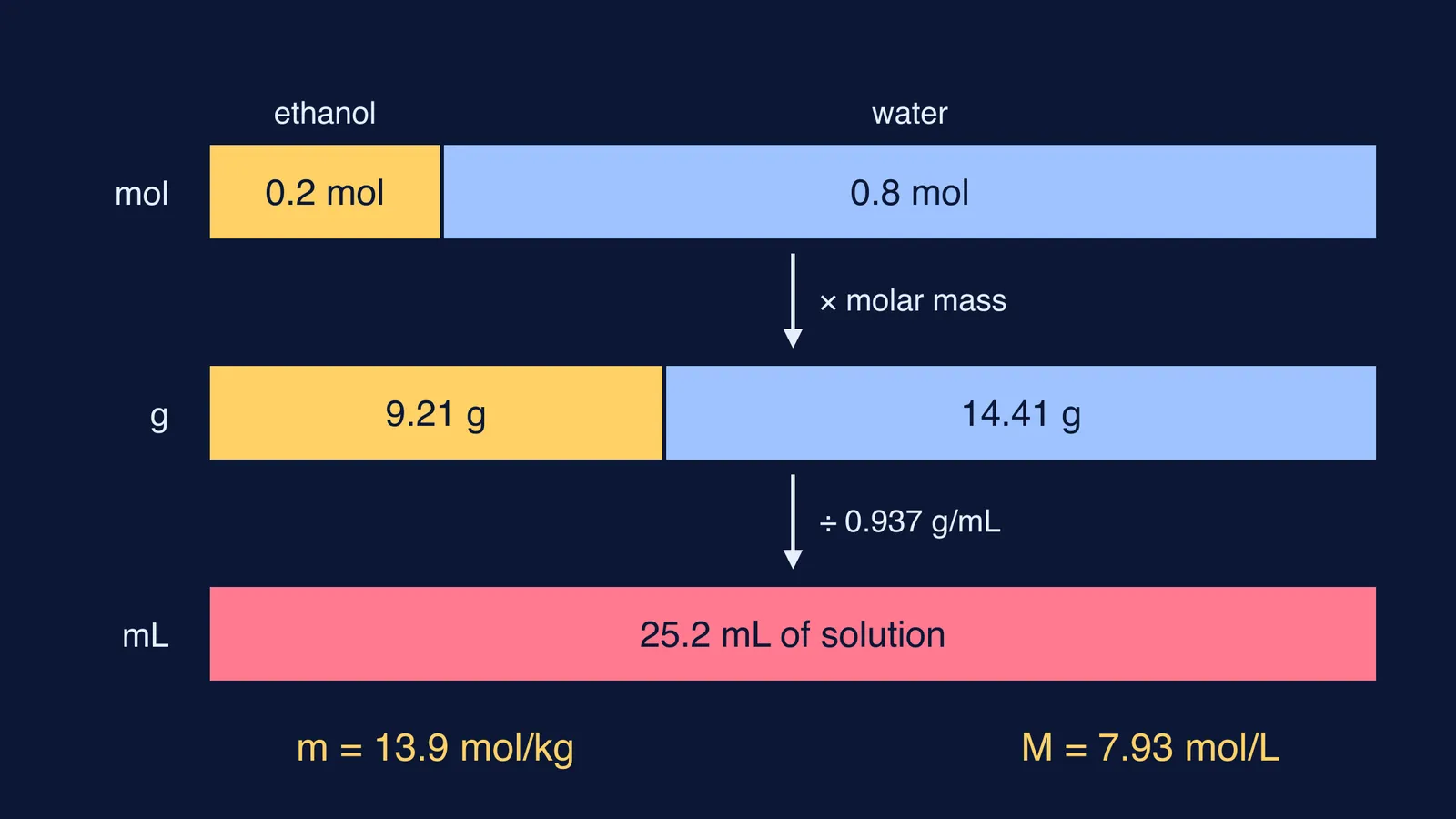
Moles: x(ethanol) = 0.2, so 1 mol of solution holds 0.2 mol of ethanol and 0.8 mol of water.
Mass of solvent: 0.8 mol × 18.0153 g/mol = 14.41 g of water = 0.01441 kg.
Molality: 0.2 mol ÷ 0.01441 kg = 13.9 mol/kg.
The same steps collapse into a one-line formula you can check your answer with: m = 1000 × x(solute) ÷ [x(solvent) × M(solvent)], with the solvent's molar mass in g/mol. Here, 1000 × 0.2 ÷ (0.8 × 18.0153) = 13.88 mol/kg. If your book uses 18 g/mol for water, you get 13.89; the difference is rounding, not a mistake.
How do you get molarity from molality using density?
Molarity divides by litres of solution, so you need the volume of the solution. Use the density of the mixture itself, not the density of water or of pure ethanol.
Mass of solution, using ethanol's NIST molar mass: (0.2 × 46.0684) + 14.41 = 9.21 g + 14.41 g = 23.63 g.
Mass percentage of ethanol: 9.21 ÷ 23.63 × 100 = 39.0%.
Density: a table of ethanol and water densities from Perry's Chemical Engineers' Handbook, reproduced by HandyMath, gives 0.93720 g/mL for 39.0% ethanol by mass at 20 °C.
Volume: 23.63 g ÷ 0.9372 g/mL = 25.21 mL = 0.02521 L.
Molarity: 0.2 mol ÷ 0.02521 L = 7.93 mol/L.
Check it with the direct formula M = 1000 × ρ × m ÷ [1000 + m × M(solute)], with ρ in g/mL and the solute's molar mass in g/mol: 1000 × 0.9372 × 13.88 ÷ (1000 + 13.88 × 46.07) = 7.93 mol/L. In an exam the density is given in the question; the steps stay the same.
Where do students lose marks on this conversion?
Dividing by the mass of solution instead of the mass of solvent for molality. Here that gives 0.2 ÷ 0.02363 = 8.46, which is wrong.
Forgetting to convert grams to kilograms, or millilitres to litres: an error of 1000 either way. The unit factor method, with units written on every line, catches both.
Using 1 g/mL for the density. That makes the volume 23.63 mL and the molarity the same wrong 8.46, instead of 7.93.
For more practice turning a concentration into moles per litre, see how to convert strength in g/L to molarity.
Where can you practise conversions like this?
If you set up the chain but still land on a different number, the Fermi Problem Library has worked problems with a step-by-step solver that explains the reasoning rather than printing an answer, so you can compare its steps with yours line by line. If the definitions themselves feel shaky, the Fermi Concept Library has every concept in physics, chemistry, biology, mathematics and computing, each with its own lesson.
Try it yourself next: run the same steps for a mole fraction of 0.1 ethanol. You should get a molality of 6.17 mol/kg.