

On this page
Say you make a glucose solution at 20 °C, label it, then heat it to 80 °C. Nothing leaves the beaker, but one of your labels is now wrong. The molarity has quietly dropped and the molality has not moved. Here is why, with real numbers, and why colligative formulas use molality.
What is the difference between molarity and molality?
Molarity (M) is the number of moles of solute in 1 litre of solution (OpenStax Chemistry 2e, section 3.3).
Molality (m) is the number of moles of solute per kilogram of solvent (OpenStax Chemistry 2e, section 11.4).
Molarity rests on a volume and molality rests on a mass, and everything else follows from that. If you need to switch between the two, our guide to converting molarity, molality and mole fraction without errors shows the steps.
Why does molarity change with temperature but molality does not?
When you heat most liquids, their particles move faster and spread out a little, so the same mass takes up more space. The mass of what is in the beaker stays the same, but its volume does not.
Water shows this clearly. Its density falls from 0.9982 g/mL at 20 °C to 0.9718 g/mL at 80 °C and 0.9584 g/mL at 100 °C, according to the water properties table in OpenStax Chemistry 2e. Lower density means the same kilogram of water fills more millilitres.
As the solution warms:
Moles of solute stay the same.
Kilograms of solvent stay the same, so molality stays the same.
Litres of solution go up, so molarity goes down.
OpenStax puts it directly: because molality is computed using only masses and molar amounts, it does not vary with temperature (OpenStax Chemistry 2e, section 11.4). Mole fraction and mass percent stay fixed for the same reason: neither has a volume in it.
Worked example: how much does molarity drift?
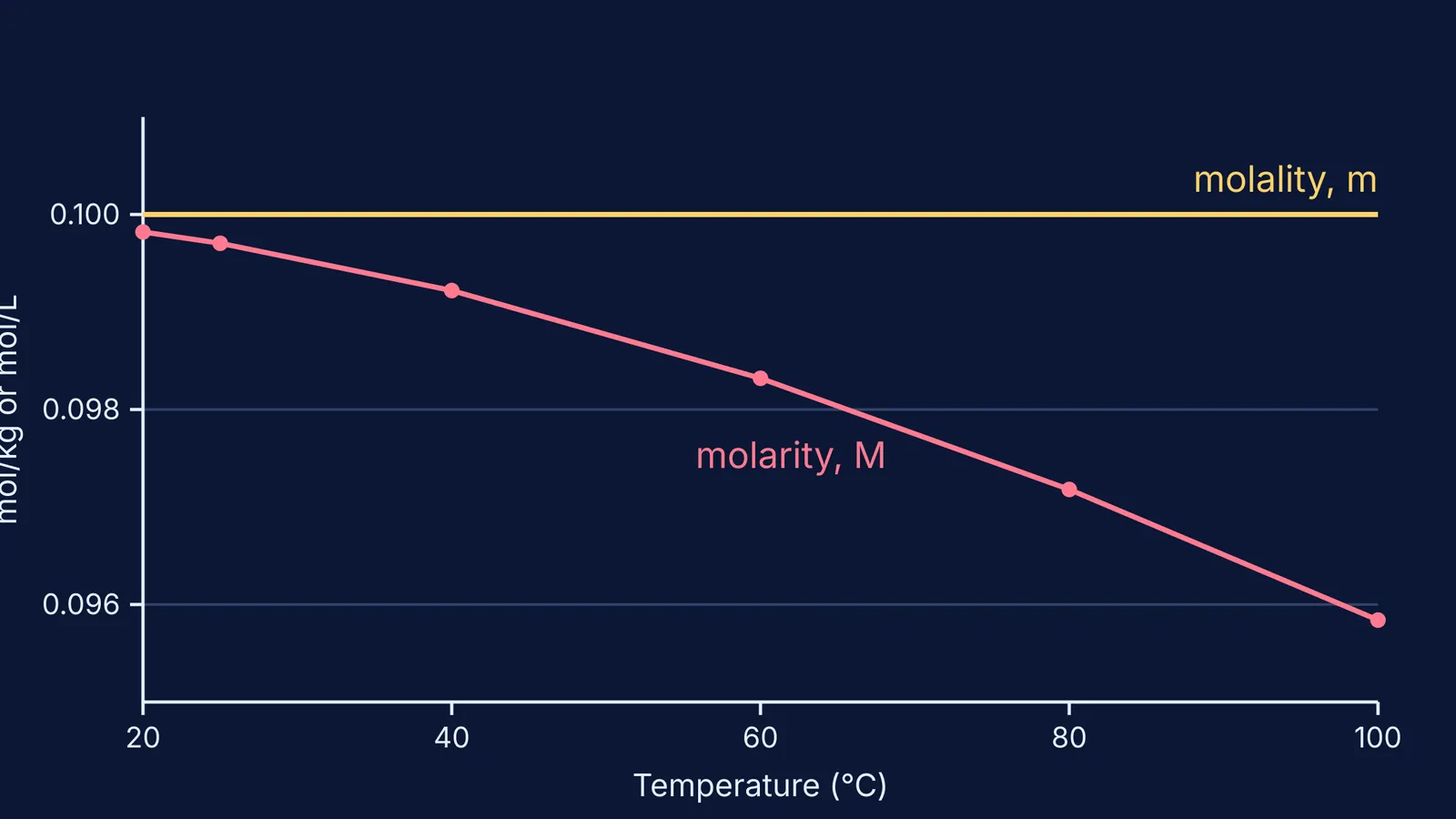
Take 0.100 mol of glucose dissolved in 1.000 kg of water. We treat the solution as dilute, so its volume is close to the volume of the water alone. A real solution's volume differs slightly, but the trend is the same. The densities come from the OpenStax water properties table.
Molality at any temperature: 0.100 mol ÷ 1.000 kg = 0.100 mol/kg.
At 20 °C the volume is 1000 g ÷ 0.9982 g/mL = 1001.8 mL, so molarity = 0.100 mol ÷ 1.0018 L = 0.0998 M.
At 80 °C the volume is 1000 g ÷ 0.9718 g/mL = 1029.0 mL, so molarity = 0.100 mol ÷ 1.0290 L = 0.0972 M.
At 100 °C the volume is 1000 g ÷ 0.9584 g/mL = 1043.4 mL, so molarity = 0.100 mol ÷ 1.0434 L = 0.0958 M.
Between 20 °C and 100 °C the molarity falls by about 4% even though no solute was added or removed. The molality stays at 0.100 mol/kg the whole time.
Why do colligative property formulas use molality?
Boiling-point elevation and freezing-point depression are measured at a different temperature from the one where you made the solution. The textbook formulas are ΔTb = Kb·m and ΔTf = Kf·m, where m is the molality (OpenStax Chemistry 2e, section 11.4). For water, the same source gives Kb = 0.512 °C/m and Kf = 1.86 °C/m.
Think about the experiment. You weigh solute and water at room temperature, then heat to boiling near 100 °C or cool towards 0 °C. If the formula used molarity, the concentration you wrote down would be out of date by the time you take the reading. A molality worked out at 20 °C is still correct at 100 °C.
For our 0.100 mol/kg glucose solution, ΔTb = 0.512 × 0.100 = 0.0512 °C and ΔTf = 1.86 × 0.100 = 0.186 °C. For more practice, try these boiling point elevation numericals using Kb and molality and this walk-through on finding molar mass from depression in freezing point.
How do you avoid molarity and molality mistakes in an exam?
Before you write the final answer:
Circle the unit you were given: mol/L means molarity, mol/kg means molality.
Ask whether the temperature changes in the question. If it does and you have molarity, you need the density at the new temperature to convert.
In ΔTb and ΔTf, divide by kilograms of solvent, not of solution. Dividing by the mass of the whole solution is an easy slip.
Sanity check: if your molarity went up when you heated a water solution above room temperature, something is upside down.
If you keep picking the wrong unit in numericals, the Fermi Problem Library has worked problems with a step-by-step solver that explains the reasoning rather than printing an answer. To revisit the idea itself, the Fermi Concept Library gives each chemistry concept its own lesson.
Next time you see a colligative formula, read the m as kilograms of solvent, which heating does not change.


