On this page
Your practical file asks for the "strength" of a sodium hydroxide solution in g/L. Your textbook and your exam speak in molarity. They carry the same information in two different units, and one number joins them: the molar mass of the solute.
What does "strength" mean in a chemistry practical?
In school titration work, strength is the mass of solute dissolved in one litre of solution, written in g/L. The NCERT Class 11 laboratory manual's titration unit asks you to find the "concentration (strength)" of a sodium hydroxide solution and gives the formula: concentration (strength) in g/L = molarity × molar mass.
The same NCERT unit defines molarity as the number of moles of solute dissolved in 1 litre of solution. So strength counts grams per litre, and molarity counts moles per litre.
How do you convert strength in g/L to molarity?
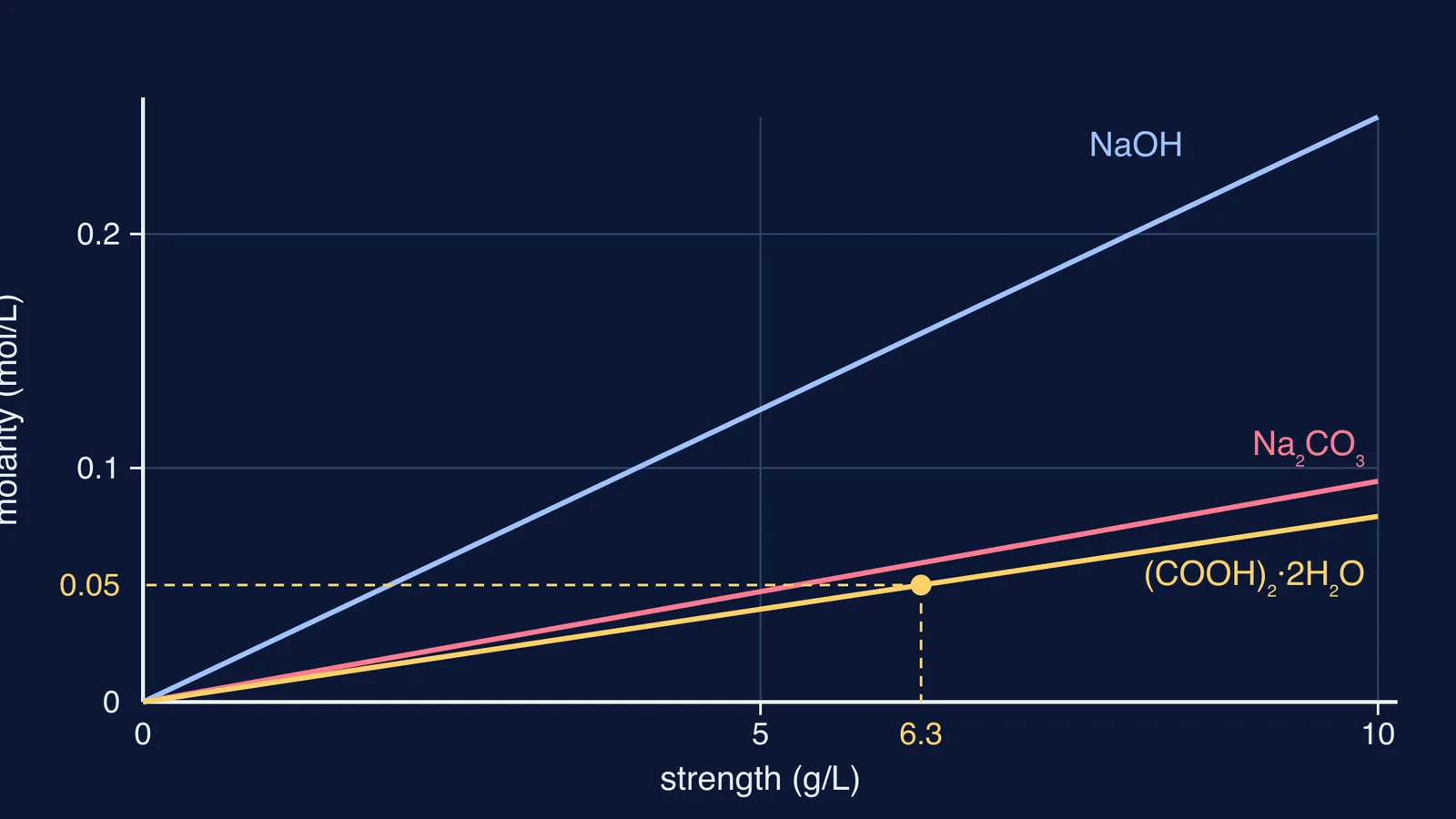
Divide strength by molar mass: molarity (mol/L) = strength (g/L) ÷ molar mass (g/mol). The units confirm it, because g/L divided by g/mol leaves mol/L.
Write the exact formula of the solute, including any water of crystallisation.
Find its molar mass in g/mol.
Divide the strength by the molar mass.
Check the unit: the answer should be in mol/L, often written M.
Step 1 is the easiest one to get wrong. The oxalic acid used in the practical is the dihydrate, (COOH)₂·2H₂O, and PubChem lists its molecular weight as 126.07 g/mol. Anhydrous oxalic acid has a molecular weight of 90.03 g/mol on PubChem.
Worked examples from the titration practical
Example 1: strength to molarity. You dissolve 6.3 g of oxalic acid dihydrate and make the solution up to 1 L, so its strength is 6.3 g/L. Molarity = 6.3 ÷ 126.07 = 0.04997, which rounds to 0.05 M, using the PubChem molecular weight.
Example 2: a different solute. A sodium carbonate solution has a strength of 5.3 g/L. PubChem gives sodium carbonate a molecular weight of 105.988 g/mol. Molarity = 5.3 ÷ 105.988 = 0.0500 M.
Example 3: molarity to strength, the NCERT way. The NCERT titration experiment titrates 10 mL of 0.1 M oxalic acid against sodium hydroxide, uses a₁M₁V₁ = a₂M₂V₂ with basicity a₁ = 2 for oxalic acid and acidity a₂ = 1 for NaOH, and gives the molar mass of NaOH as 40 g/mol. Suppose your concordant burette reading is 20.0 mL (a sample value, not from the manual).
M₂ = (2 × 0.1 × 10) ÷ (1 × 20.0) = 0.1 M
Strength = 0.1 × 40 = 4.0 g/L
The same manual asks you to calculate strength up to the fourth decimal place, so write 4.0000 g/L in the result.
If a titration answer keeps coming out wrong and you cannot see which step slipped, the Fermi Problem Library has worked problems with a step-by-step solver that explains the reasoning rather than printing an answer. For the full practical, see our walkthrough of the KMnO₄ and oxalic acid titration and how to make the standard solution you start from.
How do g/L and molarity map to SI units?
Of the two units in your practical file, only M is outdated. The NIST checklist for SI unit usage calls molarity an obsolete term, lists "molarity and the symbol M" as improper, and asks writers to use "amount-of-substance concentration of B", symbol c_B, with the SI unit mol/m³. Grams per litre is not on that list.
The conversions are simple because 1 m³ holds 1000 L:
1 mol/L = 1 mol/dm³ = 1000 mol/m³, so 0.05 M oxalic acid is 50 mol/m³.
1 g/L = 1 kg/m³, so 4.0 g/L sodium hydroxide is 4.0 kg/m³.
M, mol/L, mol L⁻¹ and mol dm⁻³ all describe the same quantity.
Your NCERT practical still uses g/L and M, so you do not need to switch. What matters is keeping the unit attached to every number. For the bigger picture of how molarity differs from molality and mass percent, read our guide to concentration, molarity and molality.
A 30-second check before you write the result
Did you use the hydrated formula if the bottle says hydrate?
Is your answer in mol/L for molarity and g/L for strength, never mixed?
Does the size make sense? The NCERT experiment uses 0.1 M oxalic acid, so an answer like 10 M for a bench solution points to a slip.
Going from molarity to strength, did you multiply; going from strength to molarity, did you divide?
If the idea of a mole itself still feels shaky, the Fermi Concept Library covers every concept in chemistry, each with its own lesson and its place in the map. Try Example 1 again with 3.15 g/L and see if you get 0.025 M.