

On this page
Many unit mistakes in chemistry are not maths mistakes. You know a litre is 1000 millilitres. The slip comes when you multiply where you should have divided, and nothing on the page warns you. The unit factor method makes the units themselves do the warning.
What is the unit factor method in chemistry?
The NCERT Class 11 chemistry textbook names it the "factor label method or unit factor method or dimensional analysis" in its first unit (NCERT, Some Basic Concepts of Chemistry). It starts from an equivalence such as 1 in = 2.54 cm. That gives two fractions, 1 in / 2.54 cm and 2.54 cm / 1 in, and each one equals 1.
A unit factor is a fraction whose top and bottom are the same quantity in different units, so it equals one (NCERT). Multiplying by one never changes a quantity. It only changes the unit it is written in.
The rule for choosing the fraction: the unit you want goes on top, the unit you want to remove goes on the bottom. Units then cancel like algebra symbols.
How do you convert litres to millilitres with unit factors?
The factor comes from the prefix. The SI prefix milli means 10⁻³ (NIST, Metric SI prefixes), so 1 L = 1000 mL.
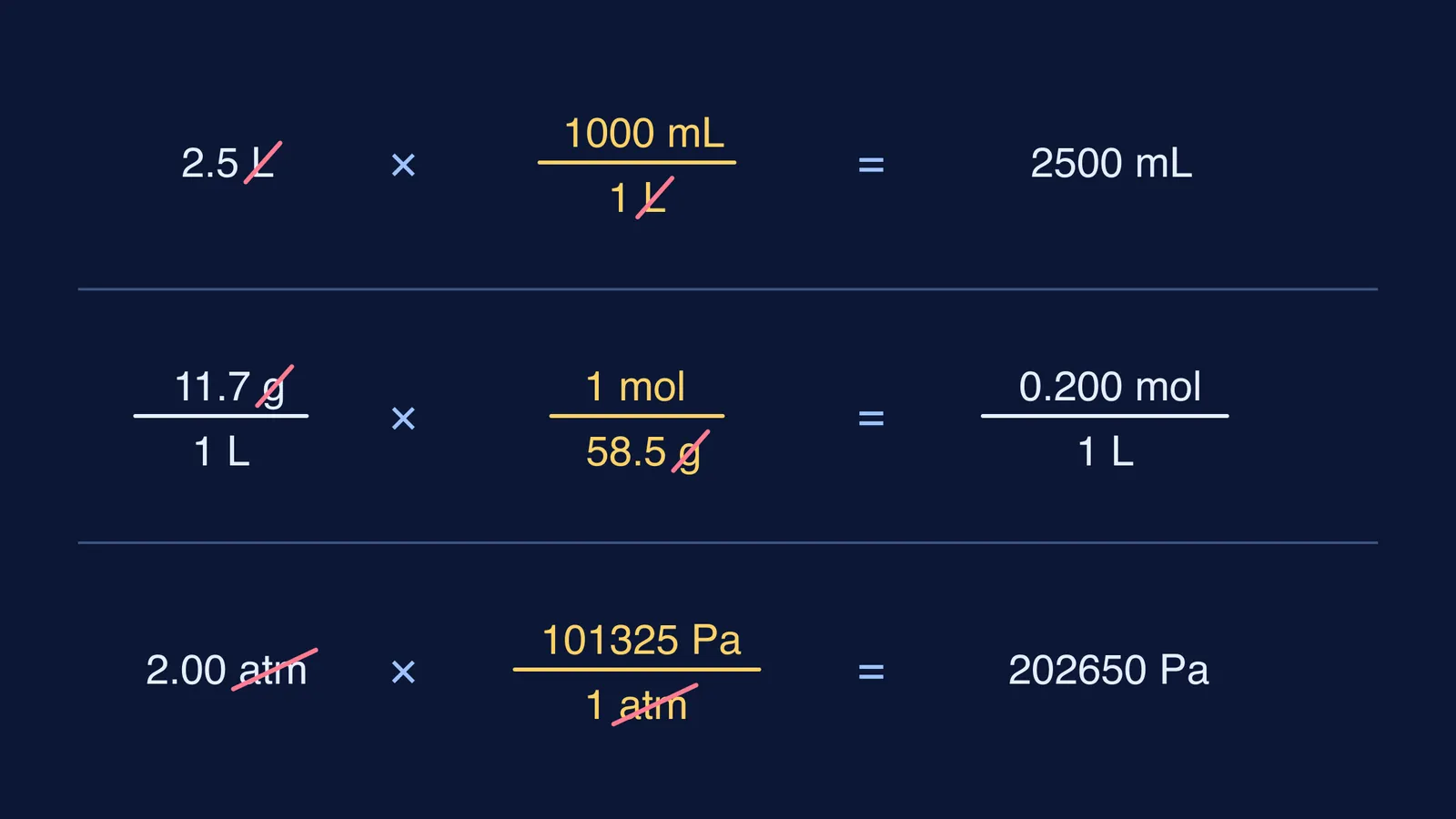
Convert 2.5 L to mL:
2.5 L × (1000 mL / 1 L) = 2500 mL
The L on top cancels the L on the bottom, and mL is left. Write the fraction upside down and you get 0.0025 L²/mL. That unit makes no sense, and it flags the error before you look at the number.
NIST lists 1 L = 1 dm³ = 10⁻³ m³ (NIST Guide to the SI, Chapter 5). NCERT works the 2 L-to-m³ case by cubing the factor 1 m / 100 cm, because a cubed unit needs a cubed factor. If cm³ and litres trip you up, our walk-through on converting cubic centimetres to litres for tank problems covers that case.
How do you convert g/L to mol/L?
Here the fraction equal to one comes from the substance, not from a prefix. NCERT uses 58.5 g as the mass of 1 mol of sodium chloride in its Problem 1.8 (NCERT). So for NaCl, 1 mol NaCl / 58.5 g NaCl equals one.
Molarity is the number of moles of solute in 1 litre of solution (NCERT). Suppose a solution holds 11.7 g of NaCl per litre:
(11.7 g NaCl / 1 L) × (1 mol NaCl / 58.5 g NaCl) = 0.200 mol/L
The grams cancel and mol per litre is left. Write the substance on every unit (g NaCl, not just g), as NCERT does with g N₂ and mol N₂, so you never cancel grams of one substance against grams of another. Run the same chain backwards and you get molarity from a bottle label, as in our post on the molarity of 98% sulphuric acid from its label.
If molarity or the mole itself still feels shaky, the Fermi Concept Library gives every chemistry concept its own lesson, so you can fix the idea before practising the conversion.
How do you convert atm to pascal?
One standard atmosphere is exactly 101,325 Pa. NIST's conversion table prints the factor 1.01325 × 10⁵ in bold, which it uses to mark exact factors (NIST Guide to the SI, Appendix B.8). The same table gives 1 bar = 10⁵ Pa, so 1 atm is slightly more than 1 bar. Don't swap the two.
Convert 2.00 atm to Pa:
2.00 atm × (101,325 Pa / 1 atm) = 202,650 Pa
An exact factor works like a counted number, which NCERT says has infinite significant figures. So 2.00, with three significant figures, sets the precision, and you report 2.03 × 10⁵ Pa.
A four-step check before you write the answer
Write the given quantity with its unit and substance, for example 11.7 g NaCl.
Write the equivalence you know: 1 L = 1000 mL, 1 mol NaCl = 58.5 g NaCl, or 1 atm = 101,325 Pa.
Turn it into the fraction that puts the unwanted unit on the bottom. Chain several in one line if needed, as NCERT does for 2 days × (24 h / 1 day) × (60 min / 1 h) × (60 s / 1 min) = 172,800 s.
Cross out units in pairs. If what remains is not the unit the question asks for, flip a factor before you touch the calculator.
Then check the size: converting to a smaller unit gives a bigger number, as 2.5 L became 2500 mL.
If powers of ten are the weak spot, try our ×10 ladder for converting km, m, cm and mm first. If you keep flipping the same factor in longer problems, the Fermi Problem Library has worked problems with a step-by-step solver that explains the reasoning rather than printing an answer, so you can see where each unit should cancel.
Tonight, solve three textbook questions with every unit written out and crossed off.


