

On this page
The concentrated sulphuric acid bottle in your school lab has everything you need to find its molarity: two numbers on the label and three lines of arithmetic. Here is the method, then the dilution step and the safety rule that go with it.
What does a reagent bottle label tell you?
A label or safety data sheet usually gives the assay as a mass percent and the density. A Fisher Scientific safety data sheet for sulphuric acid 90–98% lists the specific gravity/density as 1.84 and the molecular weight as 98.07.
The molar mass of H₂SO₄ is 98.08 g/mol, according to PubChem.
A label reading 98% means 98 g of H₂SO₄ in every 100 g of solution. That is 100 g of solution, not 100 mL, and this is where most mistakes start.
Molarity is the number of moles of solute in exactly 1 L of solution, as defined in this LibreTexts general chemistry chapter. So you need to get from "per 100 g" to "per litre". Density is the bridge.
How do you find the molarity of 98% sulphuric acid with density 1.84?
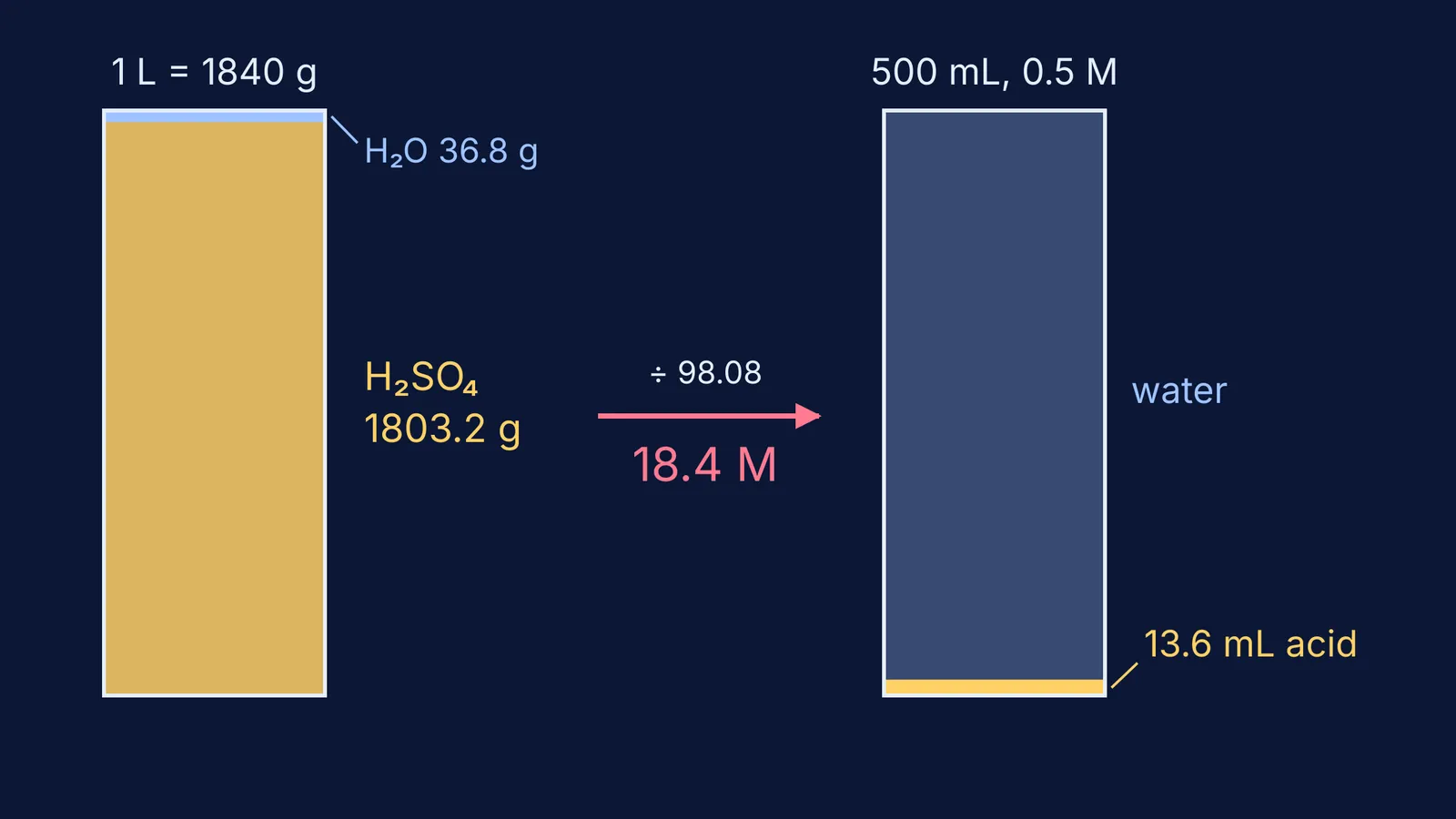
Take exactly 1 L (1000 mL) of the acid. The label gives 98% by mass, the safety data sheet gives a density of 1.84 g/mL, and PubChem gives the molar mass as 98.08 g/mol.
Mass of 1 L of solution = 1000 mL × 1.84 g/mL = 1840 g.
Mass of H₂SO₄ in it = 0.98 × 1840 g = 1803.2 g.
Moles of H₂SO₄ = 1803.2 g ÷ 98.08 g/mol = 18.4 mol, so the molarity is about 18.4 M.
The three lines fold into one formula: M = (10 × mass percent × density in g/mL) ÷ molar mass. Here, M = 10 × 98 × 1.84 ÷ 98.08 = 18.4. The 10 turns "per 100 g" into "per 1000 mL".
Molality comes from the same numbers. The 1840 g holds 1803.2 g of acid and only 36.8 g of water, so the molality is 18.4 mol ÷ 0.0368 kg, about 500 mol/kg. That is far from 18.4. If the gap surprises you, read our guide on converting between molarity, molality and mole fraction.
How much concentrated acid do you need to make a dilute solution?
Adding water does not change the moles of acid, so moles before = moles after, or M₁V₁ = M₂V₂ (the stock and dilute solutions in the LibreTexts chapter). Put in M₁ = 18.4 M from above.
500 mL of 0.5 M: V₁ = 0.5 × 500 ÷ 18.4 = 13.6 mL of concentrated acid.
1 L of 1 M: V₁ = 1 × 1000 ÷ 18.4 = 54.3 mL.
250 mL of 0.1 M: V₁ = 0.1 × 250 ÷ 18.4 = 1.36 mL.
Notice the wording: you dilute the acid *to* 500 mL. You do not add it to 500 mL of water. Volumes do not simply add when strong acid meets water, so you make the solution up to the mark on a volumetric flask. For problems that mix solutions as well as dilute them, see mixing and diluting solutions to find the final molarity. If a question asks for normality, H₂SO₄ gives two H⁺ ions; see molarity in titration using basicity.
Why must you add acid to water, never water to acid?
The Fisher Scientific safety data sheet warns that mixing with water gives off heat that "causes explosive spattering" and says: "Always add the acid to water, never the reverse." It also calls for chemical splash goggles and a face shield.
In a school lab, only dilute concentrated acid when your teacher or lab assistant is with you. The order goes like this:
Put some distilled water in the flask first, well under the final volume.
Measure the acid (13.6 mL in our example) and pour it in slowly, swirling.
Let the flask cool to room temperature.
Make up to the mark with water, stopper and mix.
A label-to-flask checklist for any acid
The same steps work for any concentrated reagent.
Read the assay as a mass percent (g per 100 g of solution).
Multiply 1000 mL by the density to get grams per litre.
Multiply by the mass fraction to get grams of acid per litre.
Divide by the molar mass to get molarity.
Use M₁V₁ = M₂V₂ for the volume you need, then make up to the mark, adding acid to water.
If one of these lines keeps going wrong, the Fermi Problem Library has worked problems with a step-by-step solver that explains the reasoning rather than printing an answer. If the idea itself is shaky, the Fermi Concept Library gives molarity, molality and every other chemistry concept its own lesson.
Next time you see a reagent bottle, read the label and work out its molarity before you open the flask.


