

On this page
When you carry out a volumetric titration or tackle an exam numerical, finding the unknown concentration hinges on one core principle: the equivalence of reacting species. In simple neutralizations between hydrochloric acid and sodium hydroxide, one mole of acid reacts with one mole of base. But when an acid donates multiple protons per molecule, calculating concentration with a naive dilution formula leads to severe errors.
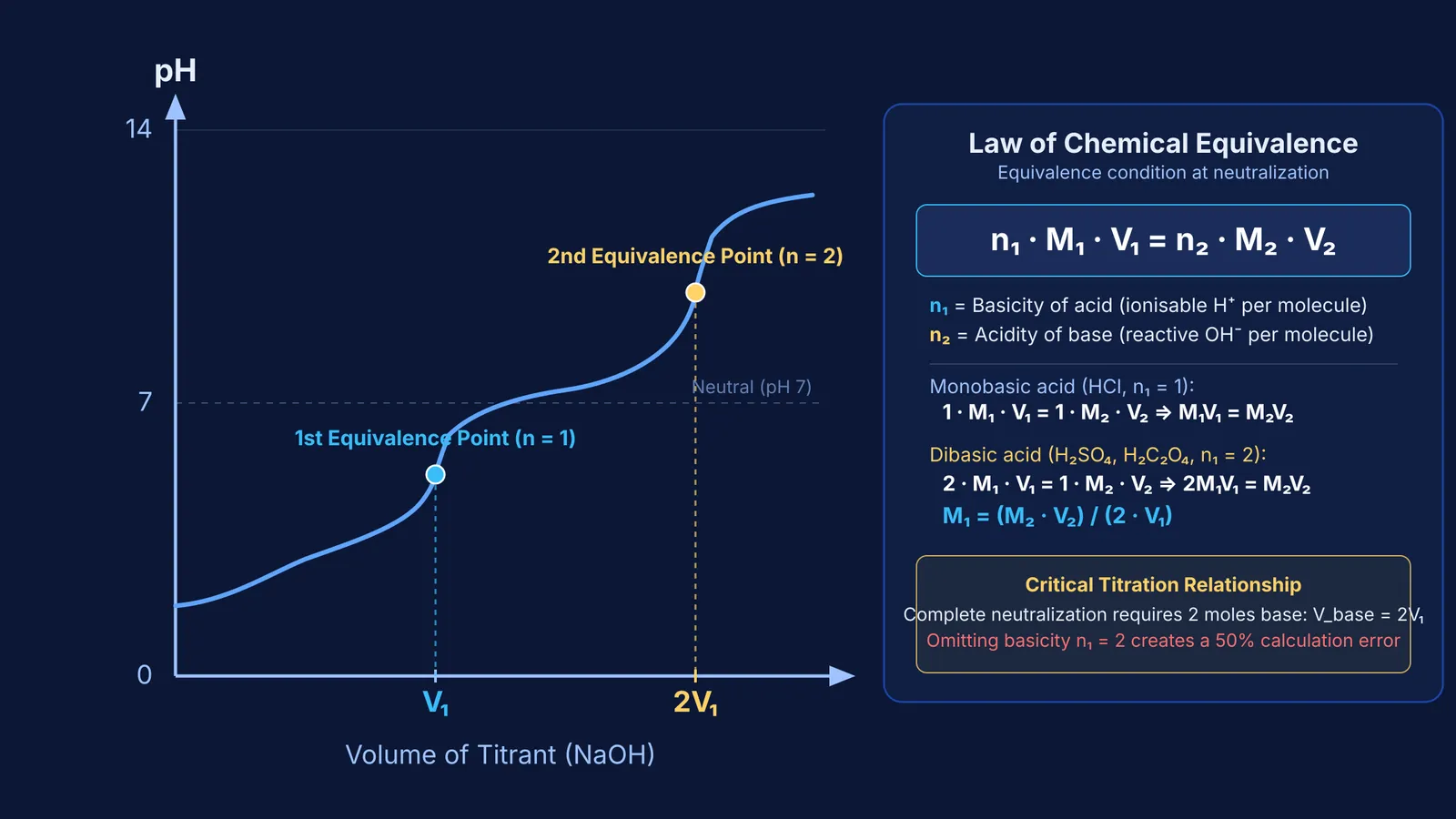
Accounting for basicity transforms the standard molarity relation into the exact law of chemical equivalence: n₁M₁V₁ = n₂M₂V₂. As detailed in OpenStax Chemistry 2e, whether you are standardising sodium hydroxide against primary standard oxalic acid or titrating sulfuric acid, understanding how basicity enters the stoichiometric equation prevents a 50% calculation error.
What is basicity in an acid-base titration?
In chemistry, the basicity of an acid is the number of ionisable hydrogen ions (protons, H⁺) that one molecule of that acid can donate during neutralization. As defined in OpenStax Chemistry 2e, neutralization stoichiometry is governed by the transfer of protons to hydroxide ions.
Acids fall into categories based on their basicity:
Monobasic acids, such as hydrochloric acid (HCl) and nitric acid (HNO₃), provide one proton per molecule (n = 1).
Dibasic acids, such as sulfuric acid (H₂SO₄) and oxalic acid (H₂C₂O₄), provide two protons per molecule (n = 2).
Tribasic acids, such as phosphoric acid (H₃PO₄), provide three protons per molecule (n = 3).
Why does the factor of 2 matter in n₁M₁V₁ = n₂M₂V₂?
Students frequently encounter M₁V₁ = M₂V₂ when mixing and diluting solutions. In pure dilution, solute moles remain constant. But in neutralization, reactants combine according to stoichiometry.
According to OpenStax Chemistry 2e, neutralization reaches its equivalence point when reacting equivalents match: Equivalents of Acid = Equivalents of Base
Because Normality (N) equals Molarity (M) multiplied by basicity or acidity (n), the condition N₁V₁ = N₂V₂ becomes: n₁M₁V₁ = n₂M₂V₂
Here n₁ is the basicity of the acid, while n₂ is the acidity of the base. For a diprotic acid (n₁ = 2) reacting with sodium hydroxide (n₂ = 1), one mole of acid releases two moles of H⁺ ions, consuming two moles of NaOH. Forgetting the factor of 2 halves or doubles your calculated concentration.
How to standardise sodium hydroxide using oxalic acid?
Solid sodium hydroxide cannot serve as a primary standard because it is deliquescent and absorbs atmospheric carbon dioxide. As outlined in standard quantitative analysis procedures (OpenStax Chemistry 2e), analysts standardise NaOH against hydrated oxalic acid (H₂C₂O₄·2H₂O, molar mass 126.07 g/mol), a stable primary standard.
The balanced neutralization reaction is: H₂C₂O₄ + 2 NaOH → Na₂C₂O₄ + 2 H₂O
Here, basicity n₁ = 2 and base acidity n₂ = 1. Suppose 20.0 mL of standard 0.0500 M oxalic acid solution is titrated with unstandardised NaOH. At the phenolphthalein faint pink endpoint, the concordant burette reading is 18.4 mL.
Using n₁M₁V₁ = n₂M₂V₂: 2 × (0.0500 M) × (20.0 mL) = 1 × M₂ × (18.4 mL) 2.00 = 18.4 × M₂ M₂ = 2.00 / 18.4 = 0.1087 M
Omitting the basicity factor of 2 yields 0.0543 M, an error of exactly 50%.
How do you calculate molarity when sulfuric acid reacts with NaOH?
Sulfuric acid is a strong diprotic acid with a basicity of n₁ = 2. Under the neutralization stoichiometry described in OpenStax Chemistry 2e, two moles of base are required to neutralize one mole of acid: H₂SO₄ + 2 NaOH → Na₂SO₄ + 2 H₂O
Suppose a 25.0 mL sample of unknown sulfuric acid requires 31.8 mL of standardised 0.1087 M NaOH to reach the endpoint: n₁M₁V₁ = n₂M₂V₂ 2 × M₁ × (25.0 mL) = 1 × (0.1087 M) × (31.8 mL) 50.0 × M₁ = 3.4567 M₁ = 3.4567 / 50.0 = 0.0691 M
In the *Journal of Chemical Education*, Addison Ault (2003) analyzed the equilibrium stages of diprotic acid titrations, highlighting how the solution passes through an amphiprotic intermediate at the first equivalence point before reaching complete stoichiometric neutralization at twice the initial titrant volume.
When working through multi-step titration problems, the Fermi Problem Library provides worked problems with a step-by-step solver that explains the reasoning rather than printing an answer, clarifying where stoichiometric coefficients apply.
What mistakes do students make during polyprotic titrations?
As discussed in OpenStax Chemistry 2e, polyprotic acid neutralizations involve sequential equilibria that complicate stoichiometric calculations. Students frequently make three procedural errors:
Swapping the sides of the factor. Putting 2 on the base side because "two moles of NaOH react" reverses the ratio, creating a fourfold discrepancy. Always attach n₁ to the acid.
Multiplying by basicity when using normality. Because Normality already includes the n-factor (N = n × M), multiplying again double-counts the protons.
Overlooking endpoint chemistry. Polyprotic acids dissociate in stages. Understanding indicators alongside how temperature shifts neutral pH ensures the correct n-factor is selected. When insoluble analytes prevent direct titration, analysts use back titration calculations.
To master these principles, the Fermi Concept Library maps every concept in physics, chemistry, biology, mathematics and computing, each with its own lesson and its place in the map.


