On this page
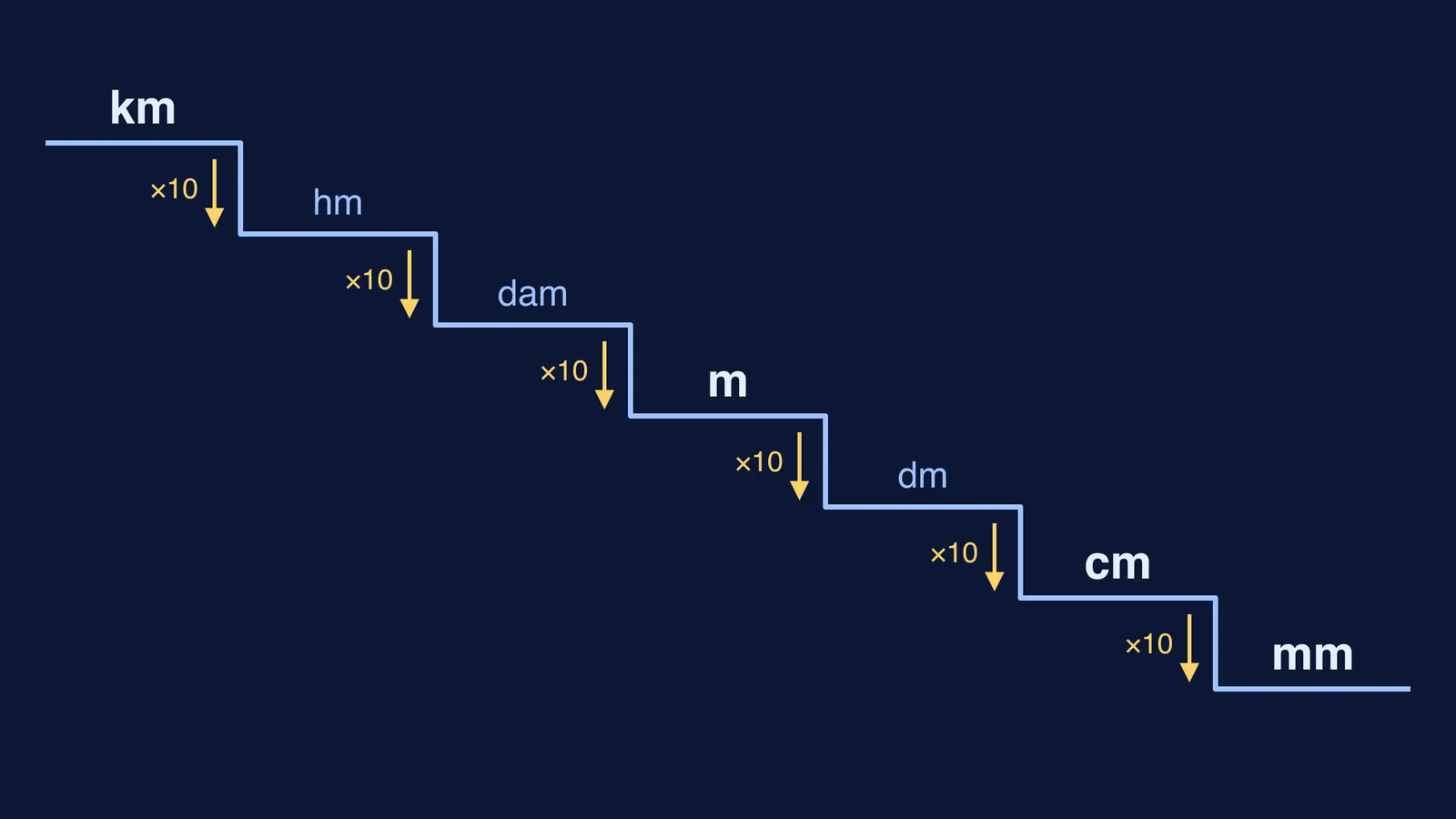
Converting lengths is one of the first places where Class 6 maths and science meet, and it comes back again and again in physics numericals. You do not need to memorise a table. You need one picture, a ladder where every step is ×10, and one habit for mixed units.
What is the ×10 ladder for metric units?
In the SI, the prefixes deka, hecto and kilo mean 10, 100 and 1000, and deci, centi and milli mean one-tenth, one-hundredth and one-thousandth, as the NIST guide to SI prefixes puts it. The BIPM, which maintains the SI, lists the same factors: kilo is 10³ and milli is 10⁻³.
The metre is the SI unit of length, according to the BIPM definition of the metre. Put it in the middle and the prefixes form a ladder:
km (kilometre)
hm (hectometre)
dam (decametre)
m (metre)
dm (decimetre)
cm (centimetre)
mm (millimetre)
Each rung is 10 times the one below it. Going down the ladder to a smaller unit, you multiply by 10 for every step. Going up to a bigger unit, you divide by 10 for every step.
How do you convert km to m, cm and mm?
Count the steps, then multiply by 10 once per step, because each prefix in the NIST table of SI prefixes is 10 times the next one down.
km to m: 3 steps down, so ×1000. 1 km = 1000 m.
m to cm: 2 steps down, so ×100. 1 m = 100 cm.
cm to mm: 1 step down, so ×10. 1 cm = 10 mm.
m to mm: 3 steps down, so ×1000. 1 m = 1000 mm.
km to cm: 5 steps down, so ×100 000. 1 km = 1 00 000 cm.
You will rarely see hm, dam or dm in a textbook problem, but keep them on the ladder. They are why km to m is three steps and not one, and forgetting them is an easy way to end up writing 1 km = 100 m.
How do you convert 3 km 45 m into metres?
A mixed unit is two measurements added together. Convert each part to the target unit, then add.
Split it: 3 km 45 m means 3 km + 45 m.
Convert the bigger part: 3 km is 3 steps down to metres, so 3 × 1000 = 3000 m.
The smaller part is already in metres: 45 m.
Add: 3000 m + 45 m = 3045 m.
The same steps work for any mixed length:
5 m 7 cm into cm: 5 × 100 = 500 cm, plus 7 cm, gives 507 cm.
2 cm 3 mm into mm: 2 × 10 = 20 mm, plus 3 mm, gives 23 mm.
Why is 3 km 45 m not 3.45 km?
It looks natural to write the two numbers side by side with a decimal point. But kilo means 1000 (NIST), so 1 km is 1000 m and the metres need three places after the decimal point, not two.
45 m is 45 ÷ 1000 = 0.045 km.
So 3 km 45 m = 3.045 km.
3.45 km would be 3 km 450 m, which is 405 m longer.
The number of decimal places matches the number of ladder steps. km to m is 3 steps, so you need 3 digits for the metres. m to cm is 2 steps, so 4 m 6 cm is 4.06 m, not 4.6 m.
How do you change metres back into km and m?
Go up the ladder: divide by 1000, keep the whole number as km and the remainder as m.
7250 m: 7250 ÷ 1000 = 7 remainder 250, so 7 km 250 m.
3045 m: 3 remainder 45, so 3 km 45 m.
507 cm into m and cm: 507 ÷ 100 = 5 remainder 7, so 5 m 7 cm.
Can you solve these five conversions?
Try these without a calculator, then check with the ladder.
6 km 8 m in metres
9 m 35 cm in centimetres
4 cm 7 mm in millimetres
2 km 5 m in kilometres, as a decimal
12 060 m in km and m
Answers: 6008 m; 935 cm; 47 mm; 2.005 km; 12 km 60 m. If you got question 1 or 4 wrong, recount the steps from km to m: there are three.
If a conversion keeps going wrong at the same step, the Fermi Problem Library has worked problems with a step-by-step solver that explains the reasoning rather than printing an answer. To revisit what the prefixes mean, the Fermi Concept Library gives each concept in physics and mathematics its own lesson.
Next time you see a mixed length, draw the ladder in the margin first.