On this page
Exam questions often give you an atomic number like 26 or 64 and ask where the element sits. You need the electron configuration, three reading rules and one extra check for the f-block.
How do you find the period, block and group from atomic number?
Start by writing the ground-state electron configuration, filling subshells in the usual order (1s, 2s, 2p, 3s, 3p, 4s, 3d, 4p, 5s, 4d, 5p, 6s, 4f, 5d, 6p, 7s, 5f, 6d, 7p).
Period = the highest principal quantum number n in the configuration, which is the outermost shell. Each period starts as a new shell begins to fill, as OpenStax Chemistry 2e shows.
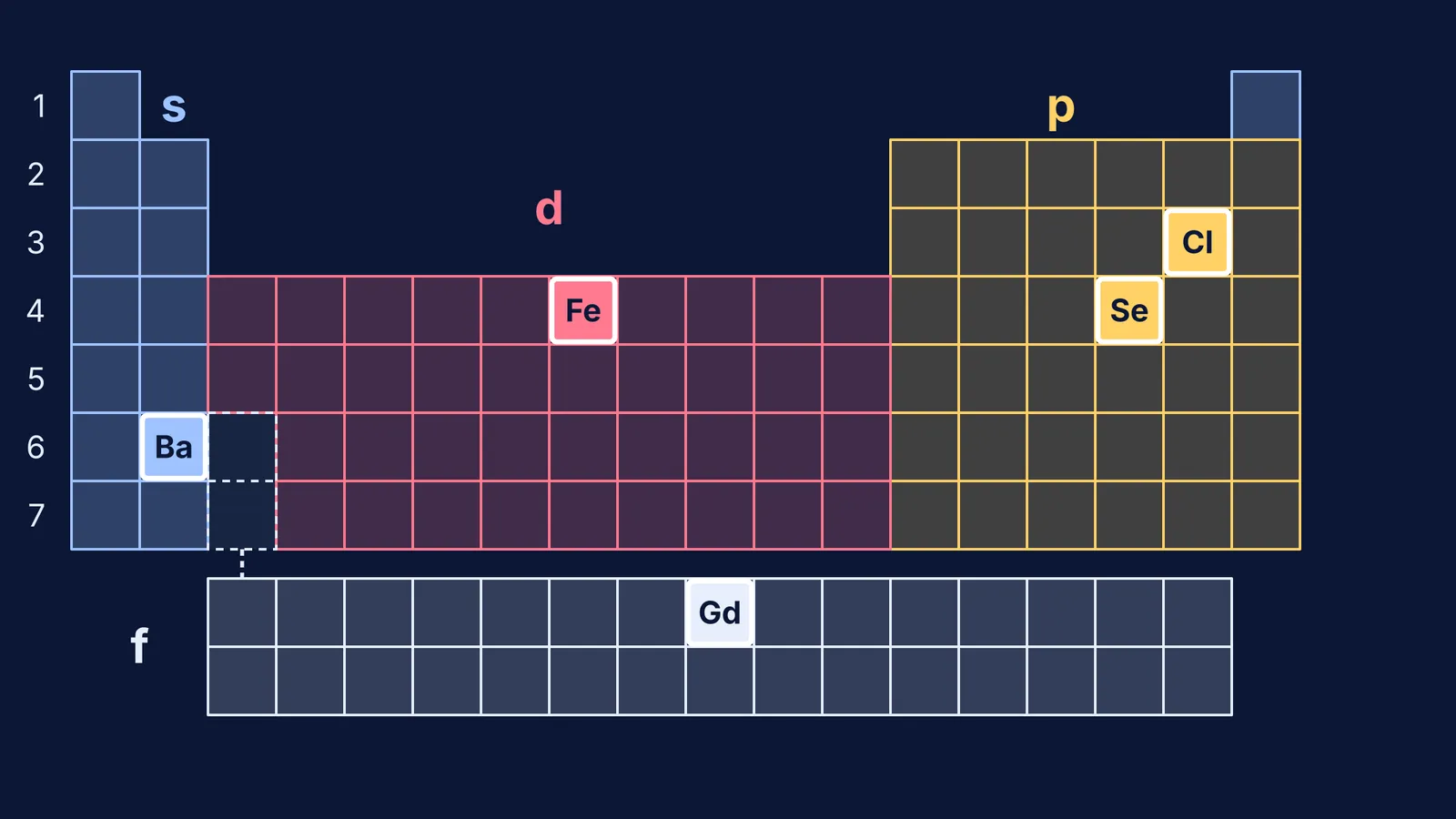
Block = the subshell the last electron enters. The OpenStax definitions: main-group elements put the last electron into an s or p orbital of the outermost shell, transition metals into a d orbital, inner transition elements into an f orbital.
Group (numbered 1 to 18, the system IUPAC has recommended since 1988): for the s-block, group = number of ns electrons; for the p-block, group = 10 + ns + np electrons; for the d-block, group = ns + (n−1)d electrons.
Worked examples: s-, p- and d-block
All configurations below match the ground states listed in the NIST Atomic Spectra Database.
Z = 17, chlorine: [Ne] 3s2 3p5. Highest n is 3, so period 3. The last electron is in 3p, so p-block. Group = 10 + 2 + 5 = 17.
Z = 34, selenium: [Ar] 3d10 4s2 4p4. Period 4, p-block. Group = 10 + 2 + 4 = 16. The filled 3d10 is not counted.
Z = 56, barium: [Xe] 6s2. Period 6, s-block, group 2.
Z = 26, iron: [Ar] 3d6 4s2. Highest n is 4, so period 4, even though the last electron went into 3d. That makes it d-block, and group = 2 + 6 = 8.
What about f-block elements and exceptions like chromium?
Take Z = 64, gadolinium. NIST lists its ground state as [Xe] 4f7 5d1 6s2 (NIST ASD). The outermost shell is 6, so period 6. The partly filled 4f subshell makes it an f-block element, one of the lanthanoids, which IUPAC defines as La to Lu.
For f-block elements, answer with period and series (period 6, lanthanoid, f-block), not a 1 to 18 group number. Even the edge of the block is debated: the IUPAC periodic table page describes a project set up to decide whether group 3 should hold Sc, Y, Lu and Lr or Sc, Y, La and Ac. Follow your textbook's convention in the exam.
Exceptions to the filling order rarely change the answer. Chromium (Z = 24) is [Ar] 3d5 4s1, not 3d4 4s2 (NIST ASD), but the group sum is 5 + 1 = 6 either way. Our post on why chromium and copper break the Aufbau order explains the half-filled and filled subshell reasoning.
How do you predict properties from the position?
s-block: apart from hydrogen and helium, reactive metals that lose their ns electrons. Barium, 6s2, forms Ba2+.
p-block: metals, metalloids and non-metals. Elements near the right gain electrons to reach a noble-gas configuration: chlorine (3p5) forms Cl−, selenium (4p4) forms Se2−.
d-block: OpenStax describes the transition elements as almost all hard, high-melting solids that conduct heat and electricity well, form alloys and show a wide range of oxidation states. Ions of the lighter ones, such as Fe3+ and Cr3+, are coloured in water.
f-block: the same OpenStax chapter notes that the lanthanides all form stable 3+ aqueous cations, so predict Gd3+ for gadolinium.
Position also sets trends in size and ionisation energy, which have their own exceptions; see periodic trends and their exceptions and our guide to d- and f-block elements.
A 60-second checklist for exam questions
Write the configuration and check it against known exceptions (Cr, Cu and a few others).
Circle the highest n. That is the period.
Find the subshell of the last electron. That is the block.
Add up the group: s = ns; p = 10 + ns + np; d = ns + (n−1)d; f = name the series instead.
Predict one property: the likely ion or oxidation state, metal or non-metal, coloured or not.
Sanity check: the group must fit the block (1 to 2 for s, 3 to 12 for d, 13 to 18 for p; helium sits in group 18).
If the group keeps coming out wrong, the gap is usually in how subshells fill. The Fermi Concept Library gives every chemistry concept its own lesson and its place in the map, so you can go back to electron configuration before trying again. For practice, the Fermi Problem Library has worked problems with a step-by-step solver that explains the reasoning rather than printing an answer.