On this page
Pluck the thickest string on a guitar, then the thinnest. The thick one sounds deep, the thin one bright. Yet all six strings run the same length, nut to bridge, and their tensions are broadly similar. In D'Addario's balanced-tension sets, "the deviation in tension between strings in the set is very small (usually within 1 lb.)" (D'Addario, All about string tension). With length and tension roughly equal, the big difference left is how heavy each string is.
Why do thicker strings make lower notes?
Tension pulls each displaced bit of a plucked string back towards the straight line. Give the same pull a heavier string and each bit accelerates less, so waves travel along it more slowly and it completes fewer vibrations per second. Fewer vibrations per second is a lower frequency, which you hear as a lower pitch.
The quantity that matters is mass per unit length, μ: the string's mass divided by its length (Joe Wolfe, UNSW: Strings, standing waves and harmonics). The speed of a wave on a stretched string is v = √(T/μ), where T is the tension (HyperPhysics, Vibrating string).
What does f = (1/2L)√(T/μ) say about thickness?
A string fixed at both ends vibrates in its fundamental with a wavelength of 2L, so its lowest frequency is f = v/2L (Wolfe, UNSW). Put in the wave speed and you get f = (1/2L)√(T/μ).
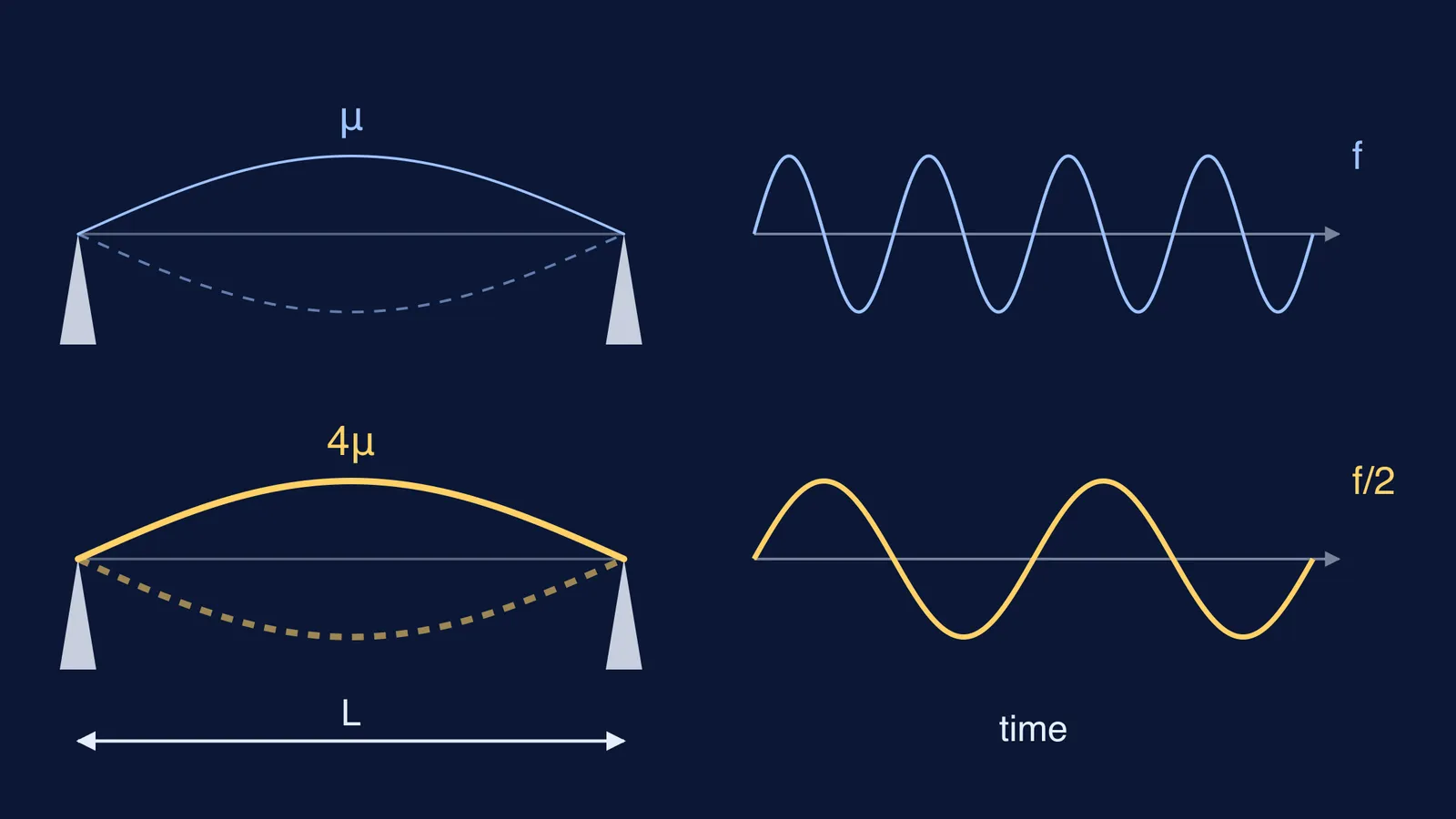
Now hold L and T fixed. Only μ is left, and frequency goes as 1/√μ:
Double μ and f falls to about 0.71 of what it was.
Quadruple μ and f halves, one octave lower.
Multiply μ by 16 and f falls to a quarter, two octaves lower.
Wolfe puts the middle rule plainly: "To make a string an octave lower, while maintaining the same length, you must quadruple the ratio M/L."
For a solid wire, μ is density times cross-sectional area, and area grows with the square of the diameter. Double the diameter of the same wire at the same tension and the note drops an octave.
How much heavier is a guitar's low E string?
Standard tuning puts the low E string at 82.41 Hz and the high E at 329.63 Hz (Wikipedia, Guitar tunings). The ratio is 329.63 ÷ 82.41 = 4.00, two octaves. With L and T roughly the same, μ must differ by 4² = 16.
A Fender Stratocaster has a 25.5-inch scale length (D'Addario), so L = 0.648 m. Assume a round 70 N on both strings (our choice; real sets vary). Rearranging the formula gives μ = T/(2Lf)².
High E: 2Lf = 2 × 0.648 × 329.63 ≈ 427 m/s, so μ = 70 ÷ 427² ≈ 0.38 g/m.
Low E: 2Lf = 2 × 0.648 × 82.41 ≈ 107 m/s, so μ = 70 ÷ 107² ≈ 6.1 g/m.
Ratio: 6.1 ÷ 0.38 ≈ 16.
As plain steel, the low E would need four times the high E's diameter, so makers wind it instead.
How can you test it with a rubber-band box?
You need an open box, two rubber bands of the same length but different width, two pencils, a small water bottle on a loop of thread, and a phone tuner app that shows hertz.
There is a trap. Stretched the same amount, the thick band pulls harder, so T is not fixed and the extra tension hides part of the effect. Hanging the same weight from each band fixes T.
Lay the pencils across the open box about 15 cm apart. They are your bridges; the gap is L.
Tape one end of the thin band down, run it over both pencils, and hang the bottle from the free end over the edge.
Pluck between the pencils and read the frequency.
Predict before you swap. If the thick band is about twice as wide, μ roughly doubles, so expect about 0.71 times the first reading: 200 Hz becomes about 140 Hz.
Swap in the thick band, same bottle, same gap. Pluck and read.
Try the unfair version: both bands stretched around the box by hand. Watch the gap between the notes shrink.
Rubber thins as it stretches, so expect the direction to be right and the size only roughly right. Write down your prediction, both readings and the percentage difference, then explain the gap.
Where does this show up in exams?
The same formula drives the sonometer practical; our guide to the sonometer experiment with frequency, length and tension covers the other two variables. For the history, read Marin Mersenne's laws of vibrating strings, and for two strings of different μ joined end to end, see the composite string with a node at the joint.
Waves are easier to see than to read, which is what the Fermi Simulation Lab is for: interactive simulations for ideas like this one. For string numericals, the Fermi Problem Library has worked problems with a step-by-step solver that explains the reasoning.
Tonight, find two rubber bands, write down your prediction, and test it.