On this page
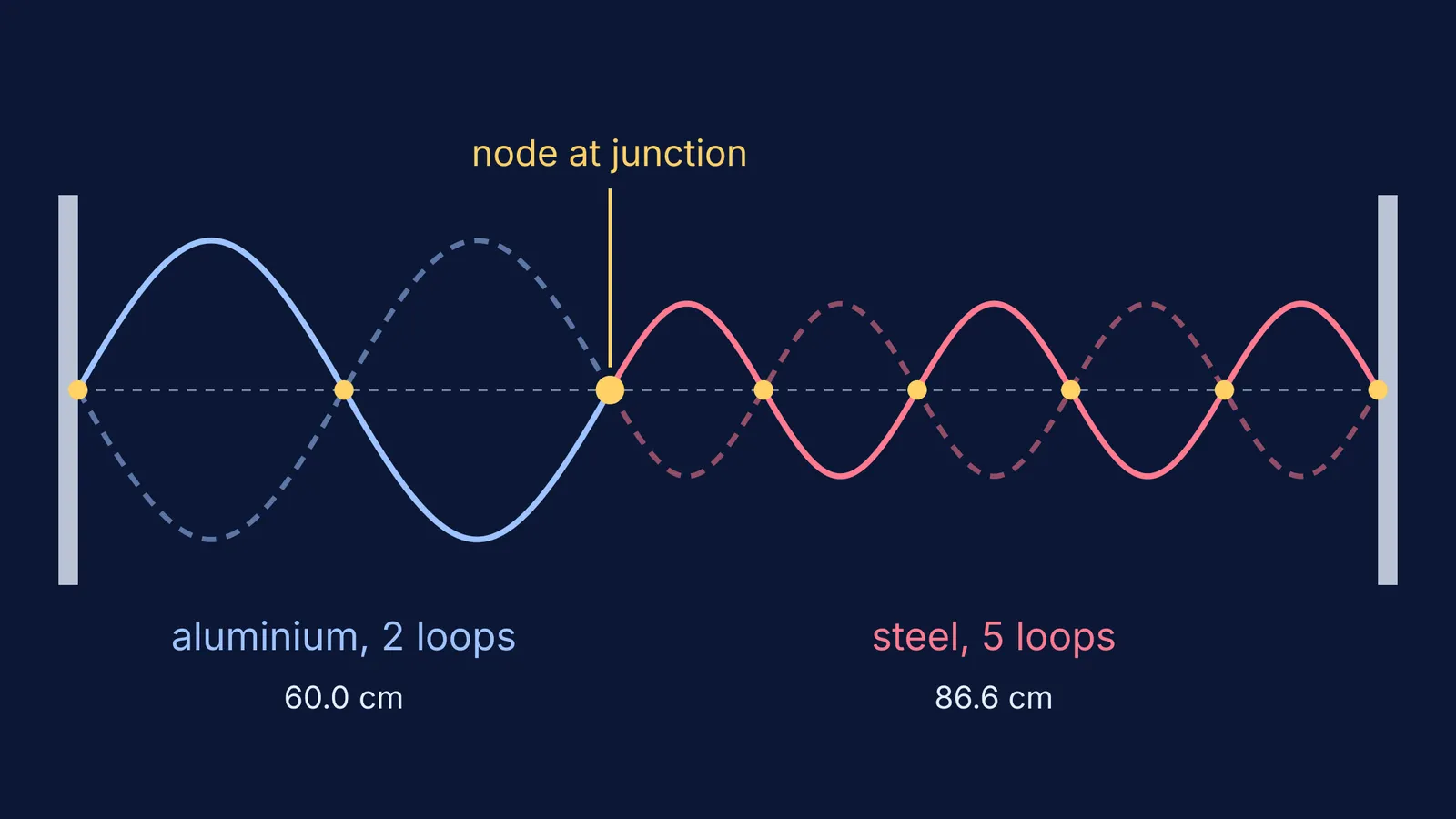
Picture a sonometer with two different wires joined end to end: aluminium on one side, steel on the other. Both are clamped at the far ends and pulled by the same hanging weight. At the right frequency you get a standing wave with a node exactly at the joint. JEE problems ask for the lowest such frequency, and the trap is treating the whole thing as one string. It is really two strings that have to agree on one frequency.
Why does each part of a joined string have a different wave speed?
The speed of a transverse wave on a string is v = √(T/μ), where T is the tension and μ is the mass per unit length (OpenStax University Physics, Section 16.3). The two wires are in series, so one weight sets the same tension in both. Their μ values differ, so their speeds differ. OpenStax puts it plainly: when the tension is the same in both strings, the wave is faster in the string with the lower linear mass density (Section 16.5).
The frequency, though, is shared. The whole string vibrates in one mode, so every point on both sides of the joint moves at the same frequency f. With f fixed and v changing, the wavelength λ = v/f is shorter in the slower, heavier wire.
What condition gives a node at the junction?
A node at the joint means the joint does not move. Each wire then behaves like a string fixed at both ends of its own length. For a string of length L fixed at both ends, the allowed frequencies are f = nv/(2L) with n = 1, 2, 3…, where n is the number of loops (OpenStax, Section 16.6).
So the composite string needs a frequency that is a harmonic of both parts at once:
n₁v₁/(2L₁) = n₂v₂/(2L₂)
With the same tension on both sides, this rearranges to:
n₁/n₂ = (L₁/L₂) × (v₂/v₁) = (L₁/L₂) × √(μ₁/μ₂)
The lowest frequency comes from the smallest whole numbers n₁ and n₂ in that ratio. Reduce the fraction to lowest terms and put n₁ back into f = n₁v₁/(2L₁).
Worked example: aluminium joined to steel
Take an aluminium wire 60.0 cm long joined to a steel wire 86.6 cm long. Both have a cross-section of 1.00 × 10⁻² cm². Use 2.60 g/cm³ for the density of aluminium and 7.80 g/cm³ for steel. A 10.0 kg mass hangs from the end, and g = 9.8 m/s². We use v = √(T/μ) and f = nv/(2L) (OpenStax, Section 16.6).
Tension: T = 10.0 × 9.8 = 98 N in both wires.
Mass per length, μ = density × area, with area 1.00 × 10⁻⁶ m². Aluminium: μ₁ = 2.60 × 10⁻³ kg/m. Steel: μ₂ = 7.80 × 10⁻³ kg/m.
Speeds: v₁ = √(98 ÷ 2.60 × 10⁻³) ≈ 194 m/s. v₂ = √(98 ÷ 7.80 × 10⁻³) ≈ 112 m/s.
Each wire's own fundamental: aluminium 194.2 ÷ 1.20 ≈ 161.8 Hz; steel 112.1 ÷ 1.732 ≈ 64.7 Hz.
Ratio: n₁/n₂ = (60.0 ÷ 86.6) × √(2.60 ÷ 7.80) = 0.693 × 0.577 ≈ 0.400 = 2/5.
Lowest frequency: n₁ = 2 and n₂ = 5, so f = 2 × 161.8 ≈ 324 Hz. Check with steel: 5 × 64.7 ≈ 324 Hz.
The aluminium carries 2 loops and the steel carries 5. Counting the two clamped ends and the joint once each gives 2 + 5 + 1 = 8 nodes and 7 antinodes. The next mode with a node at the joint uses 4 and 10 loops, at about 647 Hz.
What mistakes cost marks on this problem?
Using f = nv/(2L) once with the total length. There is no single v.
Averaging the two μ values. The wires never share a speed.
Giving the wires different tensions. One weight pulls both.
Stopping at the ratio. Turn 0.400 into n₁ = 2 and n₂ = 5, then compute f.
Counting the joint twice. The total number of nodes is n₁ + n₂ + 1.
How do you practise this type of problem?
Change one thing and predict before you calculate. Since v = √(T/μ) (OpenStax, Section 16.3), a wire of the same material with twice the radius has 4 times the μ and half the speed. Double the tension in our example and both speeds rise by √2: the loop ratio stays 2/5 and the frequency rises to about 458 Hz.
These problems build on how wave speed in a wire depends on stress and density and on what happens to sonometer frequency when the hanging mass is immersed in water. For the lab side, read our explainer on Melde's experiment with a string and tuning fork.
If your method keeps going wrong, the Fermi Problem Library has worked problems with a step-by-step solver that explains the reasoning rather than printing an answer. If standing waves feel shaky, start in the Fermi Concept Library.