

On this page
Melde's experiment uses an electrically maintained tuning fork to create standing waves on a stretched string. The string is attached to one prong of the tuning fork at one end, and passes over a smooth pulley at the other end. A weight pan is attached to the free end, allowing you to change the tension by adding or removing weights.
By changing the tension or rotating the tuning fork, you can study how waves behave under different conditions. A standing wave appears as a series of stationary loops, with points of zero movement called nodes and points of maximum movement called antinodes. If you want to review how these nodes form before jumping into the equations, the Fermi Concept Library explains wave reflection and superposition step by step.
A common question in board and entrance exams asks how the string's frequency and the number of loops change when you switch the tuning fork from the transverse to the longitudinal arrangement. The answer lies in how the fork's prongs pull on the string.
How does the transverse mode work?
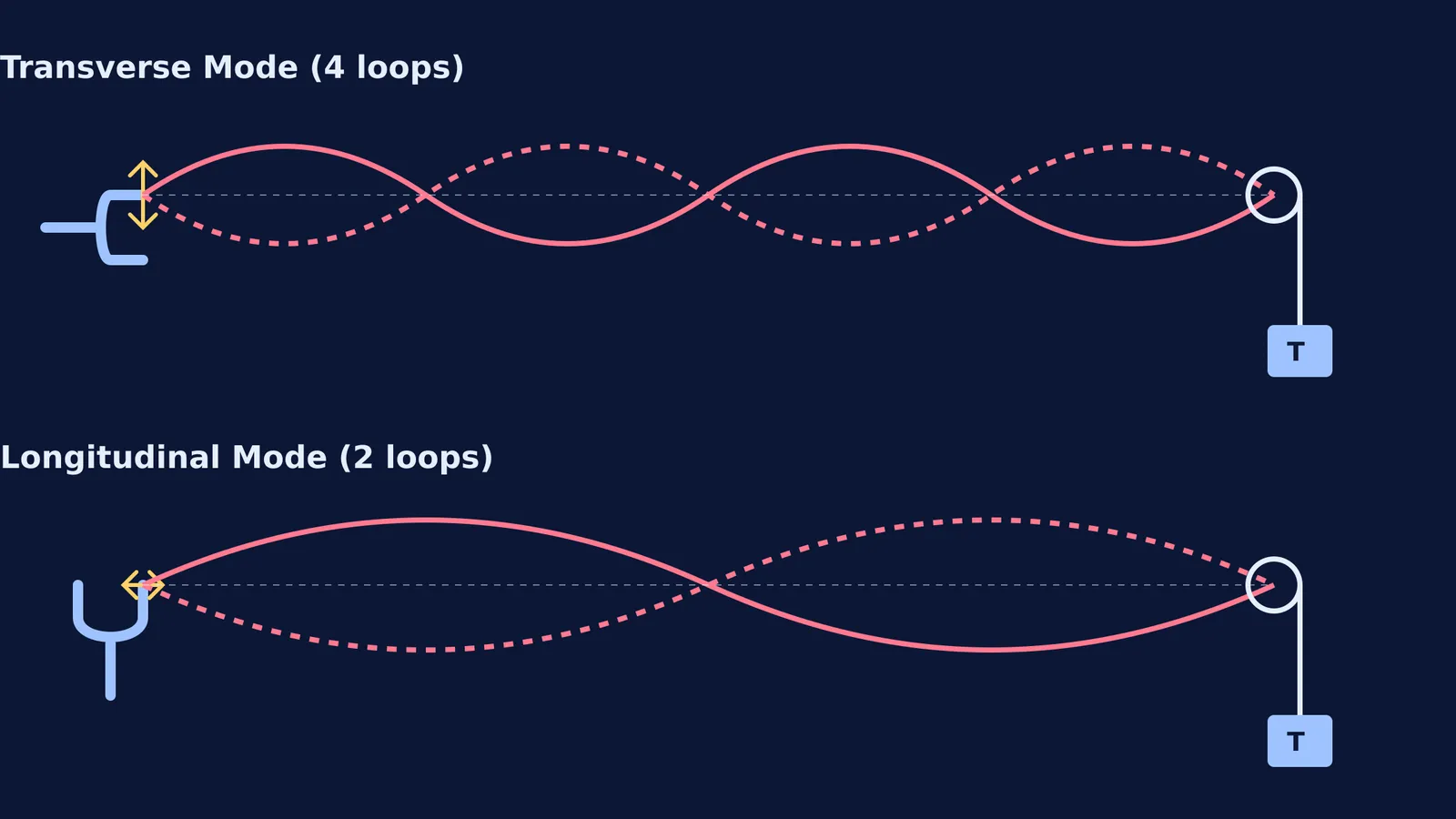
In the transverse mode, the tuning fork is positioned so that its prongs vibrate perpendicular to the length of the string. You can picture this as the tuning fork's U-shape lying horizontally, while the prongs move up and down in the vertical plane.
According to historical setups of the experiment, as the prong moves up and down, it pulls the string with it. One complete vibration of the prong creates one complete upward and downward wave pulse, which means one complete vibration of the string. Therefore, the frequency of the string (fs) is exactly equal to the frequency of the tuning fork (f).
The formula for the frequency of the tuning fork in this arrangement is:
f = (p / 2L) √(T / m)
Where:
p is the number of loops (segments between nodes)
L is the vibrating length of the string
T is the tension in the string
m is the linear mass density (mass per unit length)
Why does string frequency halve in the longitudinal mode?
If you rotate the tuning fork by 90 degrees, it enters the longitudinal mode. Now, the prongs vibrate parallel to the string. The U-shape of the fork points directly along the line of the string, so the prongs move forwards and backwards.
This creates a phenomenon called parametric resonance. When the prong moves toward the string, the tension drops and the string sags due to gravity or its own slack. When the prong moves away, it pulls the string, making it tighten again. It takes two complete vibrations of the tuning fork—two forward-and-backward motions—to complete one full tighten-and-sag wave cycle on the string, as detailed in standard reference texts. As a result, the string vibrates at exactly half the frequency of the tuning fork.
fs = f / 2
Because the standard string frequency formula (fs = (p / 2L) √(T / m)) still applies, we substitute f / 2 for fs to find the tuning fork's frequency in the longitudinal setup:
f = (p / L) √(T / m)
Notice that the factor of 2 in the denominator is gone. If you are practising these derivations and make a mistake, the step-by-step solver in the Fermi Problem Library can help you find where your reasoning went wrong.
How do the loops change at constant tension?
What happens if you keep the string length and the hanging weight (tension) exactly the same, but switch the setup from transverse to longitudinal mode?
Because the tuning fork's frequency (f) is a constant physical property of the fork—it vibrates at the same rate no matter how you turn it—we can equate the two formulas we derived earlier:
(p_transverse / 2L) √(T / m) = (p_longitudinal / L) √(T / m)
Since the length (L), tension (T), and string density (m) have not changed, we can cancel out the common terms on both sides. This leaves a very simple ratio:
p_transverse = 2 × p_longitudinal
If you had four clear, stable loops in the transverse mode, simply turning the fork parallel to the string will instantly drop the standing wave pattern down to two loops.
How to solve Melde's experiment problems?
When solving wave problems, the first thing to check is the fork's orientation. Use this three-step checklist:
Identify the mode: Look for keywords like "perpendicular" (transverse) or "parallel" (longitudinal).
Choose the correct frequency: Set fs = f for transverse, or fs = f / 2 for longitudinal.
Use Melde's Law for comparisons: If the tuning fork and string are the same but tension changes, use p² × T = constant to quickly find the new number of loops.
For more on how standing waves form, you can read How Two Travelling Waves Form a Standing Wave Equation. You can also review Stationary vs progressive waves: four key differences or test How wave speed on a string changes with tension.


