

On this page
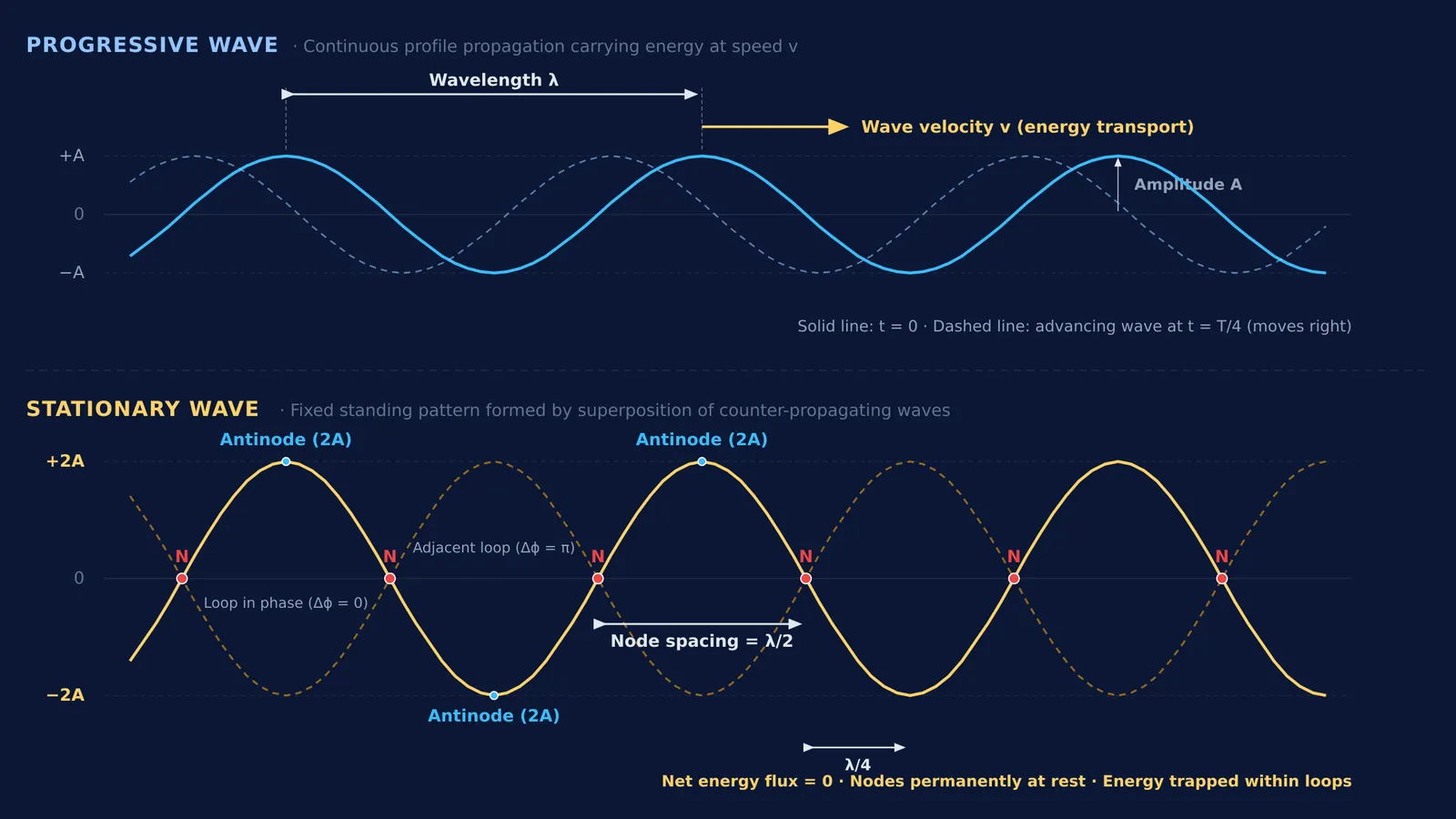
Distinguishing between travelling and standing waves is a foundational skill in wave mechanics. While both satisfy the linear wave equation, their physical behaviour diverges across four properties: energy transmission, amplitude distribution, particle phase, and boundary-dependent nodal formation. Understanding these distinctions dictates how you interpret wave functions, calculate normal modes, and solve boundary-value problems.
How does energy transfer differ between progressive and stationary waves?
A progressive wave carries energy and momentum continuously through a medium without transferring mass. As a disturbance travels, each segment performs work on the segment ahead of it. According to OpenStax University Physics, the average power transmitted by a sinusoidal wave of amplitude A, angular frequency ω, and speed v on a string of linear density μ is P_avg = ½μA²ω²v. Over one wavelength λ, the energy transported is E_λ = ½μA²ω²λ.
A stationary wave behaves differently because two identical waves travel in opposite directions. Forward and backward energy fluxes cancel over each period, yielding zero net time-averaged energy transmission across any cross-section.
When the medium passes through equilibrium at t = T/4, potential energy vanishes and energy is purely kinetic. A quarter-cycle later, particle speeds drop to zero and energy is stored entirely as elastic potential energy in string tension.
Why do amplitudes vary along a stationary wave but remain uniform in a progressive wave?
In an ideal progressive wave, every particle undergoes simple harmonic motion with identical maximum displacement. As shown in our guide on reading travelling wave equations, y(x, t) = A sin(kx − ωt) assigns every point x the same amplitude A, with position only setting the arrival time of crests.
In a stationary wave, amplitude depends on position. Superposing two counter-propagating waves gives y(x, t) = 2A sin(kx) cos(ωt), with effective amplitude A(x) = |2A sin(kx)|. Particles at antinodes oscillate with maximum amplitude 2A, while nodes remain at rest.
In a study in the *American Journal of Physics*, researchers Eunsook Kim and Sung-Jae Pak surveyed physics students who had completed 300 to 2,900 traditional problems—averaging roughly 1,500 problems per student—and found little correlation between problem-solving volume and conceptual understanding in basic mechanics. While students manipulated formulas algebraically, rote practice did not build physical intuition about spatial distributions.
The Fermi Concept Library organizes every concept in physics, chemistry, biology, mathematics and computing into an interconnected map, each with its own lesson and its place in the map, helping students link superposition mathematics to spatial amplitude profiles.
How does particle phase behave across a standing wave loop?
For a progressive wave, phase ϕ(x, t) = kx − ωt changes continuously with position. Particles separated by Δx maintain a constant phase difference Δϕ = (2π/λ)Δx, so no two adjacent particles reach crests simultaneously.
In a stationary wave, phase does not advance continuously. Within any single loop bounded by consecutive nodes:
Every particle passes through equilibrium at the same instant.
Every particle reaches peak displacement at the same instant.
All particles oscillate strictly in phase, with zero phase difference.
Crossing a node reverses the sign of sin(kx), so particles in adjacent loops move in opposite directions, oscillating exactly 180° (π radians) out of phase.
Because phase flips and envelope shapes are easier to grasp visually, the Fermi Simulation Lab provides interactive simulations for the ideas that are easier to see than to read, letting students observe dynamic standing wave envelopes in real time.
Why do nodes form at fixed boundaries while progressive waves travel freely?
Progressive waves travel indefinitely through uniform media, but reflection occurs at boundaries. As analyzed in our guide on wave reflection and phase change at boundaries, reflection from a fixed boundary introduces an automatic 180° phase inversion, creating destructive interference at the support.
When incident and reflected waves superpose at resonant frequencies, stable interference creates nodes and antinodes, as detailed in standing waves in strings and pipes. According to OpenStax University Physics:
Nodes occur where sin(kx) = 0, giving x = n(λ/2) for n = 0, 1, 2, 3...
Antinodes occur where sin(kx) = ±1, giving x = (2n + 1)(λ/4) for n = 0, 1, 2, 3...
The distance between consecutive nodes or antinodes is λ/2.
The distance between an adjacent node and antinode is λ/4.
The Fermi Problem Library provides worked problems with a step-by-step solver that explains the reasoning rather than printing an answer, helping students practice identifying wave types and evaluating boundary conditions across problem sets.


