

On this page
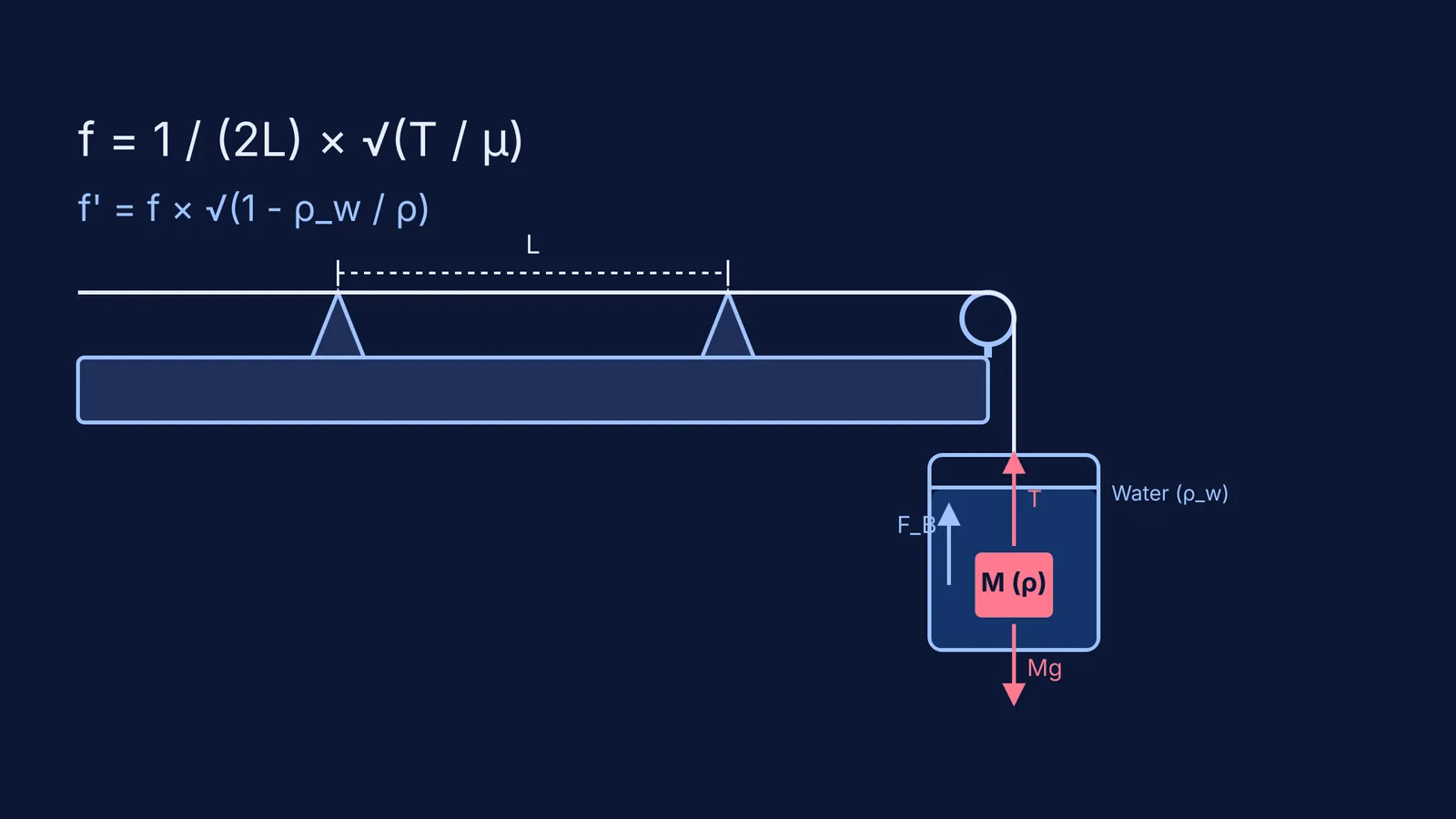
When you hang a mass from a sonometer wire, the tension in the wire equals the weight of the mass. If you then immerse that mass in a fluid like water, Archimedes' principle states that the water exerts an upward buoyant force on it. This upward push decreases the net downward force, cutting the tension in the wire. Since the fundamental frequency of a stretched string depends directly on the square root of its tension, a drop in tension means the sonometer's frequency falls.
This simple laboratory setup is more than just a demonstration of waves; it is a practical way to find the relative density of the hanging block. By measuring how much the frequency drops when the mass goes into the water, you can calculate exactly how dense the material is compared to water, all without needing to measure the object's volume.
Why does the frequency change?
To see why the pitch falls, we need to look at the forces acting on the hanging mass and the physics of the vibrating wire above it.
The fundamental frequency f of a sonometer wire is given by: f = 1 / (2L) × √(T / μ) where L is the resonating length between the two bridges, T is the tension, and μ is the linear density of the wire (Wikipedia). If you leave the length and wire unchanged, the frequency is purely a function of the tension.
When the mass M hangs in the air, the tension T_air is simply the gravitational weight of the mass: T_air = Mg
When you lower the mass into a beaker of water, it displaces a volume of water equal to its own volume V. Archimedes' principle states the water exerts an upward buoyant force equal to the weight of that displaced fluid (Wikipedia). The apparent weight of the mass, and the new tension T_water in the wire, is the true weight minus the buoyant force: T_water = Mg − V(ρ_w)g where ρ_w is the density of water and g is gravity. Because T_water is less than T_air, the net force is smaller, and the frequency must decrease.
How do you calculate the density of the load?
You can use this exact drop in frequency to measure the specific gravity (or relative density) of the hanging mass. Specific gravity is simply the density of the object ρ divided by the density of water ρ_w.
We know the mass of the object is its volume times its density, M = Vρ. We can rewrite the air and water tensions in terms of density and volume:
Tension in air: T_air = Vρg
Tension in water: T_water = Vg(ρ − ρ_w)
If we measure the original frequency f₁ in air and the new frequency f₂ in water, the ratio of the two frequencies is: f₂ / f₁ = √(T_water / T_air) = √[Vg(ρ − ρ_w) / (Vρg)]
The volume V and gravity g cancel out entirely, leaving us with a clean ratio of densities: f₂ / f₁ = √[(ρ − ρ_w) / ρ] which simplifies to: f₂ = f₁ √(1 − ρ_w / ρ)
We can rearrange this ratio to solve for the relative density ρ / ρ_w. Squaring both sides gives: (f₁ / f₂)² = ρ / (ρ − ρ_w) If you cross-multiply and solve for the ratio, you get the final formula for relative density S: S = f₁² / (f₁² − f₂²)
If you need to revise how pressure and depth work with unknown fluids, our guide to finding unknown density with a manometer covers the statics of liquids in tubes.
How do you find the new resonating length in the lab?
In a real physics practical, you often use an alternating current (AC) sonometer or a tuning fork that produces a single, fixed frequency. Because you cannot change the frequency of the tuning fork to match the new lower frequency of the wire, you must adjust the sonometer to bring the system back into resonance.
If the frequency must remain constant while the tension drops, you have to decrease the vibrating length L to compensate. The law of length states that L is directly proportional to the square root of tension. If L₁ is the length that resonates in air and L₂ is the length that resonates in water, the relative density can also be written using lengths instead of frequencies: S = L₁² / (L₁² − L₂²)
This means you slide the knife-edge bridge closer until the paper rider jumps off the wire again. Measuring this shift in length gives the exact change in tension. If you are struggling to picture how tension and upthrust balance each other, the Fermi Concept Library breaks down the physics of buoyancy and restoring forces. We also cover related mechanics problems, such as calculating the tension in a simple pendulum string at different angles.


