On this page
You forget a strong cup of black tea on your desk and come back to find it murky. Tea chemists call this "creaming down", and the cloudy material tea cream. It is a textbook idea in a cup: how much of a substance stays dissolved depends on temperature.
What is tea cream?
Tea cream is a finely divided colloidal precipitate that forms when a hot black tea infusion cools, as described in a review by K. Sivapalan and N. Herath of the Tea Research Institute of Sri Lanka.
Its main ingredients are theaflavins, thearubigins and caffeine, as R. F. Smith confirmed in a 1968 paper in the Journal of the Science of Food and Agriculture. Theaflavins and thearubigins are oxidised polyphenols, made from the tea leaf's own polyphenols during black tea processing.
The Sri Lankan review summarises an earlier analysis by Roberts (1963): theaflavins, thearubigins and caffeine sat in the cream in a ratio of roughly 1 : 4 : 1, and about 62% of the theaflavins in the tea ended up in the cream.
Why does tea become cloudy when it cools?
In hot tea, caffeine and polyphenols stay dissolved. As the tea cools, they stick to one another, most probably through hydrogen bonds, according to the Tea Research Institute review. The clusters grow until they scatter light. Under a microscope, the cream Smith studied was made of spherical globules about 2 to 5 micrometres across, the review reports.
Caffeine matters. In Roberts' tests, removing the caffeine stopped creaming down completely, and adding pure caffeine increased it, according to the review.
A 2005 study in the Journal of Agricultural and Food Chemistry by Elisabeth Jöbstl and colleagues looked closer using X-ray scattering and NMR. They concluded that theaflavin starts the process, forming nanoclusters typically 3 nanometres across, while caffeine fills the gaps and adds bulk without being needed to start it. They also found that stronger tea starts creaming earlier and makes larger particles, and that calcium promotes creaming.
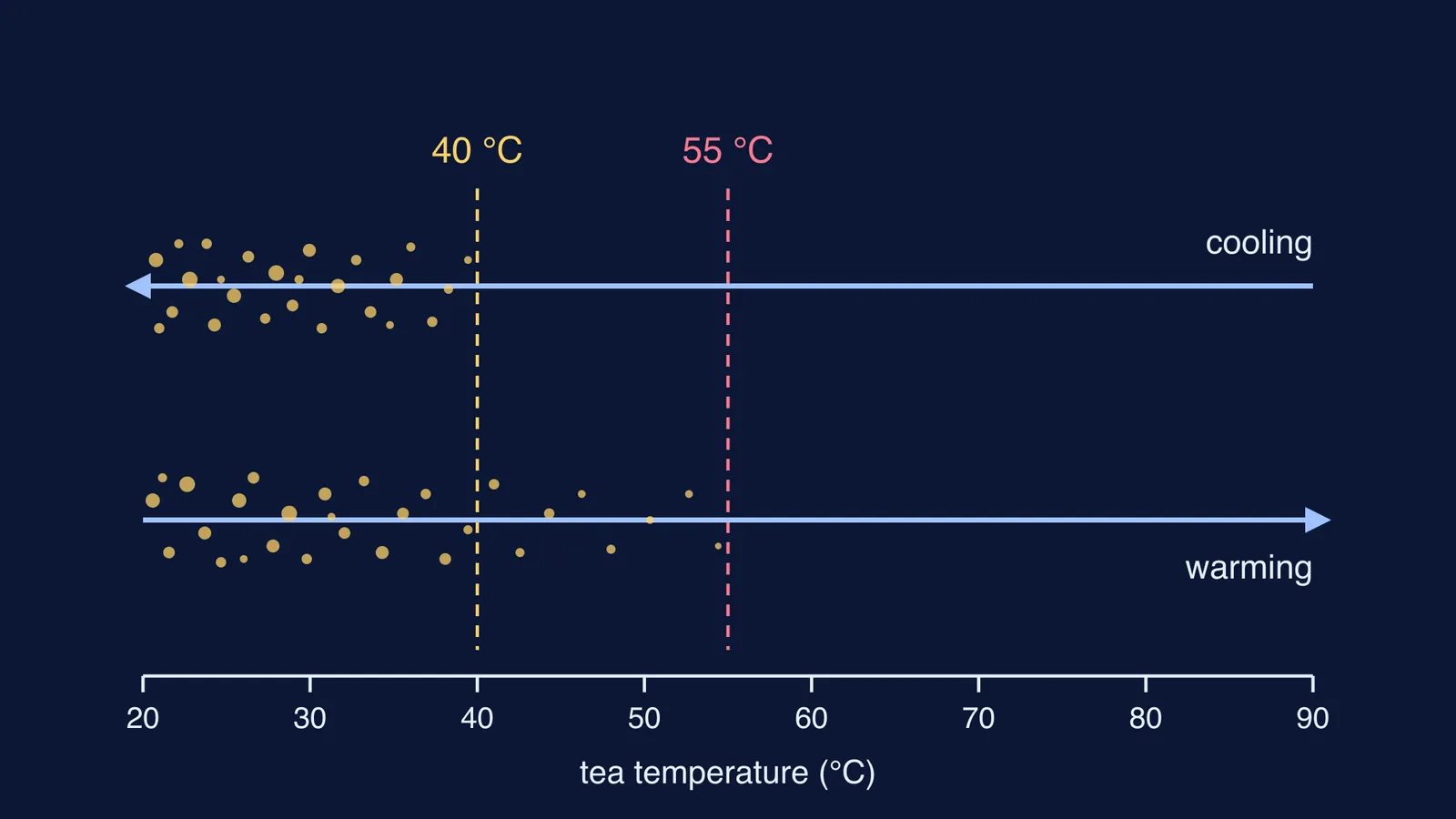
Then there are the temperatures. Smith observed that strong tea starts to form cream at 40 °C, and more forms as it cools further; on reheating, the cream slowly disappeared and the tea turned clear at about 55 °C, the review reports. So tea clears at a higher temperature than the one at which it clouded. That gap is what the diagram at the top shows.
Do hard water and strong brewing make tea cloudier?
Water matters as well as temperature. A 2019 study in the journal Nutrients by Melanie Franks and colleagues notes that magnesium and calcium in hard water can promote both tea cream and the surface film called tea scum, the same film behind the brown stains tea leaves in cups. That fits the Jöbstl finding on calcium.
Strength matters too. In a kitchen test by America's Test Kitchen, tea brewed with 2 grams of leaf per cup stayed clear when chilled, while 6 grams per cup turned cloudy. Their cold-brewed tea, steeped overnight in room-temperature water, did not haze even after it was boiled and chilled again.
How can you watch tea cream form at home?
You need two clear glasses, black tea bags, a kettle, a thermometer (a digital kitchen probe or a lab thermometer), a sheet of paper with a line of printed text, and a notebook.
Strong glass: steep 3 tea bags in 200 mL of just-boiled water for 5 minutes, then remove them. No milk, no sugar.
Weak glass: steep 1 tea bag in 200 mL the same way.
Stand both glasses in front of the printed text. Put the thermometer in the strong glass.
Every 5 °C as it cools, write the temperature and one word for each glass: clear, hazy or unreadable.
At room temperature, put the strong glass in the fridge for 30 minutes and check for sediment.
Stand the cloudy glass in a bowl of hot water and stir gently. Record the temperature at which the text becomes readable again.
What to look for:
Does the strong glass turn hazy first, and near Smith's 40 °C? Does the weak glass stay clear?
Does the tea clear on warming at a higher temperature than the one at which it clouded?
Your numbers will not match the 1968 ones exactly, because tea, strength and water differ. To go further, repeat with filtered water against hard tap water.
What does this teach about solubility?
Tea cream is solubility changing with temperature, the same idea behind how mishri crystals form from cooling sugar syrup. Tea's polyphenols also shape its taste, which we cover in why tea turns bitter when it steeps too long.
If solubility or hydrogen bonding still feels shaky, the Fermi Concept Library has a lesson for every concept in chemistry, each with its place in the map.
Next time your tea goes cloudy, reach for the thermometer before you reach for the sink.