

On this page
You rinse your mug and a brown line is still there, at the height where the tea stood. It is not dirt. It is chemistry your tap water and tea leaves run together, linking two syllabus topics: hard water and chemical reactions.
What is the brown stain in a tea cup made of?
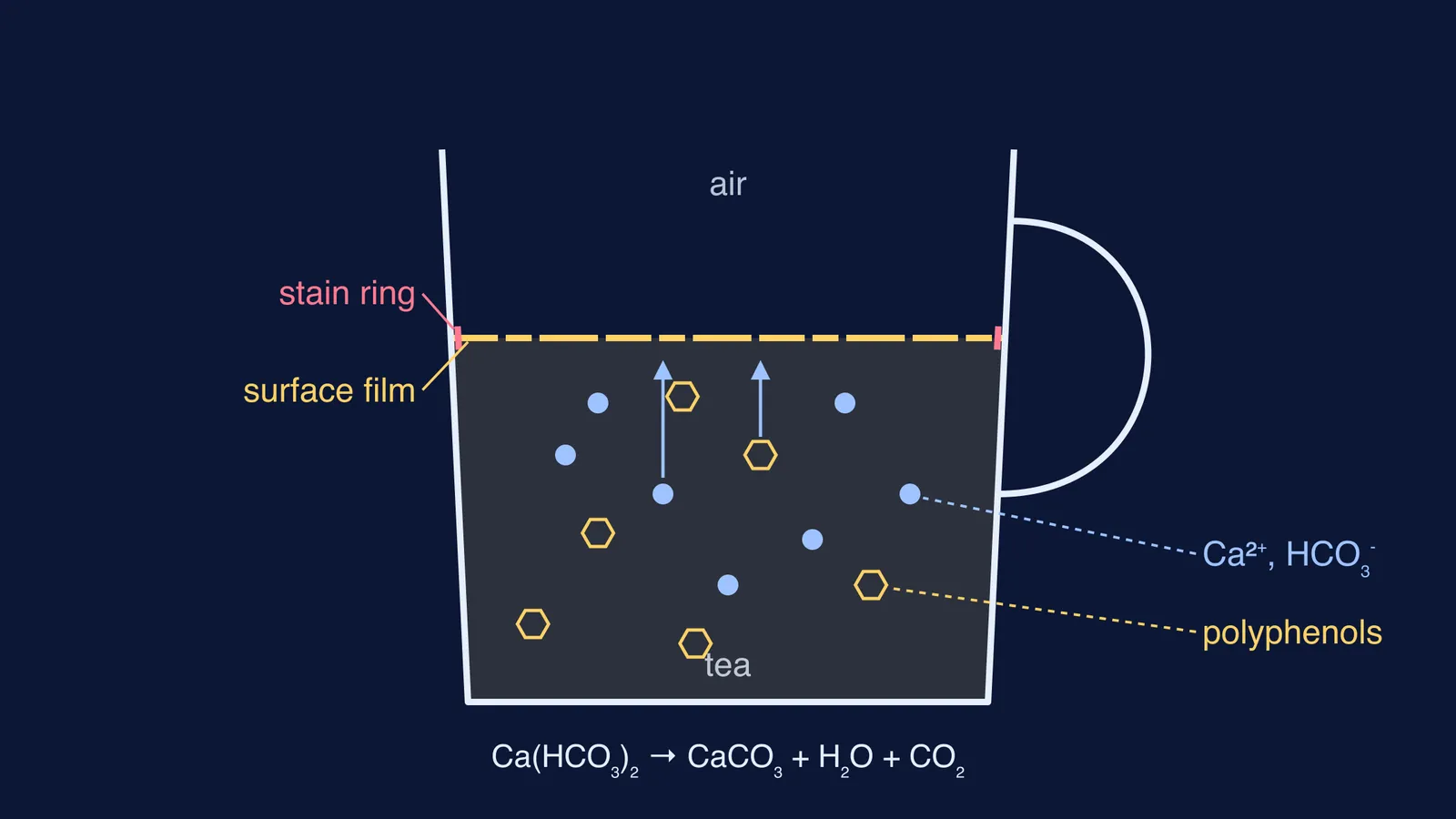
Tea scum is a film of calcium carbonate coated with oxidised tea polyphenols, as the chemistry explainer site Compound Interest summarises from the research literature. Polyphenols are plant compounds in tea leaves; they are oxidised during processing and help give tea its colour.
Michael Spiro and Deogratius Jaganyi asked What causes scum on tea? in Nature in 1993, then studied the composition and structure of tea scum in Food Chemistry in 1994. The Naked Scientists explain the key step: calcium salts in hard water bind to tannins and form an insoluble scum, which floats up and sticks to the side of the cup.
Why does hard water make tea stains worse?
Hard water carries dissolved calcium and magnesium. When the calcium is present as calcium hydrogencarbonate (temporary hardness), heating breaks it down into calcium carbonate, as The Naked Scientists note. The balanced equation is Ca(HCO₃)₂ → CaCO₃ + H₂O + CO₂. That fresh calcium carbonate is the base the brown polyphenols cling to. Hard water is also why soap gives scum instead of lather, which we cover in how soaps clean: micelles and hard water.
Caroline Giacomin and Peter Fischer measured how strong this film is in a 2021 Physics of Fluids study. Films formed in hard water (200 mg of calcium carbonate per litre) had a higher elastic modulus, meaning they were stiffer, than films in moderately hard water (100 mg per litre), soft water (50 mg per litre) or ultra-pure water. Acidity, sugar, milk, tea strength and brewing temperature also changed the film. In a press release about the work, Giacomin said: "if you were to make a cup of tea in perfectly pure water, it would not form a film at all, but the tea would taste quite bitter."
India's drinking-water standard, IS 10500:2012 from the Bureau of Indian Standards, sets an acceptable limit of 200 mg per litre for total hardness as calcium carbonate, and a permissible limit of 600 mg per litre where no other source exists. So water that meets the standard can be as hard as the hard water in the 2021 experiment, or harder.
Why is the stain a ring at the waterline?
The film forms at the air-water interface, the top surface of the tea, as the tea cools after steeping, according to Giacomin and Fischer. The scum particles float to the top and stick to the side of the cup, so the mark traces the line where the tea stood (The Naked Scientists).
Milky chai is not exempt. Michael Spiro and Yuen Ying Chong published a 1997 paper on surface films formed in hard water by black tea brews containing milk.
How hard is your water? A worked example and a kitchen test
Hardness is reported as milligrams of calcium carbonate per litre. Suppose a water report lists 80 mg per litre of calcium ions. One Ca²⁺ ion (molar mass 40 g/mol) corresponds to one CaCO₃ unit (100 g/mol), so the hardness from calcium is 80 × 100 ÷ 40 = 200 mg per litre as CaCO₃. That sits exactly at the IS 10500 acceptable limit and matches the hard water in the 2021 film study. To add magnesium and practise the full method, see how to calculate hardness of water in ppm of CaCO3.
Then test it with three cups:
Brew black tea with tap water, and the same tea with RO or packaged water.
Pour each into an identical white cup. Pour a third cup of tap-water tea and add a few drops of lemon juice.
Write your prediction, then leave all three to cool to room temperature.
Tilt each cup under a light and look for a shiny skin that cracks when touched with a spoon. Then pour the tea away and compare the rings.
Compare with the 2021 study: harder water gave stronger films and citric acid weakened them. If your tap water is hard, expect the clearest film in the tap-water cup.
If the link between hardness and the reaction of carbonates with acids still feels fuzzy, the Fermi Concept Library gives each chemistry concept its own lesson and shows its place in the map.
How do you stop and clean tea stains in cups?
Rinse the cup soon after you finish, before the film dries onto the wall.
If your water is hard, try softer water, but note Giacomin's trade-off: perfectly pure water forms no film yet the tea tastes quite bitter.
Add a squeeze of lemon. Citric acid weakened the film in the Physics of Fluids study, and Spiro's group also studied the effects of calcium carbonate, lemon juice and sugar on tea scum.
For an old ring, soak it in vinegar or lemon juice. Acids react with carbonates, releasing carbon dioxide and loosening the mineral base so the brown layer scrubs off.
For ideas that are easier to see than to read, the Fermi Simulation Lab has interactive simulations. Next, find out why tea colour spreads faster in hot water.


