

On this page
Drop a tea bag into a cup of hot water, and a dark plume of colour begins to spread almost instantly. Try the same thing with cold water, and the tea sits at the bottom in dense streaks, taking hours to mix.
This everyday observation is one of the clearest demonstrations of a core principle in physics and chemistry: temperature controls how fast particles move.
What is diffusion?
The spreading of tea colour and flavour through water is called diffusion. Diffusion is the net movement of particles from an area of high concentration (inside the tea bag) to an area of low concentration (the rest of the cup).
As noted in the history of Thomas Graham and the law of diffusion, particles naturally spread out to fill their container. However, they do not do this by driving themselves. They rely on constant collisions.
When you make tea, the water molecules act as a chaotic crowd. They are constantly vibrating, moving, and crashing into the flavour and colour molecules in the tea leaves, knocking them out through the porous paper of the bag and dispersing them across the cup.
Why does temperature speed up diffusion?
The speed of this mixing depends entirely on how much energy the water molecules have. In physics, temperature is simply a measure of the average kinetic energy of the particles in a substance. You may have seen this concept applied to the kinetic theory of gases, but it applies just as strongly to liquids.
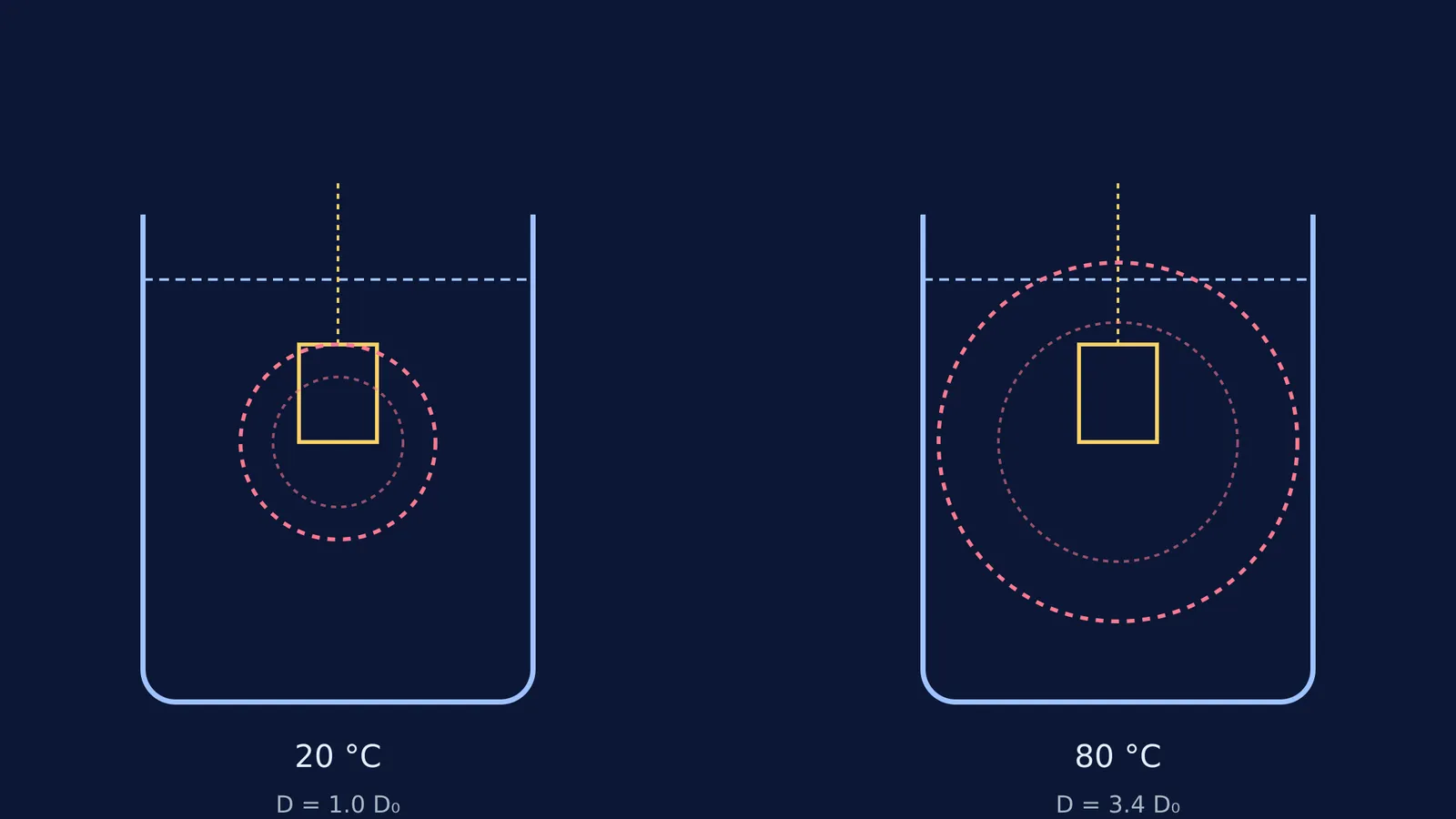
In cold water (20 °C): Water molecules have lower kinetic energy. They move relatively slowly, leading to weak and infrequent collisions with the tea compounds.
In hot water (80 °C): The water molecules are highly energetic. They dart around rapidly, colliding with the tea leaves with much greater force and frequency.
How much faster does tea diffuse in hot water?
Scientists model this relationship using the Stokes-Einstein equation, which calculates the diffusion coefficient (D). The equation shows that the speed of diffusion depends on absolute temperature (T) divided by the fluid's viscosity (η):
D = kB × T / (6 × π × η × r)
Viscosity is a fluid's resistance to flow. According to data from the Engineering ToolBox, water at room temperature (20 °C) has a dynamic viscosity of 1.002 mPa·s.
At a standard brewing temperature of 80 °C, the heat weakens the hydrogen bonds between the water molecules, causing the viscosity to drop to just 0.354 mPa·s.
Because the absolute temperature is higher and the water's resistance is lower, the diffusion coefficient of the tea compounds at 80 °C is 3.4 times greater than it is in cold water.
Why does cold brew tea take so long?
If you prefer iced tea, you might have tried making "cold brew" by leaving tea leaves in cold water in the fridge overnight. A hot cup of tea reaches its optimal flavour and colour in minutes, whereas a cold brew takes hours to achieve a similar strength.
This massive time difference is the direct result of the Stokes-Einstein equation at work. Because the diffusion coefficient at fridge temperatures is even lower than at room temperature, the colour and flavour molecules move sluggishly. The water molecules do not have enough kinetic energy to break apart some of the heavier, more complex chemical compounds in the tea leaves.
Interestingly, this is why cold brew tea often tastes different from hot tea. The intense heat of boiling water rapidly extracts catechins and tannins, which are the compounds responsible for tea's bitter and astringent flavours. In cold water, these heavy, bitter compounds are left behind inside the tea bag because the slow-moving water molecules lack the energy to pull them out. The result is a slower diffusion process, but a naturally sweeter and smoother drink.
Seeing the invisible
It is hard to imagine millions of water molecules bombarding a tea leaf. When a student is learning about particle motion and kinetics, reading the formulas is often not enough to make the concept stick.
The Fermi Simulation Lab offers interactive simulations for the ideas that are easier to see than to read. By increasing the temperature in a virtual beaker, you can watch particles accelerate, bounce harder, and diffuse faster. Seeing the direct link between a slider marked "Temperature" and the chaotic motion of particles makes the abstract maths of the Stokes-Einstein equation visible.
The next time you wait for your tea to brew, you are not just waiting for flavour. You are watching molecular collisions and kinetic energy in real time.


