

On this page
A gas mixture question needs no new formula. You treat the mixture as one ideal gas with its own γ and molar mass, then use the formula you already know. Marks are lost one step earlier, when students average the wrong quantity.
What is the formula for the speed of sound in a mixture of gases?
The speed of sound in an ideal gas is v = √(γRT/M), where γ is the adiabatic constant, T the absolute temperature and M the molar mass in kg/mol (HyperPhysics, Georgia State University). R is the molar gas constant, 8.314 462 618… J mol⁻¹ K⁻¹, an exact value in the CODATA list (NIST).
A mixture of ideal gases behaves like a single ideal gas with an effective molar mass M = Σ xᵢMᵢ, where xᵢ are the mole fractions (Mines Paris thermodynamics notes). The same notes give the mixture's molar heat capacity as Cp = Σ xᵢCpᵢ. Because Cp = Cv + R for an ideal gas (OpenStax University Physics, via LibreTexts/University_Physics_II_-_Thermodynamics_Electricity_and_Magnetism_(OpenStax)/03:_The_First_Law_of_Thermodynamics/3.06:_Heat_Capacities_of_an_Ideal_Gas)), Cv is mole-weighted too. So the recipe for n₁ moles of gas 1 and n₂ moles of gas 2 is:
M(mix) = (n₁M₁ + n₂M₂) / (n₁ + n₂)
Cv(mix) = (n₁Cv₁ + n₂Cv₂) / (n₁ + n₂)
γ(mix) = (Cv(mix) + R) / Cv(mix)
v = √(γ(mix)RT / M(mix)), with M in kg/mol
If step 1 feels shaky, our explainer on average molar mass of a gas mixture goes through it, and finding γ of a gas mixture covers steps 2 and 3.
How do you solve a hydrogen-oxygen mixture problem?
Problem. A container holds 2 mol of hydrogen and 1 mol of oxygen at 300 K. Find the speed of sound in the mixture.
For a diatomic ideal gas at room temperature, Cv = (5/2)R and Cp = (7/2)R (OpenStax via LibreTexts/University_Physics_II_-_Thermodynamics_Electricity_and_Magnetism_(OpenStax)/03:_The_First_Law_of_Thermodynamics/3.06:_Heat_Capacities_of_an_Ideal_Gas)), so γ = 7/5 = 1.4, the same value HyperPhysics gives for air.
γ of the mixture. Both gases are diatomic, so Cv(mix) = (2 × 5/2 R + 1 × 5/2 R)/3 = 5/2 R. γ stays 1.4.
Molar mass of the mixture. M = (2 × 2 + 1 × 32)/3 = 36/3 = 12 g/mol = 0.012 kg/mol.
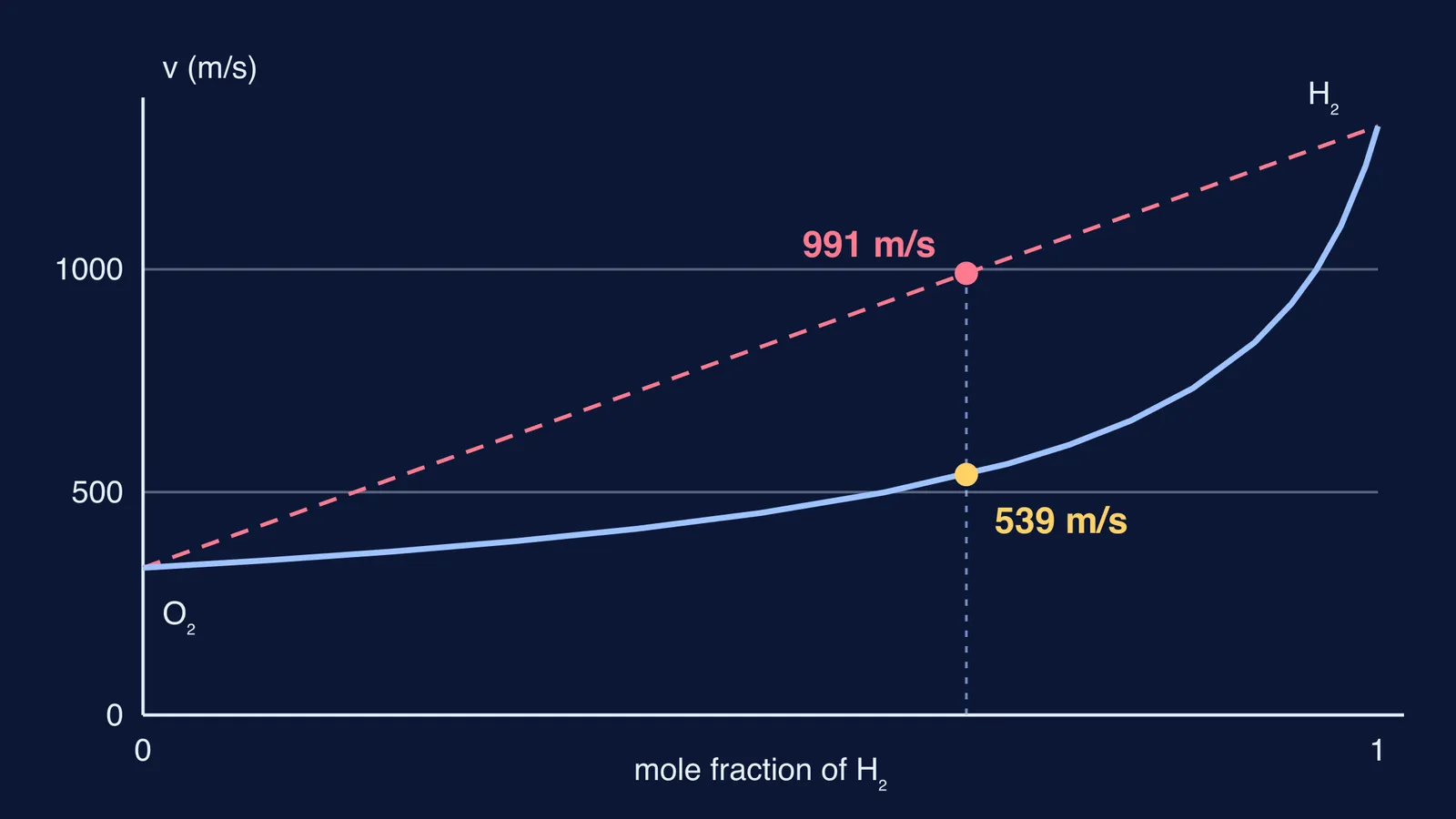
Speed. v = √(1.4 × 8.314 × 300 / 0.012) = √290 990 ≈ 539 m/s.
Sense check: at 300 K, pure hydrogen (M = 0.002 kg/mol) gives about 1321 m/s and pure oxygen (M = 0.032 kg/mol) about 330 m/s. Two-thirds of the molecules are hydrogen, yet the answer sits much nearer oxygen. That is because oxygen carries 32 of the 36 grams, and the speed depends on 1/√M.
Where do students average the wrong quantity?
Each tempting shortcut gives a different wrong number from the same ideal-gas formula:
Averaging the speeds by moles. (2 × 1321 + 1 × 330)/3 ≈ 991 m/s. This is about 84% too high, because speed is not linear in composition.
Averaging the speeds by mass. (4 × 1321 + 32 × 330)/36 ≈ 440 m/s. Now it is too low.
Averaging the molar masses without weights. (2 + 32)/2 = 17 g/mol gives about 453 m/s. This ignores the 2 : 1 ratio.
The fourth trap appears when the gases differ in type. Take 1 mol of helium (monatomic, Cv = 3/2 R; OpenStax/University_Physics_II_-_Thermodynamics_Electricity_and_Magnetism_(OpenStax)/03:_The_First_Law_of_Thermodynamics/3.06:_Heat_Capacities_of_an_Ideal_Gas)) and 1 mol of oxygen. Done correctly, Cv(mix) = (3/2 R + 5/2 R)/2 = 2R, so γ = 3R/2R = 1.5, and M = (4 + 32)/2 = 18 g/mol, giving v ≈ 456 m/s at 300 K. Averaging γ directly, (1.67 + 1.40)/2 ≈ 1.53, gives about 461 m/s. The gap is small, but MCQ options are often that close.
If you keep landing on 991 and cannot see why, the Fermi Problem Library has worked problems with a step-by-step solver that explains the reasoning rather than printing an answer, so you can find the exact step where the average went wrong.
How can you check your answer in under a minute?
Run this checklist before you mark an option:
When both gases share a γ, the mixture speed must lie between the two pure-gas speeds at the same temperature.
If both gases are the same type (both diatomic, say), γ does not change. Only M matters, so v(mix)/v(O₂) = √(M(O₂)/M(mix)) = √(32/12) ≈ 1.63, and 330 × 1.63 ≈ 539 m/s.
M goes into the formula in kg/mol, not g/mol (HyperPhysics). Forgetting this makes the answer about 32 times too small.
The heavier gas pulls the answer towards itself more than its mole share suggests.
The formula itself rests on sound being adiabatic, which is the story of the Laplace correction to Newton's speed of sound. If Cv and Cp are the shaky part, the Fermi Concept Library has a lesson for every concept in physics and chemistry. Then try 1 mol of hydrogen with 4 mol of oxygen and run the four checks.


