On this page
Almost every JEE Main question on oscillations comes back to one equation, x = A cos(ωt + φ), and what you get by differentiating it. Link it to energy and the force law and the unit shrinks to a few ideas.
What does the JEE Main syllabus include in Oscillations?
Unit 10 of the official Syllabus for JEE (Main) - 2027, linked from the NTA JEE Main website, covers Oscillations and Waves. Its oscillations part lists periodic motion, SHM and its equation, phase, spring oscillations (restoring force and force constant), kinetic and potential energy in SHM, and the derivation of a simple pendulum's period.
The matching NCERT text is Chapter 13, Oscillations, in Class 11 Physics Part II (Reprint 2026-27), with sections 13.1 to 13.8, ending at the simple pendulum. The Part II contents list no section on damped or forced oscillations (the introduction only mentions them), and the NTA unit does not name them.
Which SHM formulas do you need for JEE Main?
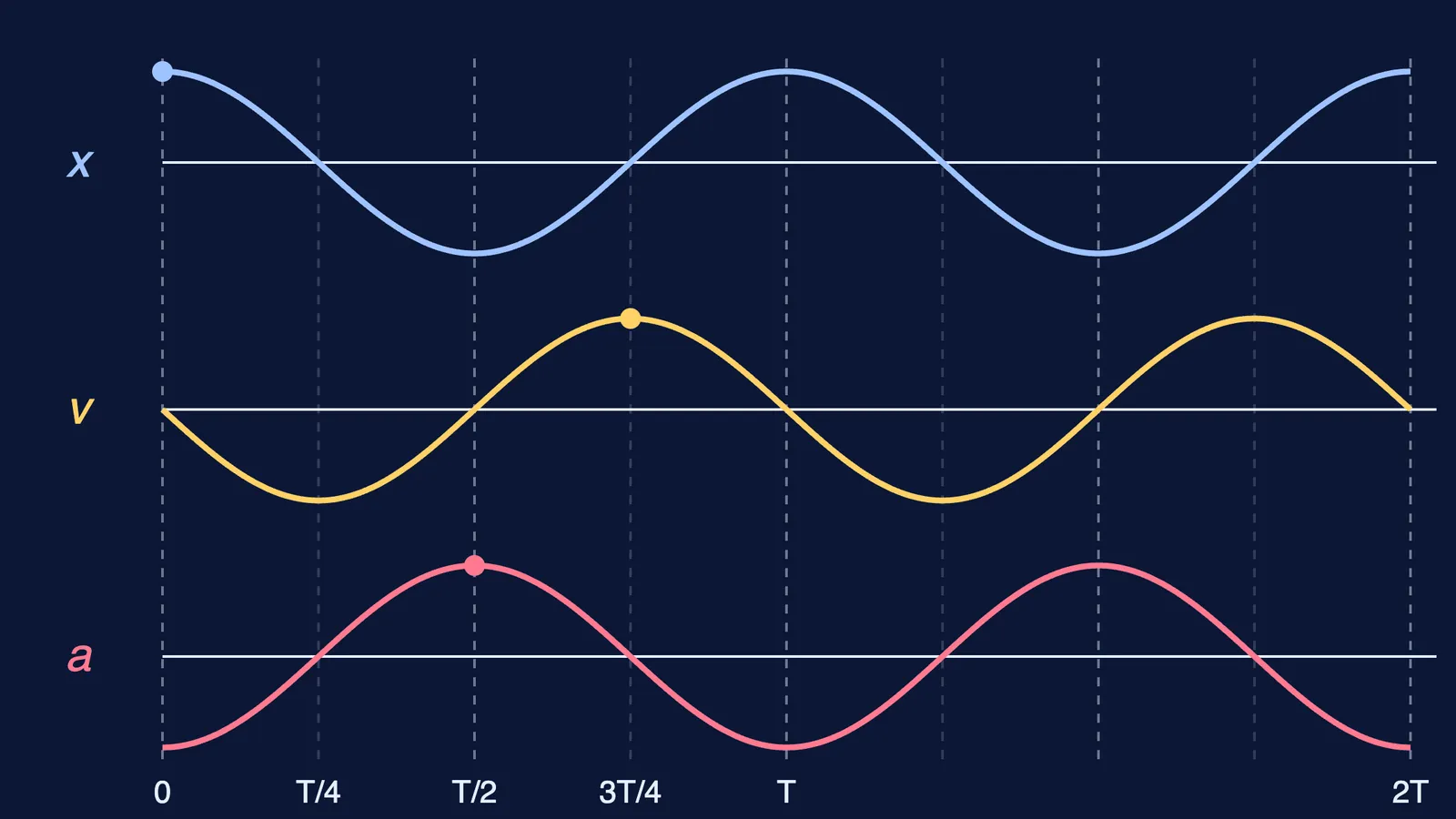
Differentiate x = A cos(ωt + φ):
v = −Aω sin(ωt + φ), so at displacement x the speed is ω√(A² − x²)
a = −ω²x, always towards the mean position
ω = √(k/m) for a spring, so T = 2π√(m/k)
E = ½kA², split as PE = ½kx² and KE = ½k(A² − x²)
T = 2π√(L/g) for a simple pendulum at small angles
The a = −ω²x form is also how you recognise SHM; see how to check if motion is SHM from its acceleration equation.
Worked example. A 0.5 kg block on a smooth floor, spring k = 200 N/m, is pulled 3 cm and released.
ω = √(200/0.5) = √400 = 20 rad/s, so x(t) = 0.03 cos(20t) in metres.
T = 2π√(0.5/200) = 2π × 0.05 = 0.314 s.
At x = 1.8 cm: v = 20 × √(0.03² − 0.018²) = 20 × 0.024 = 0.48 m/s.
At the same point, a = −400 × 0.018 = −7.2 m/s², towards the mean position.
E = ½ × 200 × 0.03² = 0.09 J. PE = ½ × 200 × 0.018² = 0.0324 J, so KE = 0.0576 J. Check: ½ × 0.5 × 0.48² = 0.0576 J.
PE/E = (x/A)² = 0.6² = 0.36: the energy is 36% potential, 64% kinetic. KE equals PE at x = A/√2 (2.12 cm), not at A/2.
How do you combine springs in series and parallel?
Parallel springs share one extension, so k = k₁ + k₂. Series springs share one force, so 1/k = 1/k₁ + 1/k₂.
With k₁ = 300 N/m, k₂ = 600 N/m and a 2 kg block:
Parallel: k = 900 N/m, so T = 2π√(2/900) = 0.296 s.
Series: k = (300 × 600)/900 = 200 N/m, so T = 2π√(2/200) = 2π × 0.1 = 0.628 s.
The series period is longer by a factor √(900/200) ≈ 2.12. A block between two springs fixed to opposite walls is parallel, though it looks like a chain: displace it and both springs push it back. See a block hung from two parallel springs and why a spring-block's period does not depend on g.
How do you find a simple pendulum's period?
For small swings, T = 2π√(L/g), independent of the bob's mass; the derivation in NCERT section 13.8 uses sin θ ≈ θ. Take L = 0.64 m and g = 9.8 m/s²: T = 2π√(0.64/9.8) = 2π × 0.2556 = 1.61 s.
Two follow-ups:
Quadruple L to 2.56 m and T doubles to 3.21 s.
In a lift accelerating up at 2 m/s², the effective g is 9.8 + 2 = 11.8 m/s² and T = 2π√(0.64/11.8) = 1.46 s.
What is the phase-difference trap in SHM?
In SHM, v leads x by π/2 and a leads x by π, so a is always opposite to x. The trap comes when two motions use different functions or signs.
Take x₁ = 4 sin(10t + π/6) and x₂ = −3 cos(10t). Since −cos θ = sin(θ − π/2), x₂ = 3 sin(10t − π/2). The phase difference is π/6 − (−π/2) = 2π/3, not π/6 (reading the brackets) or π/3 (dropping the minus sign).
If the lead of v over x is hard to picture, the Fermi Simulation Lab has interactive simulations for ideas easier to see than to read.
How should you practise Oscillations in a week?
Day 1: derive v, a and ω√(A² − x²) from x(t) without notes.
Day 2: sketch KE and PE against x.
Day 3: series, parallel and vertical springs.
Day 4: derive the pendulum period, then vary L and g.
Day 5: phase questions, rewriting each equation as a sine first.
Day 6: a timed mixed set; label each error as formula, combination, phase or arithmetic.
Day 7: redo only your wrong answers.
When you cannot see where a step went wrong, the Fermi Problem Library has worked problems with a step-by-step solver that explains the reasoning rather than printing an answer.