

On this page
Your worksheet says a = 8 − 4x and asks whether the motion is simple harmonic. You need one rewrite and two checks, and the same test settles a = −kx², a = −kx³ and every shifted form.
What makes motion simple harmonic?
In simple harmonic motion, the acceleration, and therefore the net force, is proportional to the displacement and acts in the opposite direction, as OpenStax University Physics Volume 1 defines it. For a mass on a spring this reads d²x/dt² = −(k/m)x, whose solution is x(t) = A cos(ωt + φ) with ω = √(k/m). The same source states that the period and frequency of a simple harmonic oscillator are independent of amplitude.
That definition hides three conditions:
Proportional: double the displacement and the acceleration doubles.
Opposite: the acceleration always points back toward the mean position.
Measured from equilibrium: displacement is measured from where the acceleration is zero, which need not be x = 0.
How do you check if an acceleration equation is SHM?
Use this three-step test on any equation that gives a in terms of x.
Find the mean position: set a = 0 and solve for x₀.
Rewrite it as a = −C(x − x₀). If x appears squared, cubed or inside a sine, it is not SHM.
Check that C is a positive constant. If it is, ω = √C and the period is T = 2π/√C.
Here is the test on three equations, with x in metres and a in m/s²:
a = −9x. Here x₀ = 0 and C = 9. SHM with ω = 3 rad/s and T = 2π/3 ≈ 2.09 s.
a = 8 − 4x. Rewrite as a = −4(x − 2). SHM about x₀ = 2 m, with ω = 2 rad/s and T = π ≈ 3.14 s. Amplitude is measured from x = 2, not the origin.
a = 4x. Now C = −4, so the acceleration points away from x = 0 and nothing oscillates.
To practise on more equations, the Fermi Problem Library has worked problems with a step-by-step solver that explains the reasoning rather than printing an answer.
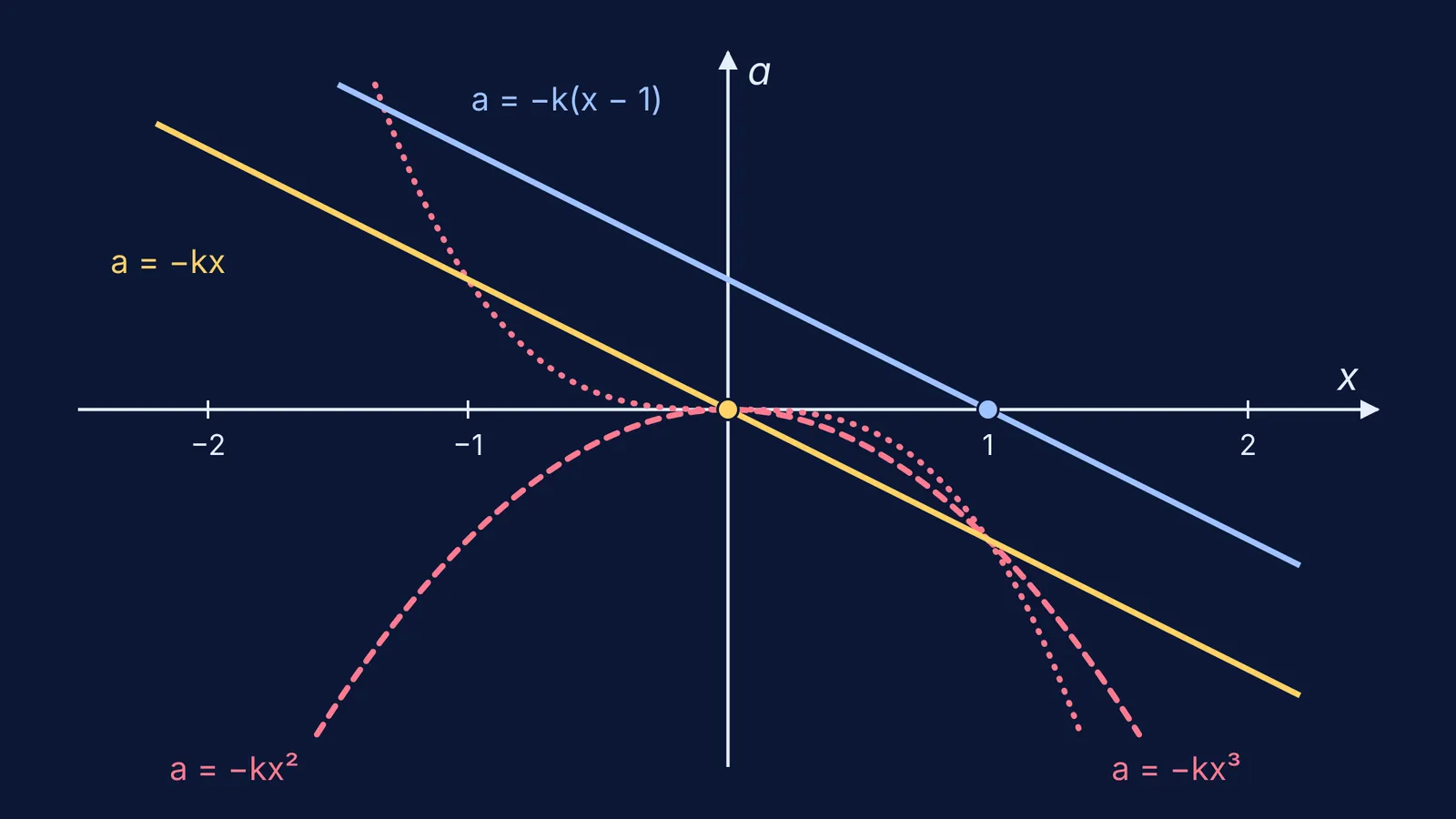
Is a = −kx² or a = −kx³ simple harmonic?
Neither, and they fail in different ways.
a = −kx² fails the opposite check. For x > 0, a is negative and pulls the particle back. For x < 0, x² is still positive, so a is still negative and pushes it further left. Released from rest at x = +A, the particle crosses the origin and keeps accelerating away. It never oscillates.
a = −kx³ fails the proportional check. Since x³ has the sign of x, the acceleration is always restoring and the particle does oscillate. But doubling x makes a eight times larger, so the motion is periodic, not simple harmonic. A units check shows the difference. Here k has units of m⁻² s⁻², so the only time you can build from k and the amplitude A is 1/(A√k). The period must therefore be proportional to 1/A: double the amplitude and the period halves, unlike SHM, where the period does not depend on amplitude.
When is motion approximately simple harmonic?
A pendulum is the classic case. Its restoring force is −mg sin θ, which is not proportional to θ. OpenStax's section on pendulums treats angles below about 15° as small: there sin θ and θ differ by about 1% or less, so d²θ/dt² ≈ −(g/L)θ and T = 2π√(L/g).
The general rule: near the mean position, keep only the term linear in (x − x₀). For a = −4x + x³, small x makes x³ tiny next to 4x, so small oscillations are approximately SHM with ω = 2 rad/s. When a question says small oscillations, it is asking for exactly this cut. Problems like the time period of a block between two springs work the same way: find C from the forces, then take its square root.
How do you check SHM when you are given x(t)?
Differentiate twice, then try to write the result as a = −ω²(x − x₀).
x = sin ωt + cos ωt gives a = −ω²x. SHM, with amplitude √2.
x = 3 sin² ωt = 3/2 − (3/2) cos 2ωt gives a = −4ω²(x − 3/2). SHM about x = 3/2 with angular frequency 2ω, not ω.
x = sin³ ωt = (3 sin ωt − sin 3ωt)/4 mixes two frequencies. It is periodic but not SHM.
If mean position still feels shaky, the Fermi Concept Library gives each physics concept its own lesson. To watch the period stay fixed as amplitude changes, try the five predictions in our mass-spring SHM simulation. Once you know a motion is SHM, the next step is finding the SHM equation from the initial position and velocity.


