

On this page
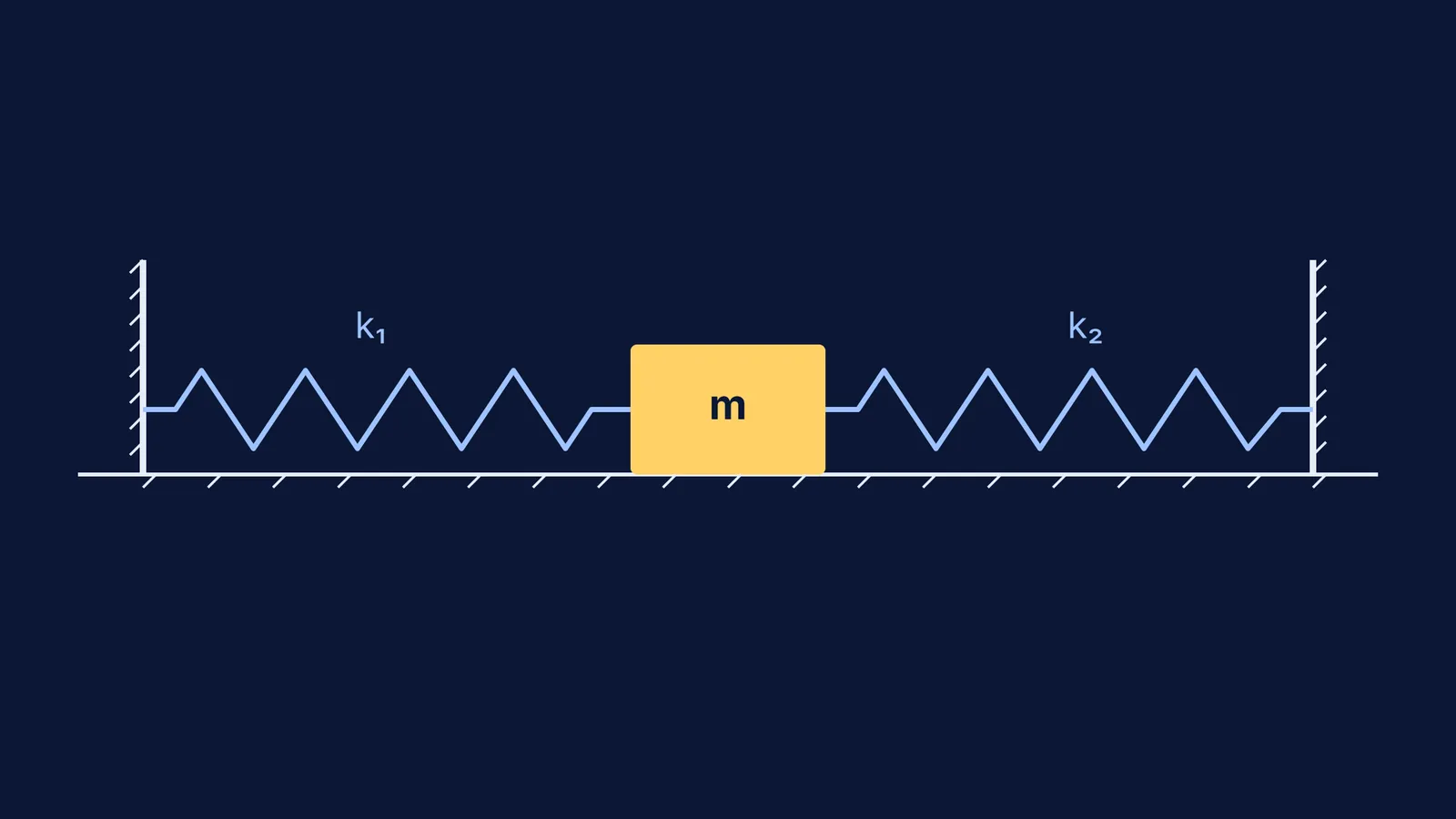
If you place a block on a smooth table, attach a spring to its left, and attach another spring to its right, you have a classic oscillator. When the block moves, it interacts with both springs at once.
Because the springs are physically arranged in a line, many students assume they are in series. But in physics, a block between two springs acts as a parallel combination.
Here is how to calculate the restoring force, find the effective spring constant, and determine the exact time period of the oscillation.
Why do springs on opposite sides act in parallel?
The difference between series and parallel springs is not about how they look, but about how they stretch.
In a series combination, springs are attached end-to-end. They experience the same force, but their extensions add up.
In a parallel combination, springs are forced to have the same displacement. When a block sits between two springs fixed to walls, moving the block to the right by a distance x forces the right spring to compress by x. At the same time, the left spring is stretched by exactly x. Because the displacement of both springs is identical, the system behaves as a parallel combination.
If you get confused on an exam, you can draw the forces. The compressed right spring pushes the block back to the left. The stretched left spring pulls the block back to the left. Both restoring forces act in the same direction, adding together to push the block back to the centre.
How to find the effective spring constant?
To find the time period, you need to replace the two springs with a single imaginary spring that would have the exact same effect on the block. The stiffness of this imaginary spring is called the effective spring constant (k_eff).
According to Hooke's Law, the force from the first spring is F₁ = -k₁x. The force from the second spring is F₂ = -k₂x.
Because both forces act in the same direction, the total net force on the block is their sum: F_net = -(k₁x + k₂x) = -(k₁ + k₂)x
This tells us that the effective spring constant is the sum of the two individual constants. As detailed in Byju's guide to the spring-mass system, for a parallel combination, k_eff = k₁ + k₂.
How to find the block between two springs time period?
Once you have the effective spring constant, finding the time period is straightforward.
The general formula for the time period of a mass-spring system in simple harmonic motion is: T = 2π√(m / k_eff)
By substituting our effective spring constant, we get the specific formula for this setup: T = 2π√(m / (k₁ + k₂))
If both springs are identical, so that k₁ = k₂ = k, the formula simplifies to: T = 2π√(m / 2k)
What if the setup is vertical?
You will often see variations of this problem where the block is suspended vertically between an upper spring and a lower spring.
Gravity now pulls the block downward, which changes the equilibrium position. The block will rest slightly lower than it would without gravity, stretching the top spring and compressing the bottom spring until the net force is zero.
However, gravity is a constant force. It shifts the centre of the oscillation, but it does not change the restoring force that occurs when the block is displaced away from that new equilibrium. The effective spring constant remains k₁ + k₂, and the time period remains exactly the same as in the horizontal case.
If you are struggling to picture why constant forces do not change the time period, playing with the mass-spring SHM simulation can help you see how the block moves around the shifted equilibrium.
How to calculate the time period in a worked example?
Problem: A 2 kg block rests on a frictionless horizontal table. It is attached to a left wall by a spring with constant 30 N/m, and to a right wall by a spring with constant 20 N/m. What is its time period?
Check the displacement: If you move the block 1 cm right, the left spring stretches 1 cm and the right spring compresses 1 cm. The displacement is the same, so they are in parallel.
Find the effective constant: Add the constants. k_eff = 30 + 20 = 50 N/m.
Calculate the time period: T = 2π√(2 / 50) = 2π√(1 / 25) = 0.4π seconds.
If you ever find yourself setting up a complicated energy conservation equation for this, stop and check the effective spring constant first. It is almost always a faster route to the answer, a principle you will see applied often when deciding when to use energy conservation instead of Newton's laws.
If you need help with similar questions, the Fermi Problem Library has worked problems with a step-by-step solver that explains the reasoning rather than printing an answer.


