On this page
Hang a block from a spring, pull it down and let go, and gravity is clearly part of the picture. So you might expect g somewhere in the period. It isn't there, and that trips students up whenever a question moves the spring to the Moon, into a lift or onto a ramp.
Does the period of a spring-block system depend on g?
No. For an ideal spring of force constant k carrying a mass m, the period is T = 2π√(m/k), as derived in OpenStax University Physics, Volume 1, section 15.1. The same section notes that the period and frequency of a simple harmonic oscillator are independent of amplitude.
Compare this with a simple pendulum. Its period is T = 2π√(L/g), and OpenStax section 15.4 states that it "depends on its length and the acceleration due to gravity". The difference is where the restoring force comes from. In a pendulum, gravity is the restoring force. In a spring-block system, the spring supplies it, and gravity is just a constant pull in one direction.
Why does gravity only shift the equilibrium point?
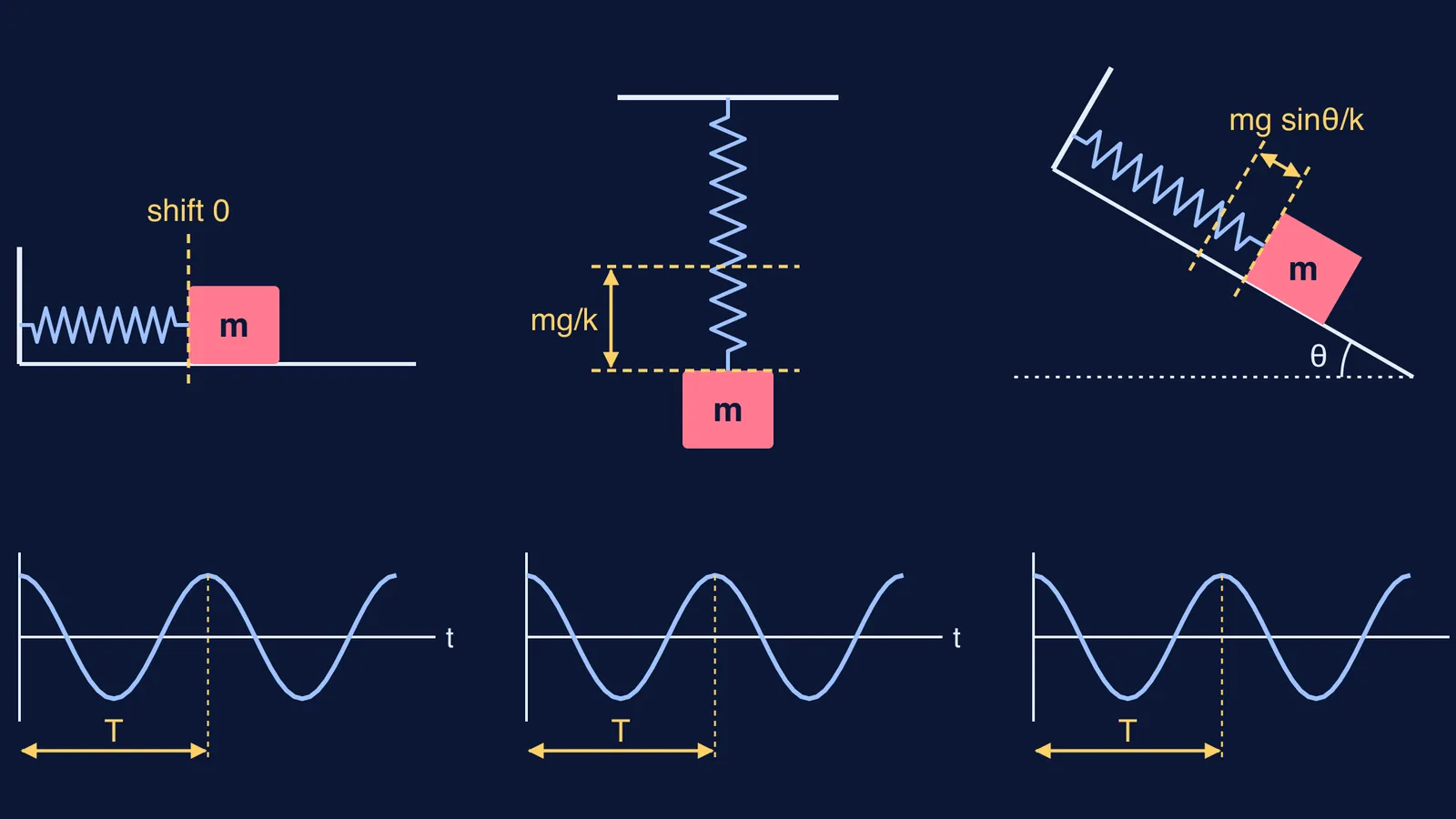
Take a vertical spring. Hang the block and let it settle. At rest, the spring force balances the weight, so k·x₀ = mg and the static stretch is x₀ = mg/k.
Now pull the block a further distance y below that new rest position. Taking downward as positive:
Weight: +mg
Spring force: −k(x₀ + y) = −mg − ky
Net force: −ky
The mg terms cancel exactly. What is left, F = −ky, is the same equation as for a block on a smooth horizontal floor, so the period is the same T = 2π√(m/k). In the words of OpenStax section 15.1, the constant force of gravity "only served to shift the equilibrium location of the mass".
What about a spring on an inclined plane?
On a smooth incline at angle θ, only the component of gravity along the slope, mg sinθ, acts along the spring. At rest, k·x₀ = mg sinθ, so the spring stretches by x₀ = mg sinθ/k. Displace the block by x along the slope and the net force is mg sinθ − k(x₀ + x) = −kx. The angle drops out, and T = 2π√(m/k) again. We work through the incline case with a full numerical in why a spring-block on an incline keeps the same time period.
This needs a smooth incline. Friction, or a spring that goes slack, changes the motion itself, not just the rest point.
Worked example: one block, three set-ups
Take m = 0.5 kg, k = 200 N/m and g = 9.8 m/s², and use the formulas from OpenStax section 15.1.
Period in every case: T = 2π√(0.5/200) = 2π × 0.05 ≈ 0.314 s
Horizontal, smooth floor: the rest point does not shift
Vertical: shift = mg/k = (0.5 × 9.8)/200 = 0.0245 m, about 2.5 cm
Smooth incline at 30°: shift = mg sin30°/k ≈ 0.0123 m, about 1.2 cm
Same 0.314 s, three different rest points, as the diagram above shows.
The same logic handles the two favourite exam twists. On the Moon, g is smaller, so a vertical spring stretches less, but the period does not change; we cover that case in does a spring-mass period change on the Moon. In a lift accelerating upward at a, the block behaves as if gravity were g + a, so the rest point drops to m(g + a)/k, and the period is still 2π√(m/k).
How do you solve spring-period questions without falling for the g trap?
Run this checklist before you write a single equation:
Find the effective k (springs in series, in parallel, or a spring cut into pieces).
Find the mass that actually moves.
Set every constant force aside for the period. Use it only to locate the new equilibrium.
Measure amplitude from the new equilibrium, not from the spring's natural length.
Check the formula's assumptions: a smooth surface, a spring that never goes slack, and a spring whose own mass is negligible (see the m/3 correction for a spring's own mass).
If you keep getting T right but the amplitude or maximum speed wrong, the slip is usually step 4. The Fermi Problem Library has worked problems with a step-by-step solver that explains the reasoning rather than printing an answer, so you can see exactly where the equilibrium shift enters. If simple harmonic motion itself feels shaky, the Fermi Concept Library gives each concept its own lesson and its place in the map, so you can step back one idea.
Next time g turns up in a spring question, ask one thing: is it moving the rest point, or the rhythm? For an ideal spring, it only ever moves the rest point.