

On this page
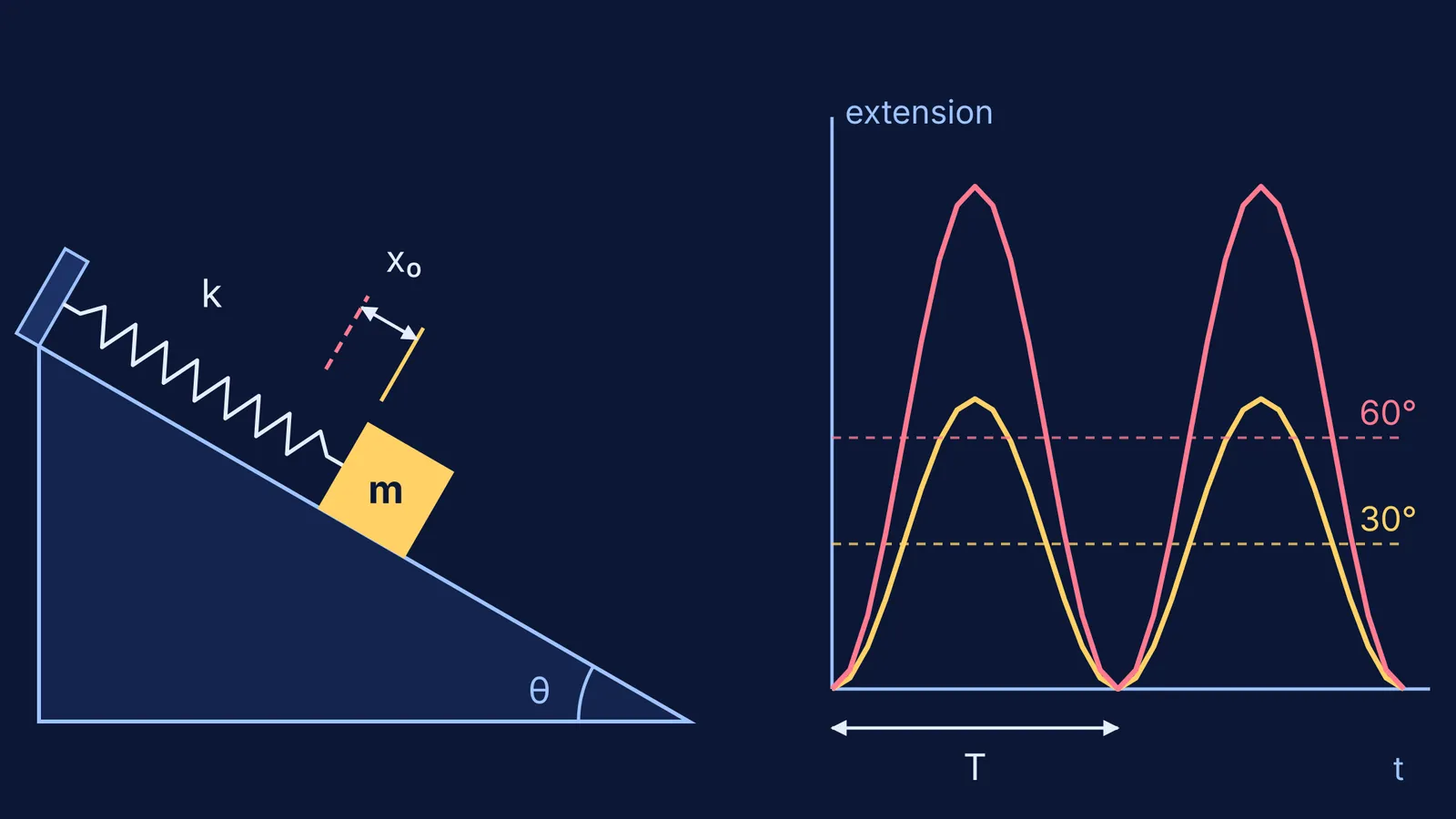
A common JEE-style question puts a block on a smooth incline, ties it to a spring fixed at the top, and asks for the time period. It is tempting to reach for g sin θ and put it inside the square root, which is wrong. The slope changes where the block settles and how far it swings, but not how long each swing takes.
What is the time period of a spring-block system on an inclined plane?
For a block of mass m on a spring of stiffness k, the period is T = 2π√(m/k), and the period of a simple harmonic oscillator does not depend on its amplitude (OpenStax University Physics, Volume 1, section 15.1).
On a smooth incline at angle θ, the weight splits into mg sin θ along the slope and mg cos θ into the slope (OpenStax, section 5.6). The normal force cancels mg cos θ, so only two forces act along the slope: the spring force and mg sin θ.
Measure x as the stretch of the spring, positive down the slope. Newton's second law along the slope gives:
m(d²x/dt²) = mg sin θ − kx
Rewrite it as m(d²x/dt²) = −k(x − x₀), with x₀ = mg sin θ / k
Put u = x − x₀. Then m(d²u/dt²) = −ku
The last line is the equation of a block on a horizontal spring. Same m, same k, so the same ω = √(k/m) and the same T. The angle has dropped out completely.
This is the same argument OpenStax uses for a mass hanging from a vertical spring: gravity only shifts the equilibrium, so the motion has the same form as on a horizontal spring (OpenStax, section 15.1). The vertical spring is just the incline with θ = 90°. We used the same idea in whether a spring-mass period changes on the Moon, where g changes but T does not.
Where is the new equilibrium position on the incline?
At equilibrium the net force along the slope is zero, so kx₀ = mg sin θ and x₀ = mg sin θ / k. This follows from the force components above (OpenStax, section 5.6).
Take m = 2 kg, k = 200 N/m and g = 9.8 m/s². Then ω = √(200/2) = 10 rad/s and T = 2π/10 ≈ 0.63 s at every angle. Only the equilibrium extension moves:
θ = 0° (level floor): x₀ = 0
θ = 30°: x₀ = (2 × 9.8 × 0.5)/200 = 0.049 m, or 4.9 cm
θ = 60°: x₀ = (2 × 9.8 × 0.866)/200 ≈ 0.085 m, or 8.5 cm
θ = 90° (hanging vertically): x₀ = (2 × 9.8)/200 = 0.098 m, or 9.8 cm
How do you find the amplitude on an incline?
Amplitude is measured from the new equilibrium, not from the spring's natural length. Mixing the two up is a common slip. The period stays fixed whatever the amplitude (OpenStax, section 15.1). Use the 30° incline above, with x₀ = 4.9 cm and ω = 10 rad/s.
Released from rest at natural length. The block starts 4.9 cm above equilibrium with zero speed, so the amplitude is 4.9 cm. It swings down to a maximum stretch of 2x₀ = 9.8 cm and back. This is the incline version of a load released suddenly on a spring, which stretches it twice as far as a load lowered gently.
Pulled 3 cm beyond equilibrium and released. The amplitude is 3 cm. The stretch swings between 1.9 cm and 7.9 cm.
Pushed from natural length at 0.3 m/s down the slope. Use A = √(u₀² + (v₀/ω)²) with u₀ = 4.9 cm and v₀/ω = 0.3/10 m = 3 cm. So A = √(4.9² + 3²) ≈ 5.7 cm.
In all three cases T is still about 0.63 s: the start sets the amplitude, the angle sets the centre. The same split appears in a spring-block system in a car that suddenly accelerates, where the pseudo-force plays the role of mg sin θ.
What can change the answer on an incline?
The result above assumes a smooth incline, a light spring and a sliding block. Check these before you write T = 2π√(m/k):
Friction. Kinetic friction flips direction every half-swing, so the centre jumps, the amplitude shrinks and the block eventually stops. It is no longer a single SHM.
A rolling body instead of a sliding block. Rotation adds inertia, so the period changes. That is a different problem.
If you want to try variations, the Fermi Problem Library has worked problems with a step-by-step solver that explains the reasoning rather than printing an answer. If the gap is the idea of equilibrium itself, the Fermi Concept Library gives each concept its own lesson and its place in the map.
Next time you see a spring on a slope, write the force equation, shift the origin to x₀, and read off ω. Three lines, and the angle takes care of itself.


