

On this page
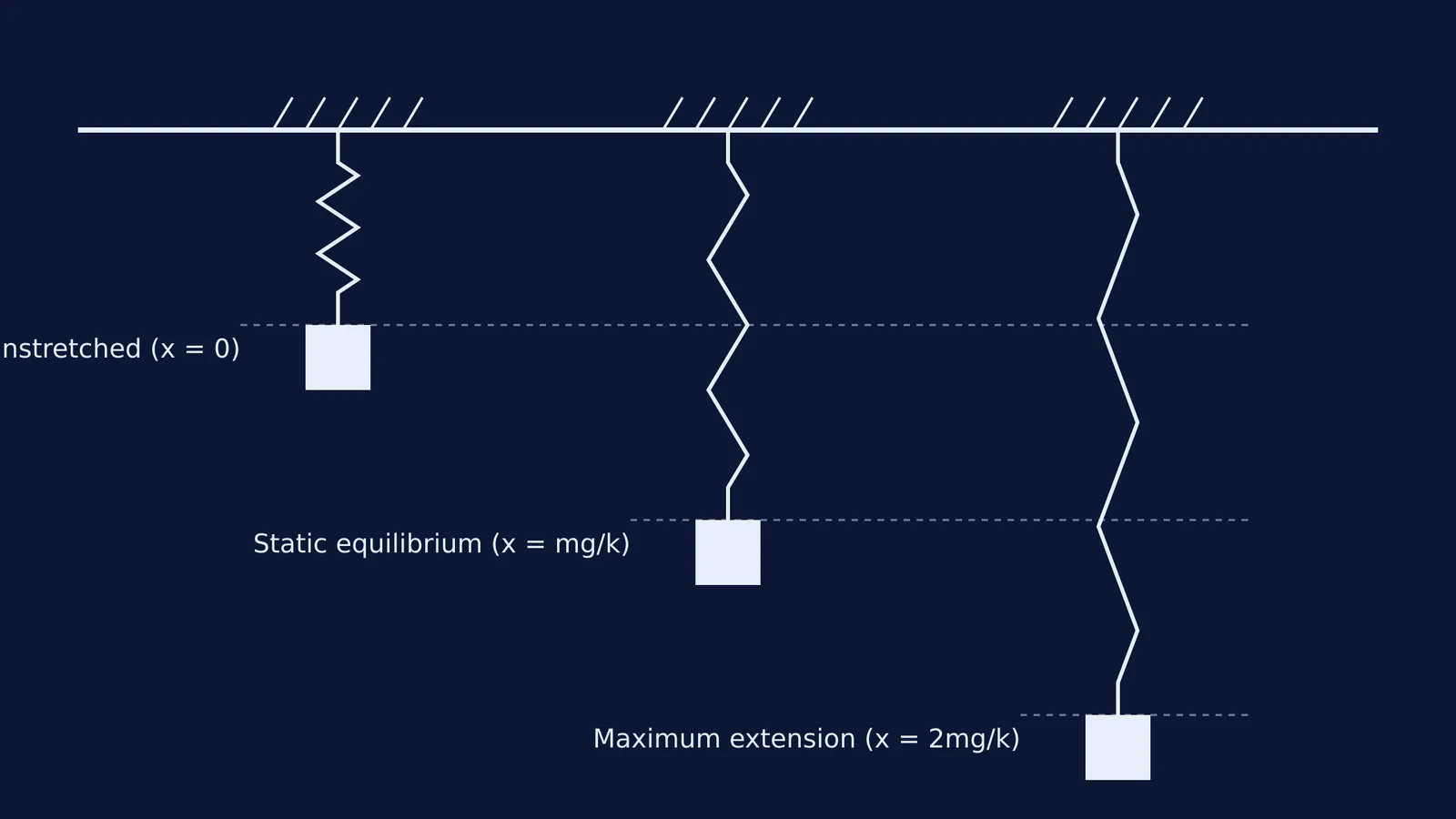
When you hang a mass m on a vertical spring (of stiffness k) and lower it slowly, it eventually settles at an equilibrium point. But if you hold that same mass at the unstretched position and let it drop suddenly, the spring stretches much further.
This is a classic problem in mechanics, and its result is a fundamental rule in engineering: a suddenly applied load causes exactly twice the extension—and twice the internal stress—of the same load applied gradually.
What is the difference between lowering slowly and releasing suddenly?
The difference between the two scenarios comes down to how work is done by the forces involved. In any mechanical system involving springs and masses, we must consider the work done by gravity and the work done against the restoring force.
When you apply the load gradually, your hand (or a crane) supports some of the weight as the mass descends. The mass is always kept in a state of static equilibrium, meaning it never gains any speed. You keep lowering it, slowly transferring the load to the spring, until the upward elastic force of the spring (kx) exactly balances the downward force of gravity (mg).
This gives the standard static extension, which is the point where the net force on the mass is zero: x = mg/k
When you apply the load suddenly by releasing the mass from rest, there is no hand holding it back. Because the spring is initially unstretched, its upward restoring force is zero. Gravity is the only force acting initially, pulling the mass down, and it accelerates, picking up kinetic energy.
By the time the mass reaches the static equilibrium line (mg/k), the forces are finally balanced (the spring pulls up with mg, and gravity pulls down with mg), but the mass is moving quickly. It has accumulated kinetic energy during its fall. Because it is moving, its momentum carries it downward past the equilibrium point, stretching the spring further. The spring's upward force now exceeds gravity, causing the mass to decelerate until it finally stops at its lowest point.
How do you prove the maximum extension is 2mg/k?
To find that lowest stopping point, we use the principle of conservation of mechanical energy. Since there are no non-conservative forces like friction doing work in this ideal scenario, the total mechanical energy of the system remains constant throughout the fall.
We can analyze the energy at two specific moments:
Initial State: The mass is released from rest at the top, where the extension is x = 0. Because it is not moving, it has zero kinetic energy. The spring is unstretched, so it has zero elastic potential energy.
Final State: At the maximum extension (let's call it x), the mass momentarily stops before bouncing back up. Its kinetic energy is once again zero. However, it has fallen a distance x, meaning it has lost gravitational potential energy equal to mgx. At the same time, the spring has stretched by x, meaning it has gained elastic potential energy equal to 1/2 kx² according to HyperPhysics.
Because energy is conserved, the total energy in the final state must equal the total energy in the initial state. Therefore, the loss in gravitational energy must equal the gain in elastic energy: mgx = 1/2 kx²
Assuming x is not zero, we can divide both sides by x and solve for the maximum extension: mg = 1/2 kx x = 2mg/k
The mass then oscillates continuously between the starting point (0) and the maximum extension (2mg/k), perfectly centred around the static equilibrium point mg/k. In a real system, internal friction and air resistance would gradually damp these oscillations, eventually bringing the mass to rest at mg/k.
Why does this matter for steel wires and structures?
Imagine a heavy lift cage of mass m hung from a steel lift cable. The cable behaves like a stiff spring with a constant k. If the cage is lowered onto the cable slowly, the static extension is simply the equilibrium stretch: x = mg/k
Now imagine the lift is propped up so the cable is just taut and unstretched, and then the prop is suddenly kicked away. The cage falls, loading the cable instantly. The maximum extension it reaches before bouncing back up is: x_max = 2mg/k
Because stress is directly proportional to extension, the sudden drop doubles the peak stress in the steel cable as structural design guides explain. If the cable was only designed to hold the static weight safely, this sudden shock could exceed its elastic limit.
This 2mg/k result applies to any elastic material, including steel wires, climbing ropes and building columns. In structural engineering, a suddenly applied load is a dynamic load. If a crane suddenly drops its lifting tension on a cable, or a heavy machine is dropped onto a floor beam, the material experiences twice the stress it would under a static load. This is why engineers must design structures with a dynamic magnification factor of at least 2 for sudden loads—a sudden jolt is far more dangerous than a steady pull.
If you have concept gaps around the forces at equilibrium and the energy at maximum extension, the Fermi Concept Library has a lesson for every concept in physics.


